• Welcome to Photrio!
    Registration is fast and free. Join today to unlock search, see fewer ads, and access all forum features.
    Click here to sign up

Procedures To Shooting Portraits on 8x10

Forum statistics

Threads
203,517
Messages
2,855,889
Members
101,883
Latest member
bgb
Recent bookmarks
5

braxus

Subscriber
Allowing Ads
Joined
Oct 19, 2005
Messages
1,885
Location
Fraser Valley B.C. Canada
Format
Hybrid
Im getting an Intrepid Black 8x10 by late summer and working on getting a Fuji L 300mm f5.6 for my standard lens. What is the recommended procedure to shooting head shot portraits on 8x10? Im thinking f stop, recommended shutter speed range and how close to Subject i should get. Portraits will be outdoors with available light. Film will be slower speed films and most likely black and white.
 
Last edited:
Only you know what kind of image you want to walk away with. That determines everything. There's no universal answer.

If I assume a couple of things, my first thoughts would be:
  • f/11-f/22 depending on how close you'll be to the model since you'll likely need a lot more depth of field than you'd get closer to wide open.
  • At 300m you'll be pretty close for a frame-filling head shot. It may not be pleasing to the model getting so close as 300m is on the wide side so you enter the territory of the 'big nose problem'. A longer lens would be nicer.
  • The aperture combined with slow film dictates that you either need a lot of light or you'll have to contend with relatively slow shutter speeds. If you go for 'lots of light' and your setup relies on outdoor & available light, this may boil down to using direct sunlight, which is harsh. If you rely on softer natural light (open shade, overcast weather) shutter speeds will be slow. You know the drill. Organize for it. If you want to avoid motion blur in the model by using fast-ish shutter speeds (let's say 1/25 and faster), you may end up using more direct sunlight and that means you'll have to bring reflection screens etc. to soften the light on the model.
  • For critical focus, you may want to bring some kind of head rest so the model doesn't accidentally move a little closer or further away from the lens between composing the photo and exposing the film.
  • Be ware of the background. Outdoor portraits often end up being spoiled by 'busy' backgrounds. It's easy to overlook when using large format because there's so much going on that you forget focusing on this.
Why do the portraits have to be recorded on 8x10 film? Why is a different and less unwieldy recording format not a feasible option?
 
A 300mm lens on 4x5 is great for head shots but I think you'll find the same lens on 8x10 surprisingly wide. At least that was my experience.
Certainly for long-term, I would look for something around 450mm+.

Due to the large negative size, 400 film works very well, especially for slower lenses, bellows extension, faster shutter speed etc.
 
The best portraits are made at a subject-to-lens distance of at least 2.5 meters. I prefer 3 meters. This is due to one essential element—perspective. Perspective is a direct function of subject distance—and no other factor.

As noted in post #2, a 300 mm lens makes satisfying tightly framed portraits on the 4” x 5” format because its focal length relative to the format places the lens at the proper distance for pleasing portrait perspective. To replicate this on the 8” x 10” format requires a lens of 600 mm. A telephoto lens with the required coverage will be easier to use, as it requires less bellows extension. A telephoto requires less bellows because the nodal points of the lens are generally forward of the frontmost element.

Some will argue that a significantly shorter lens is perfectly adequate for portraiture. That may be so for broader-framed portraits. However, they might forget that a tightly framed portrait requires a longer lens to place it at the proper distance from the subject.

The 4” x 5” film records a great deal of fine detail. It can be enlarged to any practical size without loss of quality. It's more practical to use a 4” x 5” camera for such work.
 
Last edited:
  • At 300m you'll be pretty close for a frame-filling head shot. It may not be pleasing to the model getting so close as 300m is on the wide side so you enter the territory of the 'big nose problem'. A longer lens would be nicer.
  • The aperture combined with slow film dictates that you either need a lot of light or you'll have to contend with relatively slow shutter speeds.
Why do the portraits have to be recorded on 8x10 film? Why is a different and less unwieldy recording format not a feasible option?
I might move up to a 450mm maybe now that I've seen your guys replies. That said I want to try and replicate the portraits they shot in the 40s and 50s when they used 8x10 as the format for those. Im also curious as to how those pictures will look on such a big negative. I could also shoot 4x5 on the same camera. But I want to try my hand at 8x10 and see if I like the look. I take it f11 will still give me very shallow depth of field? I might move up to a 320 ISO soft film, which I think is made Foma?? I did try shooting 4x5 Efke 25 outdoors once, and yes the shutter speed was really slow.

The best portraits are made at a subject-to-lens distance of at least 2.5 meters. I prefer 3 meters. This is due to one essential element—perspective. Perspective is a direct function of subject distance—and no other factor.

As noted in post #2, a 300 mm lens makes satisfying tightly framed portraits on the 4” x 5” format because its focal length relative to the format places the lens at the proper distance for pleasing portrait perspective. To replicate this on the 8” x 10” format requires a lens of 600 mm. A telephoto lens with the required coverage will be easier to use, as it requires less bellows extension. A telephoto requires less bellows because the nodal points of the lens are generally forward of the frontmost element.

Some will argue that a significantly shorter lens is perfectly adequate for portraiture. That may be so for broader-framed portraits. However, they might forget that a tightly framed portrait requires a longer lens to place it at the proper distance from the subject.

The 4” x 5” film records a great deal of fine detail. It can be enlarged to any practical size without loss of quality. It's more practical to use a 4” x 5” camera for such work.
Im thinking of maybe a 450mm at this point. I do shoot portraits on my 50mm on a full frame camera, and I do like the look, which is why I was initially thinking of the 300mm for this camera. I will also be getting a 4x5 reducing back for my 8x10 camera, but I want to try shooting on 8x10 to achieve an old look and to see if I like the look on such a large camera. Its overkill for sure, but hey, this is all fun right?

As to the 450mm, there is a Fuji C 450mm F12.5? Anyone have any thoughts on that lens for portraits?
 
Last edited:
The "old look" that you seek might be less based on the gear or film format/size and more on the film selection, composition/setting, lighting, and paper the portrait is printed on. No matter, shooting wiht 8x10 will be an adventure.
 
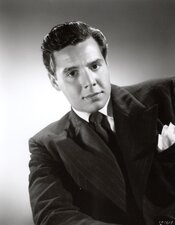
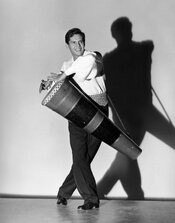
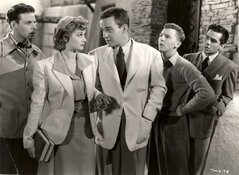
Ok fair enough. These are the kind of shots I was told that used 8x10. I know with these, its mostly down to lighting and lens used.
 

Attachments

  • desi-arnaz-portrait.jpg
    desi-arnaz-portrait.jpg
    194.2 KB · Views: 27
  • desi-arnaz-too-many-girls-1.jpg
    desi-arnaz-too-many-girls-1.jpg
    294.5 KB · Views: 24
  • desi-arnaz-too-many-girls-2.jpg
    desi-arnaz-too-many-girls-2.jpg
    343.2 KB · Views: 27
As to lenses, 8x10 is getting close to the territory of 1:1 macro for a head shot (not quite, but if you're framing tight, it is). At that point, the old saw about focal length goes out the window, because getting into macro territory with the bellows extension of 2x focal length changes the effect of the lens. Some of the greatest portraits of the 20th century (think Yusuf Karsh, George Hurrell) were done on an 8x10 with a Kodak 14" (360mm) Commercial Ektar. There were tons of soft focus portrait lenses made in the first half of the 20th century in the 400mm (16") range. I have a 16" (405mm) Kodak Portrait soft focus lens that I absolutely adore on 8x10. Bear in mind whatever lens you use, be it a 300 or a 360 or a 450, a tight headshot can be 1:1, and even a loose headshot (head and shoulders) is going to require at least 1 stop exposure comp for bellows extension. The tight headshot will be approaching 2 stops. Combine this requirement with the general "slowness" of larger lenses, and fast film (400 speed) is your friend especially for natural light photos. Grain is not an issue on 8x10 film - you won't see it unless you start doing 40x50 inch prints. And even then maybe not much.

 
Ok fair enough. These are the kind of shots I was told that used 8x10.

The first two of those most probably were 8x10 - that last one maybe something smaller. But that look you're referencing in those photos had as much to do with the lighting technique as the camera. Get a book or two on George Hurrell and George Platt Lynes to see how they lit their photos. They (at least Hurrell) did a lot of retouching on the negative as well to get that perfect skin look.
 
Ok fair enough. These are the kind of shots I was told that used 8x10. I know with these, its mostly down to lighting and lens used.

It could also be down, in part, to ortho film vs panchromatic and filtering... as well as retouching as TFC mentions.

Regarding lenses, the Kodak Commercial Ektar is a dandy option. I use a 12-inch on 4x5 for portraits with great success. Also some "odd-ball" Tessars are really good too; like Gundlach Radar. If I were intentionally creating that look I'd intentionally use a lens of that era...

Desi was a very handsome man; wasn't he!
 
Last edited:
I just looked at the Fuji 450mm lens options, and they all range between $2500 and $3500 US. Ouch. I may wait on that one. Is the Ektar 360mm more reasonable in price?
 
A 300mm f/5.6 on 8x10 is about the same look as a 40mm f/0.75 on full frame.

A 450mm f/12.5 is about the same as a 60mm f/1.7

Here’s a calculator that can do all of these calculations for you. I find it pretty helpful when I’m doing research into purchasing a lens.


You can also use it to calculate depth of field and subject distance. Pretty handy for planning shots in advance.
 
I just looked at the Fuji 450mm lens options, and they all range between $2500 and $3500 US. Ouch. I may wait on that one. Is the Ektar 360mm more reasonable in price?

a 14" Commercial Ektar in good condition should run you closer to $1000 US. You might be able to find one for less if you're not picky about cosmetics and you're patient.
 
a 14" Commercial Ektar

The only challenge to Kodak Commercial Ektar is possibly learning the process to use as it is different from modern shutters, and the flash cord connections. Not big challenges and a super classic (and great) lens.
 
The only challenge to Kodak Commercial Ektar is possibly learning the process to use as it is different from modern shutters, and the flash cord connections. Not big challenges and a super classic (and great) lens.

the two biggest quirks are the flash sync (it requires a bipost to PC adapter cord) and a cable release with a long throw to make sure it fires the shutter - modern mechanical cable releases often don't have a long enough piston and if you're not aware of this, you could put a modern cable on this shutter and push it all the way and not fire the shutter. Cocking and firing the shutter aren't that different otherwise. It depends on how old the shutter is as to if you need to put it to T to focus rather than having an open/close mechanism.
 
the two biggest quirks are the flash sync (it requires a bipost to PC adapter cord) and a cable release with a long throw to make sure it fires the shutter - modern mechanical cable releases often don't have a long enough piston and if you're not aware of this, you could put a modern cable on this shutter and push it all the way and not fire the shutter. Cocking and firing the shutter aren't that different otherwise. It depends on how old the shutter is as to if you need to put it to T to focus rather than having an open/close mechanism.

Yep, cocking of both shutter and sych, seperately, is a bit odd plus the color-coded flash synch settings. (Edit... both of which might not be necessary for x-synch). For that vintage look, though, I think I'd opt for hot lights and not any flash.
 
Last edited:
Ok fair enough. These are the kind of shots I was told that used 8x10. I know with these, its mostly down to lighting and lens used.

None of these photos is a headshot. The closest is the first which is a head and shoulders almost bordering on an upper body. You could get away with a 300mm for this one depending on how the sitter feels about the perspective. The camera would be something like 3 feet away from the subject.
 
Yep, cocking of both shutter and sych, seperately, is a bit odd plus the color-coded flash synch settings.

I haven't done it on any of my Ilex shutters, but I do know some folks who have permanently physically altered the shutter so the flash sync is always on X and not M/FP/whatever the setting for flash bulbs is.
 
I haven't done it on any of my Ilex shutters, but I do know some folks who have permanently physically altered the shutter so the flash sync is always on X and not M/FP/whatever the setting for flash bulbs is.

Coorect... although that wasn't a modification; it's how the Ilex shutter works for X. I editted my post as such, apparently while you wree also writing. :smile:
 
Coorect... although that wasn't a modification; it's how the Ilex shutter works for X. I editted my post as such, apparently while you wree also writing. :smile:

I meant as in I have seen people put the flash sync lever in the X sync position and then epoxy/screw/etc something so it cannot be moved out of X - a major source of frustration if you're using flash and it's syncing on flashbulbs when you're firing electronic strobes. I understand why people did it, but I think I'm sufficiently skilled in my use of LF gear now to not need it. The risk is that the flash will fire, and appear to have gone off, but it will fire BEFORE the shutter is fully open, resulting in a partial to complete failure to expose the film (I did this ONCE, and learned my lesson the hard way).
 
Ok fair enough. These are the kind of shots I was told that used 8x10. I know with these, its mostly down to lighting and lens used.

I will not fuss too much about lens, and try to start shooting as early as possible. There are just too many theories (e.g. equivalent focal length from 8x10 to 135) out there, which might not be relevant to you in your portrait photography situation.

From OP's example photos, 2 & 3 can easily be done with a 300mm lens. Photo 1 probably needs a longer lens like 360mm. In my work, I found 300mm and 360mm both useful and practical for portraiture in the traditional sense (half body, head and shoulder, but not close-up of face only). You can just pick one of these two that is within your budget and have a good shutter. In 8x10 portrait, image quality is not going to be your main concern. Lenses differ mostly in character, not quality per se.

For existing light, you will probably shoot in shadows or at least filtered daylight. That often means ISO 400 film to achieve reasonably fast shutter speed.

When I started, I use strobe since it is much easier to control lighting and use any ISO film I like. Just make sure your shutter has X-sync, and your flash has enough output power after modifiers.
 
Yeah, this is 99% lighting. Big old multi-kW cinema hot lights. 8x10 in natural light will give you nothing like this.

I don’t think there are rental houses that will rent anything that will look remotely like these lights to the general public. And the low end to buy a similar fixture is like $10k or something.

But I wouldn’t let that stop you from shooting some natural light portraits on 8x10. Won’t look like what you thought originally but could be pretty cool anyway.

Also apparently this is the vintage shutter flash sync thread now. So that’s great

Edit: did some looking around and there are a bunch of ≈360mm lenses for relatively low prices, <$650 or so but once you get into longer focal lengths than that things get pretty expensive. You could even find a better deal if you’re patient enough to wait for the right lens to show up at the right price.

There’s a schneider G-claron 355mm on keh right now for $650 in bargain condition, but you could probably find something in better condition for less if you keep an eye out.
 
Last edited:
Just did a head-shot session yesterday with a 240mm lens on the 4x5. To me, it's the perfect focal length for this.

If you're using the equivalent, or longer, on the 8x10, don't forget to bring something to mesure bellows extension. My shots are about 1/3 to 1/2 stop underexposed because I 🙄🙄🙄 forgot 😩.

Also suggest fast film. I had HP5+, rated at 320. I didn't want full sunlight, so in the shade, I was at f/32 with a time of 1/2 a second. I was pretty close to the subjects, so even at f/32, I only had a few inched of depth of field. None of this holds if using flash, of course.
 
Photrio.com contains affiliate links to products. We may receive a commission for purchases made through these links.
To read our full affiliate disclosure statement please click Here.

PHOTRIO PARTNERS EQUALLY FUNDING OUR COMMUNITY:


Ilford ADOX Freestyle Photographic Stearman Press Weldon Color Lab Blue Moon Camera & Machine
Top Bottom