

• Welcome to Photrio!
    Registration is fast and free. Join today to unlock search, see fewer ads, and access all forum features.
    Click here to sign up

Problems with Kodak D-76 and T-MAX 400 development: Low-contrast negatives

Babel

H
Babel

  • 1
  • 0
  • 19

Recent Classifieds

Forum statistics

Threads
201,875
Messages
2,831,594
Members
100,996
Latest member
sonora
Recent bookmarks
0

cinotrah

Member
Allowing Ads
Joined
Feb 17, 2015
Messages
11
Format
35mm
Hello everyone,

I have been developing analogue black & white for a good year now, and a couple of months back, I've discovered my prints contain less contrast than what they used to. I've learned how to influence contrast in paper development by way of playing with the R and Y values of the enlarger (using a Durst M370). However, this did not completely solve the problem of most of the sort of gray-ish pictures. As I was looking through the negatives, I've realized that it was those which contained less contrast, so now I'm wondering what it is I could be doing wrong now, compared to 2013.

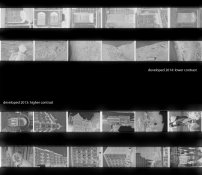
I use Kodak D-76 in a 1:1 solution and T-MAX 400 film in a round developer tank; the manual which I've used suggests a 12,5 minutes developing time for this setup; and so far, I've had both good and bad results (see attachment). Is there a difference in development time if I'm developing one roll of film or two at the same time? Were the chemicals simply too old and too used up to provide good results? Usually, chemicals are changed in fairly regular intervals at the lab I'm working at, but I'm wondering if they just happened to be old.. I used the same Nikon-FA with the same setup in all the negatives I've attached.

Any suggestions greatly appreciated. Thanks a lot!

cinotrah
 

Attachments

  • negatives_differences.jpg
    negatives_differences.jpg
    261 KB · Views: 473

Hatchetman

Member
Allowing Ads
Joined
May 27, 2011
Messages
1,553
Location
Chicago, IL
Format
Multi Format
A little confused. D76 1:1 should be used "one shot" meaning use it one time and dispose. D76 in a replenish system is different. Not sure how labs go about adding more developer over time.
 

Richard S. (rich815)

Member
Allowing Ads
Joined
Jan 14, 2003
Messages
4,924
Location
San Francisco
Format
Multi Format
Your attachment not able to be viewed. Try what you know are newer chemicals, make sure your camera's meter is working properly and that you are metering the scenes properly otherwise we're all just speculating...
 

snapguy

Member
Allowing Ads
Joined
Jan 1, 2014
Messages
1,287
Location
California d
Format
35mm
I viewed your attachment okay. But am also confused. You are developing your own film but at a lab outside your own home? You should examine the negs every time you develop them and not have to look back and say they've been bad for a long time. How do you like your steak -- rare, medium or well done? If it's not cooked enough then you should keep it in the pan for a longer period of time the next time. The same principle works with negs. It looks like you need to make sure the "soup" is fresh and give it more development time if they are coming out too thin. Are you keeping track to temperature as well as time? Good luck.
 

removed account4

Subscriber
Allowing Ads
Joined
Jun 21, 2003
Messages
29,832
Format
Hybrid
I don't use d76, but I do use something similar to it, some refer to it as a clone ...
sprint film developer. my suggestion won't be specific to your film developer but hopefully it
will be useful to you.
my suggestion is to bracket your exposures a little bit..
use a tripod to make things easy ... take a meter reading and make an exposure using
what the meter suggests .. then 2 more exposures one with a whole stop over exposed, and one a whole stop
under exposed ... you can do this with your fstop dial, or just change your shutter speed, it varies the light the same way ...
THEN
develop your film ad directed.
you can do this again 2 more times if you want and change your developing times by maybe 20%
and fine tune your system ...
THEN expose yor film at whatever speed you decided worked best with whatever developing time
worked best for your "system" ...
( if you liked over exposed, set your ISO dial at 1/2 the box speed, under exposed to 2x the box speed ...
it's easier to do that than to be constantly remembering to over/under expose your film seeing
ISO shutter speed and fstops are all interconnected....)
a lot of people do the bracket-thing for every new film they use to determine
what works for them ...

as others have said I wouldn't re-use your developer, it weakens after each use until it dies.
 

mike c

Subscriber
Joined
Jan 5, 2009
Messages
2,863
Location
Los Angeles
Format
Multi Format
The 2014 looks like under development, maybe exhausted developer, poor agitation, low temperature (68 deg. F is normal) or like you mention at 1:1 not enough chems for the amount of film. Think your exposure is good (can see shadow detail)but check it out with another meter or camera. John has some good suggestions on exposure as well (above).
 
OP
OP

cinotrah

Member
Allowing Ads
Joined
Feb 17, 2015
Messages
11
Format
35mm
I viewed your attachment okay. But am also confused. You are developing your own film but at a lab outside your own home? You should examine the negs every time you develop them and not have to look back and say they've been bad for a long time. How do you like your steak -- rare, medium or well done? If it's not cooked enough then you should keep it in the pan for a longer period of time the next time. The same principle works with negs. It looks like you need to make sure the "soup" is fresh and give it more development time if they are coming out too thin. Are you keeping track to temperature as well as time? Good luck.


Thanks for your help. I'm working in a shared lab with 3 other parties, one of them is in charge of changing the chemicals, and frankly, I guess I'll have to mix my own ones from now on, in order to keep track of the results.

Hatchetman, I had no idea D76 1:1 is a one-time developing solution, but I might be mistaken in what the lab is providing. As far as I know, at least 8-10 rolls are developed before the chemicals get changed there.
 

Peter Schrager

Subscriber
Allowing Ads
Joined
Jul 19, 2004
Messages
4,325
Location
fairfield co
Format
Large Format
best results for tmax400 xtol 1+2 semi stand for 12-13 minutes. semi means shake at first; then every 3 minutes...great negatives!
best,peter
 

gone

Member
Allowing Ads
Joined
Jun 14, 2009
Messages
5,504
Location
gone
Format
Medium Format
Ditch the T-Max, and switch to Tri-X (or about anything else BUT T-Max) and you'll get the contrast issue solved. That film seems to be good for portraits. Maybe. Other people sometimes get good results from it, but I have never been able to. A decent lens and a yellow filter help too.
 

Paul Howell

Subscriber
Allowing Ads
Joined
Dec 23, 2004
Messages
10,119
Location
Scottsdale Az
Format
Multi Format
Thanks for your help. I'm working in a shared lab with 3 other parties, one of them is in charge of changing the chemicals, and frankly, I guess I'll have to mix my own ones from now on, in order to keep track of the results.

Hatchetman, I had no idea D76 1:1 is a one-time developing solution, but I might be mistaken in what the lab is providing. As far as I know, at least 8-10 rolls are developed before the chemicals get changed there.

If the lab is using stock D 76 replenished and you are using developer times for D 76 1:1 your negatives will likely be too dense. If the lab is using D 76 1:1 and replenishing your time could be really off towards the end of the cycle. If you like the look of D76 buy your own bottle of HC 110, Tmax developer or DDX. All 3 work well with Tmax 400, have long shelf lives, and are one shot.
 

DREW WILEY

Member
Allowing Ads
Joined
Jul 14, 2011
Messages
14,875
Format
8x10 Format
76 is peculiar in that it seems to need a few days to stabilize, then (in an airtight bottle) it "plateaus" in activity for six weeks or so, perhaps longer, until it expires. This means you should standardize your process either on immediately mixed 76 or on developer at least a week old, because the results will differ. 1:1 is a popular dilution. But obviously the developer should be used "one shot" - just once and discarded. If you wish, you can buy a buffered version of it from Photo. Formulary which doesn't vary so much from fresh to slightly aged. 76 works perfectly well with TMax films, though there are other developers I prefer more. If the contrast is too low you just need more development time. TMax films are a little more fussy about correct exposure than many other black and white films, but are quite rewarding if understand them.
 

Bill Burk

Subscriber
Allowing Ads
Joined
Feb 9, 2010
Messages
9,473
Format
4x5 Format
I use this combination all the time, and sometimes lower contrast happens to me too.

I shoot the film at EI 250 because that will help the shadows in cases like this of accidental underdevelopment.

Remember the stock solution to film square inches ratio: Recommended is 8 ounces of stock solution per roll of 36 exposures, 35mm film. This means to develop one roll of film you need 16 ounces of mixed 1:1 developer. I have not been following this recommendation for very long because it was only recently that I realized I wasn't using enough. I don't think that's your main problem but it certainly works against you.

I really think the batch of developer has a problem and should be replaced. You might want to mix your own to take with you to the lab. Or be the one who mixes the next batch and use good water to mix with.
 
OP
OP

cinotrah

Member
Allowing Ads
Joined
Feb 17, 2015
Messages
11
Format
35mm
You might want to mix your own to take with you to the lab. Or be the one who mixes the next batch and use good water to mix with.

Thanks Bill! Good water = distilled water at 20°C / 68°F?
 

Bill Burk

Subscriber
Allowing Ads
Joined
Feb 9, 2010
Messages
9,473
Format
4x5 Format
Sure, distilled or filtered water. When mixing the powder you warm up the water. The water you mix the stock solution with is what needs to be good. There's a thread about a specific brand of distilled water that is bad... otherwise most bottled water is good. I use tap water to mix the 1:1 dilution for developing because the problem people saw happened over time... and you'll be developing right away once you mix 1:1.

I also recommend taking a test shot on every roll of film... At the beginning or end or whenever you remember... shoot any real shot as planned and then shoot again 2 stops overexposed. This will give you two shots you can measure the density differences in... and from that you get a measure of contrast (measured contrast as opposed to a gut feeling about the contrast). Good to keep checks on your process.
 

DREW WILEY

Member
Allowing Ads
Joined
Jul 14, 2011
Messages
14,875
Format
8x10 Format
Bottled drinking water is often simply tap water with the chlorine filtered out and certain "taste" minerals added. Knowing where some of it comes from as distributed in this part of the world, I wouldn't even drink it certain brands! Distilled water is something completely different and should hypothetically be pure, if legally labeled. But our own local tap water is fine for garden-variety developer like D76. In other places, the mineral content or whatever might present a problem. Just depends. When in doubt, use real distilled. Deionized water would be a second choice. Since most developers contain sodium sulfite, the water needs to be fairly hot for this to dissolve, around 120F. I've done tons of densitometer plots of various films with 76, among various developers, and have never seen any inconsistency whatsoever batch to batch, provided I did time the usage as per what I noted previously.
 
Photrio.com contains affiliate links to products. We may receive a commission for purchases made through these links.
To read our full affiliate disclosure statement please click Here.

PHOTRIO PARTNERS EQUALLY FUNDING OUR COMMUNITY:


Ilford ADOX Freestyle Photographic Stearman Press Weldon Color Lab Blue Moon Camera & Machine
Top Bottom
