Steve, at the great risk of asking you to do exactly what you've indicated you do not want to do, could you spare a moment to clarify what you mean by "can't reason beyond the whole adjacency/increased sharpness debate"? I'm guessing that you mean semi-stand development benefits local contrast differentiation and not solely through adjacency/increased sharpness (although many people focus solely on semi-stand's adjacency/sharpness benefits). I could be totally wrong in my interpretation, though. If the whole thing gives you the heeby-jeebies, then feel free to ignore this question.
Thanks,
Leo
Hi Leo,
I have often said the internet is the best thing to happen in a long time, and the worst. The sharing of knowledge by well informed photogs has taught me many things I would not have known if not for the internet. However, it has also taught me there are all to many people who enjoy if not convent the opportunity to expound on topics they have little practical experience or knowledge about, I call them "forum photographers". End of the soap box!
My area of expertise is very narrow, silver printing and making negatives for that process. Nearly all my experience comes for years of trial and error and an unusually large waste basket, where both negatives and prints have gone to rest.
That said, and certainly not to offend anyone in this thread or elsewhere, I know what works best and most efficiently for that process and pass that information along freely. However, I have little inclination or time to constantly defend my observations so in the end the more persistent forum contributor sways the unknowing and so the cycle continues. Sorry, that's another mini soap box!
It's well documented how and why the reduced agitation technique works and the benefits it can produce. Reference either my discussions or Sandy King's discussions of this topic for real and accurate information. For me personally, the technique is much more about the creative possibilities afforded the LF photog than any increase in adjacency or sharpness. In fact, I have learned again through trial and error there are some drawbacks to this magic bullet if you will that cannot be overcome. An issue for another time. Back to the creative part, reduced agitation does three things that most fine printers have battled for eons. Film speed is maximized, midtone (micro) contrast is maximized and highlight compression is maximized. Therefore, one who is proficient at this technique should be able to photograph in ANY lighting situation, whether it be too little contrast or extreme literal contrast.
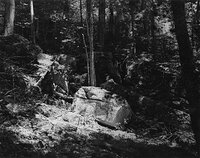
There are two extreme examples on my web site (sorry I don't know how to link the photos as Jim did). One is the panoramic of the prison interior where measured contrast was 14 zones apart and another (Penile Colony) where measured contrast was less than 3 zones. Each image has nearly identical micro contrast and both were printed on hard contrast AZO, all because global contrast in the negative was executed at exposure and designed for the final printing material, in this case AZO.
If you have an interest in exploring the technique this link goes back to a lengthy and very descriptive explanation of my methods with commentary from numerous photogs in particular Sandy King.
(there was a url link here which no longer exists)
I'll close with this, I just returned from a week in Toronto where a solo exhibition of my photography was sandwiched in between several masters who were giving three day workshops. One of the notables was a well known "digital negative / wet process" guy. I told him I believe I can do anything in the darkroom that he could do with a computer, he scoffed and said "Hogwash"... and then he saw my prints!
Small apology on the Soap Box comments and hope this advances your photography!
Cheers