• Welcome to Photrio!
    Registration is fast and free. Join today to unlock search, see fewer ads, and access all forum features.
    Click here to sign up

Print Manipulation - Am I being lazy?

Valencia

A
Valencia

  • 2
  • 1
  • 64
Tied to the dock

D
Tied to the dock

  • 4
  • 0
  • 98

Recent Classifieds

Forum statistics

Threads
203,096
Messages
2,849,764
Members
101,664
Latest member
logan.perrin
Recent bookmarks
0
I have no idea how you would keep track of all those manipulations. What a tedious job of printing that would be.

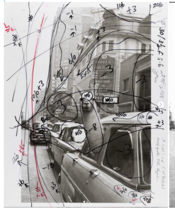
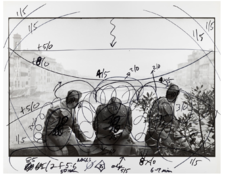
Maybe tedious, nevertheless essential. These prints are not for personal enjoyment. They are either for sale or, even more probable, for museum exhibitions. Expectation is high that they all look like the original, first print (whether by the photographer him/herself or by the first printer). For that, you need a road map as precise and well-defined as possible — even if the general printing style of the era in which it was made has changed (as well as the paper, print developer, etc.).
 
What do printers do with color chrome film?

You can make an internegative and print it with R4 chem, at that point all of the color techs come into play. The trick would figuring which color negative film to use. At times Photo Wearhouse Ultrafine has old stock internegative film on hand, but I would use Porta 160.
 
Good on you btw for your years of experience, but what makes it giggle worthy? I certainly don't go through such extensive print acrobatics myself, but I do keep a record of my dodge and burn efforts, what's wrong with that?

Simply ridiculous manipulations and meaningless to a good printer.
 

Attachments

  • Screen Shot 2024-11-08 at 12.07.44 PM.png
    Screen Shot 2024-11-08 at 12.07.44 PM.png
    1.2 MB · Views: 81
  • Screen Shot 2024-11-08 at 12.07.12 PM.png
    Screen Shot 2024-11-08 at 12.07.12 PM.png
    510 KB · Views: 84
Simply ridiculous manipulations and meaningless to a good printer.

Out of curiosity, what would a good printer view as sensible and meaningful manipulations for this print?
 
Out of curiosity, what would a good printer view as sensible and meaningful manipulations for this print?

I would have to see the original film and possibly a contact sheet before I would start and then I would talk with the photographer on the type of printing style they would like and if possible see examples of what they like.
 
I would have to see the original film and possibly a contact sheet before I would start and then I would talk with the photographer on the type of printing style they would like and if possible see examples of what they like.

Well, Eve Arnold died in 2012, so the conversation might be a tad difficult to organize 🙂. That said, what makes you think she did not have a conversation with Pablo Inirio beforehand, and wasn't extremely happy with how the print turned out after his manipulations?

I'm pretty sure he did, actually. It was his modus operandi, as per this excerpt from an interview with him: “A lot of it is just craftsmanship. You can’t really get so much into the art, because it’s not your picture… I have to just print it how they want it — and that’s fine! It actually makes life easier, because if you have total freedom, there’s too much range."

I can understand wanting to do things differently than Inirio. It's a question of taste. I can't understand calling the manipulations "ridiculous" and "meaningless" if the result is in total agreement with the wishes of the photographer.
 
I giggle when I see these prints with so called dodge and burn notes, as a professional printer for now 50 years I can say without hesitation any printer with any self worth would throw back
this type of map and just make the print.

I believe the “map” was made by the printer, not necessarily by the photographer. But probably from the photographer’s input.
 
The darkroom instructions are a marketing ploy by Magnum to make money. I am not sure they are the original instructions or were recreated in order to have a product to sell. I do not doubt they reflect the work done. On the other hand, the instruction images I have seen for Avedon’s “In The American West” seem quite authentic (one can see the same image going through several stages of printing with additional instructions) and reproductions have not been offered for sale as far as I know.
 
The darkroom instructions are a marketing ploy by Magnum to make money. I am not sure they are the original instructions or were recreated in order to have a product to sell.

And a brilliant marketing ploy it is! Magnum needs money to pay its photographers. If that makes it possible for someone like Koudelka to keep doing what he's doing without having to get a day job, then I'm all for it.

That said, I don't see the point in being doubtful, or even cynical, about the process and intent. Pablo Inirio is the printer. Some of these prints, by his own admission, he had to print many times over and over again. Having a map to do so makes sense. Moreover, if you look at every before and after photos, the markings are in agreement with what you see. I don't see what interest he would have in just making stuff up and risk ruining his reputation.
 
I
Well, Eve Arnold died in 2012, so the conversation might be a tad difficult to organize 🙂. That said, what makes you think she did not have a conversation with Pablo Inirio beforehand, and wasn't extremely happy with how the print turned out after his manipulations?

I'm pretty sure he did, actually. It was his modus operandi, as per this excerpt from an interview with him: “A lot of it is just craftsmanship. You can’t really get so much into the art, because it’s not your picture… I have to just print it how they want it — and that’s fine! It actually makes life easier, because if you have total freedom, there’s too much range."

I can understand wanting to do things differently than Inirio. It's a question of taste. I can't understand calling the manipulations "ridiculous" and "meaningless" if the result is in total agreement with the wishes of the photographer.

I am currently print a Magnum Photographers Museum collection over 300 prints for exhibit world wide and as well printed a complete Vivian Maier exhibition a few years back and in both cases I was left to my own devices to print. If some believe that these crazy printing notes are real so be it , I just don't therefore the giggle.
 
If some believe that these crazy printing notes are real so be it , I just don't therefore the giggle.

Some say my naïveté is my most charming asset.

That it makes others giggle is just an added bonus. As I aim to spread joy in this world, I can tell myself I'm doing my job well. 🙂
 
Some notes might be useful for a printer at a given time to replicate a print later on, if the paper is still available, the emulsion is still within the ball park of the original paper, and if the printer has not moved on to split grade printing. The notes provided are for exhibition prints which will be different from the print that made for the wires when the half tone process was used.

As I am not a master printer, I can not imagine myself following those notes. In some cases I might bleach an area to lighten it rather than try to doge 3 or 4 areas in different parts of the print by 1 or 2 seconds.
 
If the photographer’s instructions or intent is not straightforward, it makes perfect sense for the printer to make notes to clarify and be able to later make the proper moves in the darkroom.
 
And a brilliant marketing ploy it is! Magnum needs money to pay its photographers. If that makes it possible for someone like Koudelka to keep doing what he's doing without having to get a day job, then I'm all for it.

That said, I don't see the point in being doubtful, or even cynical, about the process and intent. Pablo Inirio is the printer. Some of these prints, by his own admission, he had to print many times over and over again. Having a map to do so makes sense. Moreover, if you look at every before and after photos, the markings are in agreement with what you see. I don't see what interest he would have in just making stuff up and risk ruining his reputation.

I'm not sure Magnum employs any photographers. They are an agency, selling the photographer's work and publishing books and reprints. Mr. Koudelka only gets paid if something sells. As a matter of fact, a reason he has cited for switching to digital was eliminating the need to raise money to pay for film.
 
Magnum was started by Robert Cappa and others to maintain control over their work. When you work for a wire such as AP, AP owns the rights to the images. Those who freelance may or may maintain ownership of her/his negatives depending on the contract. It is an agency more like a talent agency, as noted by Pieter12, photographers are not employed as such.
 
I'm not sure Magnum employs any photographers. They are an agency, selling the photographer's work and publishing books and reprints. Mr. Koudelka only gets paid if something sells. As a matter of fact, a reason he has cited for switching to digital was eliminating the need to raise money to pay for film.

Magnum was started by Robert Cappa and others to maintain control over their work. When you work for a wire such as AP, AP owns the rights to the images. Those who freelance may or may maintain ownership of her/his negatives depending on the contract. It is an agency more like a talent agency, as noted by Pieter12, photographers are not employed as such.

Yes, I know all that. My bad for not being clear. I didn't mean to imply that Magnum employs photographers — Koudelka or anyone else. Meant to point out the simple fact that like any organization, they need money to operate — operations which do include printing and/or selling prints by photographers such as Koudelka —, and that I'm for any clever means to find the cash to do so.
 
If some believe that these crazy printing notes are real so be it

They are real. They're just not what you do. They are, apparently, what he does. You can make 300 prints from 300 negatives and be left on your own to do it - he want to make every subsequent print as much like the previous time as he can. Magnum markets these because someone saw them and thought they were interesting. I don't know why they're worth talking about. Not everyone does everything the same way.
 
That's what many photographers have done, and continue to do. Which illustrates it's just fine to be a good photographer and a poor printer, as long as the photographer is willing and capable of working with a competent printer. Of course it's different if a photographer wants to produce good prints, and does not have the means (financial, intellectual, social, organizational etc.) to collaborate effectively. In that case they have no choice but to learn to print well.

I think many are using these examples as an excuse for not learning to print properly. Life is an endless learning process, and nobody ever becomes dumber because of it. Stop the excuses. If someone used a competent printer to get the most out of their negatives, then they have no right to claim exclusive ownership of that image. Too often, the photographer is lifted on a pedestal while the printer is lost in obscurity—unjust, in my opinion.
 
Last edited:
The fact is, @RalphLambrecht , photography has in many ways moved on from printing. The vast majority of photos never make it onto a piece of paper - including the majority of film photos. An increasing number of commercial photography never gets printed. And it's always been the case that some people love using the camera and taking photos and do that very well but hate darkroom work. Cartier-Bresson is a prime example. But aside from that, people do still spend time making the photos look how they want, using a computer. And if your photo is pretty much only ever going to be seen on a screen, isn't that the appropriate way to edit it?
 
Ignore its existence.
Saves a lot of money, too.

If there's no way around it - scan and digital output.

I was asking a rhetorical question. In the old days, photographers shot chromes and submitted them to magazines for publication. How much dodging and burning was done?
 
Oh, more dogma. I see. We were short of that.

Having said that - a lot happened in the printing process, with all the cropping, masking, color adjustments etc.
And of course printing color is somewhat different than b&w.
 
I think many are using these examples as an excuse for not learning to print properly. Life is an endless learning process, and nobody ever becomes dumber because of it. Stop the excuses. If someone used a competent printer to get the most out of their negatives, then they have no right to claim exclusive ownership of that image. Too often, the photographer is lifted on a pedestal while the printer is lost in obscurity—unjust, in my opinion.

An architect doesn't build the building but gets credit for the design.
 
Oh, more dogma. I see. We were short of that.

Having said that - a lot happened in the printing process, with all the cropping, masking, color adjustments etc.
And of course printing color is somewhat different than b&w.

I was asking a legitimate question. How much editing did they do when they used to print color chrome film compared to BW negative film?
 
Photrio.com contains affiliate links to products. We may receive a commission for purchases made through these links.
To read our full affiliate disclosure statement please click Here.

PHOTRIO PARTNERS EQUALLY FUNDING OUR COMMUNITY:


Ilford ADOX Freestyle Photographic Stearman Press Weldon Color Lab Blue Moon Camera & Machine
Top Bottom