• Welcome to Photrio!
    Registration is fast and free. Join today to unlock search, see fewer ads, and access all forum features.
    Click here to sign up

Print goes instantly darker in fix

Coburg Street

A
Coburg Street

  • 0
  • 1
  • 51
Jesus

A
Jesus

  • 0
  • 1
  • 48

Recent Classifieds

Forum statistics

Threads
201,732
Messages
2,829,323
Members
100,920
Latest member
wuduwald
Recent bookmarks
0

catem

Member
Allowing Ads
Joined
Jan 14, 2006
Messages
1,358
Location
U.K.
Format
Multi Format
Does it matter ?

Yes, if you learned to control print tone by observation.
Like being able to tune a violin by ear instead of a meter.

Ilford's MG, a great paper otherwise, rewards time and temperature workers.

What a great way of putting it. I'm definitely an 'ear' (not that I've tuned violins - but played the piano and guitar in a past life! HATED sight reading :smile: ) and 'observation' person. Now I feel better about it.

p.s. it's a lovely photo of Suzanne, I've seen it. And of her camera :smile: (I thought we were allowed to posted the dreaded d's in threads?)
 
Last edited by a moderator:

df cardwell

Member
Allowing Ads
Joined
Jul 16, 2005
Messages
3,358
Location
KY USA
Format
Multi Format
I've noticed a minor change ,,,

A couple years ago, when I acquired a LOT of Warmtone,
I spent some time with the step tablet to see what the paper does.
My first thought was,
"Oh Gosh, I hope I don't have to use Boiling Dektol to find black !"

Well, no. AS SOON as the print hit the
ALKALINE FIX, Zone II 1/2 plummeted to Zone O.
It takes about one second. Higher values aren't affected.

It is very much like a negative clearing, as Graybeard describes.

ANYBODY USING ACID FIX ?

LPD, Dektol, 120, 130, all show the same effect.

AND I never saw this before MG FB Warmtone.

Anyway, at least we aren't imagining it.

PAULA: IS THIS HELPING ??
 

Bob Carnie

Subscriber
Allowing Ads
Joined
Apr 18, 2004
Messages
7,735
Location
toronto
Format
Med. Format RF
This is exactly what we do here , we have a dimmer with tungsten lights to view our exhibition prints ,, we find out lighting of the shows and look closely that way , Bright room lights are just put on for checking for artifacts and such.
For every print we usually do a slight variation to give the photographer a choice.

Regarding viewing prints ..... I do all my dodge and burn judgments in the developer now.. I watch for emergence times of various areas of the print and make a mental note which areas are slow to show themselves and what areas are too horny and come up to fast.

The room lights are for quick and I mean quick assesment of contrast which in my case is a % of hard and soft light on the print. Once printing I rarely switch the basic soft and hard filters... usually 1 and 5 and base all judgements on time of each.

Also I do not keep any test strips or prints laying around , they go immediately to the garbage, the only prints that are in the water rinse trays are those that are considered for the client to purchase.

So in my case , all important details are done before the lights are turned on and for sure I want to consider where the prints are going over looking at the prints in darkroom florescent lighting.

I like the Thompson lights as well as they can be adjusted for mood and lighting in the darkroom.


Ages ago, I met a wonderful printer who had a viewing light on a dimmer, to examine a wet print, and because she only printed with one or two papers, was able to adjust the lux for whatever she was printing. Besides that, if she knew where a print was going to be placed, would visit the site and measure the viewing light. She examined her dry prints at THAT level. It was very simple to accommodate both techniques. When I started using a Thomas safelight, it was easy to adjust the safe light light to the be close to the wet viewing light. Of course a few papers didn't like that, most did, and sometimes a the restrainer needed to be adjusted in the developer.

Back in the '90s, didn't Howard Bond talk about a wet light on a dimmer ? Can't remember.
Anyway. Point is, we DON'T have to work in the dark, however we work.

LOPAKA: Joe Clark, a great guy.
CALLOW: where's the beer ?
ERIC: The Ilford trick snuck up on me, I was drinking beer and printing and listening to a really good hockey game. It gradually sunk in what was going on, but it was too late to do anything about it so I just sat down, opened another pop and listened to the rest of the game.
Everybody, I've got the COOLEST picture of Suzanne working in her studio.....
But, umm, its d*g*t*l so I can't show ya !
Matt: hiya ! Salmon running in Iowa ?
 

Bob Carnie

Subscriber
Allowing Ads
Joined
Apr 18, 2004
Messages
7,735
Location
toronto
Format
Med. Format RF
Mr Cardwell

My hat is off to you,

I learned the time temp method with test strip and looking in bright light...
Today 33 years later and a few negatives down the road , I make all my critical decisions in the Developer and under dim light now I trust myself when I think the print is done , without waiting for the full spectrum of light.

You are the first or second person that I have ever heard in my professional printing career talk about the extreeme simplicity of printing , and I believe you are totally correct.

The Nail That Stands Up Will Be Hammered Down.

Perhaps there might be a grudging acceptance that a different point of view is not necessarily grossly inferior.
(If there has been an official dogma pronouncement, forgive me. I have been away.)

What one sees in the developer tray might very well be what one sees on the wall.
It all depends on what you believe, and how you work,
and how one integrates and manages the variables that make expressive work POSSIBLE.

With papers like Elite and Portriga, and others before them,
it was possible to judge highlights and shadows to a nicety,
and practice Factorial Development as Adams discussed.
This is not dark magic, but simple craft. See David Vestal.

If this violates your personal belief system, I apologize.
Do what works for you. I learned to print over a long period, a long time ago.
What works for me, works for me.

Responding to Suzanne's question, I answered honestly.
Working with Ilford's MGs is different than working with any other papers I have ever worked with.
There is no choice but to develop to a given time, fix, and turn on the lights.
It is a lovely paper. It is a pain in the neck.
I will use it until I run out of it, be thankful I have it,
and hope that I can lay hands on a sufficient quantity of goodness-knows-what
that lets me work the way I prefer to work, the way I am capable of working.

I wonder sometimes how Edward Weston was so massively productive
without benefit of all the fancy toys we litter the darkroom with today.
Trusting his eyes, and his judgement. How quaint, how primitive !

I wonder how a violinist can compensate for a room's humidity
and changing temperature of his fiddle,
or the shifting acoustics of a hall,
and still play with perfect intonation, and great expression.
 

df cardwell

Member
Allowing Ads
Joined
Jul 16, 2005
Messages
3,358
Location
KY USA
Format
Multi Format
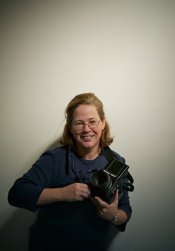
Suzanne & RZ

OT

Suzanne has this nifty little studio,
New England light bouncing all over the place.
 

Attachments

  • suzanne  1 .jpg
    suzanne 1 .jpg
    55.2 KB · Views: 139

Don Wallace

Member
Allowing Ads
Joined
Jun 12, 2006
Messages
419
Location
Ottawa, Cana
Format
Large Format
Does it matter ?

Yes, if you learned to control print tone by observation.
Like being able to tune a violin by ear instead of a meter.

Ilford's MG, a great paper otherwise, rewards time and temperature workers.

If you varied the ratio of exposure and development to fine tune the image,
that no longer works; it penalizes a traditionally skilled craftsman.

I strongly resist this comparison because it implies that those who develop their prints by inspection are somehow more creative than others. I always develop to completion simply because I prefer to fine tune by inspecting the final print (quick-dried) under good light. This doesn't make me somehow less creative than someone who does it another way.

For the record, I have been a musician for over 50 years (started as a child). Violinists do not tune by ear, regardless of how warm and appealing this analogy may sound. Professional violinists always tune to a standard A-440. Anyone who has had the excruciating experience of a violinist who did not tune closely enough to the other instruments, particularly if they are slightly sharp, knows exactly what I mean. Recognizing standards so that musicians can work together is not a limit on creativity but rather creates an environment within which imagination and spontaneity can flourish.
 

df cardwell

Member
Allowing Ads
Joined
Jul 16, 2005
Messages
3,358
Location
KY USA
Format
Multi Format
I don't mean to suggest that one way of performing is better,
only different. It was brought up to discuss the characteristic of the paper under discussion
and that it demanded a work-around.

I apologize if my analogy offended you.
I don't actually KNOW any violinists,
just fiddle players.

As for artistic standards, in photography, all that matters are the results.
 

removed account4

Subscriber
Allowing Ads
Joined
Jun 21, 2003
Messages
29,832
Format
Hybrid
what the heck is develop to completion?
i have heard this over and over again, but
in 30 years no one has ever told me what it means,
they just said it. ( maybe they knew better? )

does develop to completion suggest that if a developer suggests
" 3 mins " and ... THAT is the only way to make prints in that particular developer ??

why shouldn't one have the same tools one has making prints as one has
turning film into negatives. there is no "1 time fits all" when one makes negatives
for quite a long long long time photographers have developed film by inspection.

i can't imagine a "one time fits all" approach when making prints.
i turn film into negatives and negatives into prints the same way
i cook, by my own eye ( taste ) and intuition ( experience ).

i am sure others do things differently, whatever floats your boat, as they say,
but if someone could explain to me what develop to completion means, i would love to know what i have been missing!

thanks in advance!

john
 
Last edited by a moderator:

jeroldharter

Member
Allowing Ads
Joined
Nov 6, 2005
Messages
1,955
Location
Wisconsin
Format
4x5 Format
what the heck is develop to completion?...

i can't imagine a "one time fits all" approach when making prints.
i turn film into negatives and negatives into prints the same way
i cook, by my own eye ( taste ) and intuition ( experience ).
...

I think the idea of development to completion is an aesthetic that some people just won't like. Some people like to scramble the variables, go by instinct, and take satisfaction when the educated guess works well.

The develop to completion crowd (including me) likes to improve craft by eliminating (or controlling) variables. Developing prints "to completion" means leaving them in developer for a sufficiently long time to minimize variation based on slight differences in time or temperature. For me, that means developing at ambient temperature in my darkroom, with at least relatively fresh developer, for 3 minutes. I can develop a batch of 10 or a single print this way with identical results and account for dry down. I could buy an expensive compensating timer that someone else has calibrated and hope that works to account for temperature variation but why bother? I don't see any realistic way of accounting for dry down by developing based on visual inspection. Perhaps people who are printing constantly for years can develop some consistency in that, but rare virtuosity is not a method.

The idea of cooking to taste is not the same as basing development time on a view of a print under an amber safelight. It's more like taking a bite out of the side of a cow and "knowing" that the steak will be good once it finishes cooking. Some people can no doubt do that, but why bother acquiring the skill.

Certainly other methods exist that can control printing variables. But to my mind, basing development time on the visual inspection of an aging man (me) under a 15 watt amber safelight, especially within just 120 seconds after turning off the room lights, is one of the worst methods for for most people. Of course, the proof is in the pudding.
 

jd callow

Moderator
Subscriber
Allowing Ads
Joined
Jan 31, 2003
Messages
8,466
Location
Milan
Format
Multi Format
Develop to completion is where the print nolonger gains density in the dev. In otherwords you don't pull the print when you think it looks 'right', but when the development has slowed to a crawl -- I suspect if you left a print in the developer overnight the whole print might turn black. Depending upon the developer (in my limited b/W experience) Rc prints develop to completion in around 2 min, fb depends upon the paper.
 

df cardwell

Member
Allowing Ads
Joined
Jul 16, 2005
Messages
3,358
Location
KY USA
Format
Multi Format
I think I'm with you on about 90%, Doctor, but not completely.

While I AM a practitioner of witchcraft, alchemy, factorial development or ... inspection,
there is no argument from me about the need for development for a 'sufficiently long' time.

I think - if anything - that there is a misunderstanding of what is going on in an 'inspection' darkroom.

First, there is a hard won consistency. Temperatures are stable. In my darkroom, the lights are quite bright, just the right color, and fog-proof. Yes, fog is tested on a regular basis. This is, after all, the room that supplies my income. Surprises are not encouraged. And I usually turn my safelights on while I am getting ready to print, so my eyes adjust long before I have to make any decisions.

Dry down is not a surprise. It is a basic consideration, as is the illumination level of where the print will hang. Exhaustion rates of developers are accounted for. The characteristics of a given paper and developer combination are known: what is the working range, does contrast change over a long development time, can the curve be reshaped to move the midtones relative to the whites and blacks - some can, some can't. I seldom work with a paper I haven't made a hundred prints with. I buy a lot of paper at a time. I spend a lot of time with a step wedge getting to know the full personality of a paper before it ever makes a picture.

What is the print color going to be ? If a warmer tone is desired, that means a shorter development time will be needed, 1 or 1 1/2 minutes. Careful tests need to be made before putting a precious, full sheet of paper into the developer. Always beginning with a softer developer, adding contrast as needed, restrainer as might be required, based on dry tests. And not heat dried paper, not if the prints will be air dried. This means, obviously, that a print might take a while to dry.

It takes as long as it takes. I have a rocking chair in my darkroom. Sometimes, I just sit and listen to music. A piece of music often becomes an analogy to what I hope to make of a print; I'm working on a portrait this week that seems to have summoned Casals to the darkroom, and the picture of my old friend seems to taking form as I listen to Bach.

All of this is prologue to the production of the final prints, whether an edition or a one-off. By the time I get to this point, I've made several test prints, and lived with the toned, and dried variations pinned to a wall for a day or two, or more. So, when it is time to push the button, I'm sure what is going to happen, and I'm free to WATCH THE PRINT. I use a re-wet test print for reference, and develop until a threshold white looks right. At this point, I trust my eyes to discern what a timer cannot comprehend. By now, changes happen slowly, and it is a rewarding and stress free moment. It may SEEM to be an unproductive way to work, but every week there are drying racks full of good prints. Getting the first one just right DOES take days, but then the fun starts.

All of this suits my temperament, and the mystery and slow paced progress is what has kept me enchanted by the craft for 40+ years. There are many different ways to make good prints, and I believe we each need to work out a method that is successful and fulfilling for ourselves. The proof IS in the pudding, but also in enjoying the MAKING of the pudding.
 

catem

Member
Allowing Ads
Joined
Jan 14, 2006
Messages
1,358
Location
U.K.
Format
Multi Format
There are many different ways to make good prints, and I believe we each need to work out a method that is successful and fulfilling for ourselves. The proof IS in the pudding, but also in enjoying the MAKING of the pudding.

And most people use a mixture of methods - I know I do. It's important to know the time at which the print will achieve maximum Dmax (which I take to be developing to completion) at a certain temperature. Then the variables come in, which it is more, or less, easy to control (depends on the time of year for me, with regard to temperature fluctuations) and then there's the particular result you want from that print. Watching when the print starts to appear gives you a good idea of how long the print needs to stay in the developer and if you want to adjust from a difficult negative it's important to watch what's going on. As for dry-down, you can work it out to some extent, but for me learning about a paper's characteristics comes about through observation mainly in the wash, with lights on. So I suppose I've learnt in retrospect. Some people achieve results by working it out beforehand e.g. knowing exactly what percentage/ how many seconds to allow for dry-down for any paper. I've never done that, just know from experience how much if at all to adjust from the first print I see in the wash, under my particular lights-on lighting, for a particular paper. I find this more reliable and convenient than taking the print into daylight, which is what all people in communal darkrooms obviously have to do, and most students are taught to do for obvious reasons. I'm not one to do lots of analysis on a new paper before doing anything else - I find it quicker and more satisfying to get on with it and quickly learn to make adjustments.

There's no 'better' or 'more creative' way - and in this way it is like music, or anything else for that matter. We all learn in different ways, and find different tools more or less useful or appealing.
 
Last edited by a moderator:

removed account4

Subscriber
Allowing Ads
Joined
Jun 21, 2003
Messages
29,832
Format
Hybrid
thank you for your explanations !

i guess i print and process my film
in the general framework of "to completion"
but i never really understood that expression .

:smile: thanks!

john
 
Last edited by a moderator:

jeroldharter

Member
Allowing Ads
Joined
Nov 6, 2005
Messages
1,955
Location
Wisconsin
Format
4x5 Format
I think I'm with you on about 90%, Doctor, but not completely.

While I AM a practitioner of witchcraft, alchemy, factorial development or ... inspection,
there is no argument from me about the need for development for a 'sufficiently long' time.
....
All of this suits my temperament, and the mystery and slow paced progress is what has kept me enchanted by the craft for 40+ years. There are many different ways to make good prints, and I believe we each need to work out a method that is successful and fulfilling for ourselves. The proof IS in the pudding, but also in enjoying the MAKING of the pudding.

Well said. I think one of the great things about darkroom work (vs. digital) is how personal it is and how one's work methods are a personal expression as much as a simple image.
 

Don Wallace

Member
Allowing Ads
Joined
Jun 12, 2006
Messages
419
Location
Ottawa, Cana
Format
Large Format
df cardwell;629702 [I said:
I think - if anything - that there is a misunderstanding of what is going on in an 'inspection' darkroom.[/I]

I think you are making way too much out of this. I think most people who spend time in a darkroom know that you can pull a print out at a point before the increase in density begins to slow to a crawl. If that is your method, then, well, that is you method. Lots of people use it and it works just fine. I sure don't have any complaints about it.

However, I continually resist your suggestion that your experience in the darkroom is one of unfettered rhapsodic creativity while others are slaves to cold, scientific procedure.
 
Photrio.com contains affiliate links to products. We may receive a commission for purchases made through these links.
To read our full affiliate disclosure statement please click Here.

PHOTRIO PARTNERS EQUALLY FUNDING OUR COMMUNITY:



Ilford ADOX Freestyle Photographic Stearman Press Weldon Color Lab Blue Moon Camera & Machine
Top Bottom