
-
Welcome to Photrio!Registration is fast and free. Join today to unlock search, see fewer ads, and access all forum features.Click here to sign up
You are using an out of date browser. It may not display this or other websites correctly.
You should upgrade or use an alternative browser.
You should upgrade or use an alternative browser.
primary colors
-
A
- Thread starter CMoore
- Start date


Recent Classifieds
-
Want to Buy LVT printer/developer machine in EU, Durst rhino or similar.
- Started by ScandiPhoto
-
For Sale Ilford hp5 7x17 plus contact printing frame
- Started by Ales'
-
Free Cinestill TCS-1000 for UK only (maybe Ireland?)
- Started by Alex Varas
-
For Sale FS: Vintage leather ever-ready case for Nikon Rangefinder camera.
- Started by AnselMortensen
-
For Sale FS: Stereo Realist Leather Ever-Ready Case
- Started by AnselMortensen
Forum statistics
No, Rob. No one is claiming otherwise. In fact, to clarify my example I changed the colors used. However, whether subtractive or additive process is used, the results can be similar. For instance, if you have two flashlights, one filtered magenta and the other yellow, then overlap the projected light spots, the combined color will be red.

And of course, everyone should say after me: "Roy-gee-biv"
I am reminded of a class during a (hard) week long course at the Kodak Facility in which a number of Biological/Medical photographers from both Europe and the N. American continent were participating in preparation towards sitting their
written Board Certification examination.
Dr. Martin Scott was leading the way through colo(u)r theory/wavelength using the 'standard' Roy-Gee-Biv (one more to add to the long list of mnemonics served in our direction throughout that week)... then asked the class if there were any more that might 'just as readily' serve the purpose.
The class 'exploded' with hoots... hollers... applause... and laughter when offered the one I have always preferred for the visible colo(u)r spectrum
"Virgins In Bed Give You Odd Results"
Ken

That was a long time a go.
Nevertheless, Martin is still with us and is a regular at GEH.
PE
Nevertheless, Martin is still with us and is a regular at GEH.
PE
Dr. Martin Scott was leading the way through colo(u)r theory/wavelength using the 'standard' Roy-Gee-Biv.
I always thought I was good at the engineering part of photography, but never heard this phrase, nor understand what it is about...
Must be due to that great pond dividing us.

I always thought I was good at the engineering part of photography, but never heard this phrase, nor understand what it is about...
Must be due to that great pond dividing us.
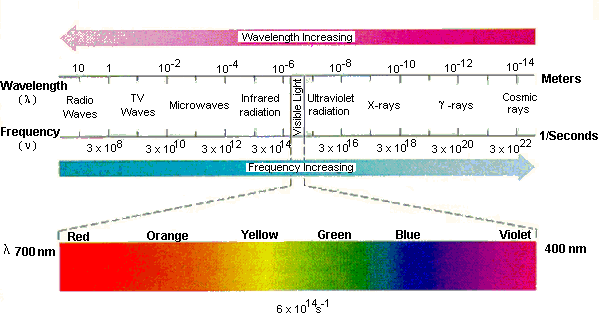
RedOrangeYellowGreenBlueIndigoViolet = ROYGBIV.
No sign of magenta:munch:.
I always thought I was good at the engineering part of photography, but never heard this phrase, nor understand what it is about...
Must be due to that great pond dividing us.
Yeah, we have a long and rich history to fall back on....
http://the-hazel-tree.com/2012/09/30/richard-of-york-gave-battle/
RedOrangeYellowGreenBlueIndigoViolet = ROYGBIV.
No sign of magenta.
Those are the colors of the spectrum. Cyan isn't there either. These are all imaginary.

PE
Those are the colors of the spectrum. Cyan isn't there either. These are all imaginary.
PE
Interestingly enough though, one could argue that cyan would be found in the middle between two adjacent "parent" colours - green and blue. Magenta's two "parents" - red and blue - are a ways apart.

Sirius Glass
Subscriber
RedOrangeYellowGreenBlueIndigoViolet = ROYGBIV.
No sign of magenta:munch:.
Therefore magenta is not a color.

Interestingly enough though, one could argue that cyan would be found in the middle between two adjacent "parent" colours - green and blue. Magenta's two "parents" - red and blue - are a ways apart.
This is because of the way the eye works and the way the color charts are drawn. They are represented by an upside down "U" with B and R at the opposite ends of the "legs". But Magenta connects the legs and is therefore a color.
PE

lxdude
Member
What about magenta?

Hoo-boy, here we go!
It's simple, really- P and E remove Q and G
48 bit colour provides for over 68 billion colours. I'll award a prize to the first person who can post the names for each of those colours here, not a link to them but the actual official scientific name of each of them here. No cheating.
Last edited by a moderator:
Hoo-boy, here we go!
It's simple, really- P and E remove Q and G
I'm glad that is over! I have several bottles of Magenta dyes here for a reasonable price. Of course the prices start at the square root of -1.
PE
Sirius Glass
Subscriber
Hoo-boy, here we go!
It's simple, really- P and E remove Q and G
You wrote the name of which name we do not speak!

- removed account8
- Deleted
You live in Canada though.
- removed account8
- Deleted
- Joined
- Jul 14, 2011
- Messages
- 15,023
- Format
- 8x10 Format
I got many a good laugh out of the way paint companies would try to attach a name to every color chip. I've always been under the impression that they subcontracted that work to people on death row, because only they had both the leisure and depravity to come up with
all those weird names. And of course, it was always fun to make up our own spoof color cards. I once made up one which was a set of dirty browns and muddy grays which was labeled, Los Angeles Sunrise. Guess that would apply to Houston too.
all those weird names. And of course, it was always fun to make up our own spoof color cards. I once made up one which was a set of dirty browns and muddy grays which was labeled, Los Angeles Sunrise. Guess that would apply to Houston too.
- Joined
- Jul 14, 2011
- Messages
- 15,023
- Format
- 8x10 Format
Ha Matt? Since this discussion was posted on a black and white thread, that confirms my hunch that everyone posting is colorblind. So maybe
now we should take about the nuances of color printing if given the vision of bees, instead of humans.
now we should take about the nuances of color printing if given the vision of bees, instead of humans.
And now for a musical interlude: https://www.youtube.com/watch?v=LPn0KFlbqX8
- Joined
- Jul 14, 2011
- Messages
- 15,023
- Format
- 8x10 Format
I just noted the various toxicity comments apparently posted over the weekend, when I never check the web. I have various artist friends with atrocious health problems from tooling lead and cadmium pigments with their bare fingers over the years. Liver failure, ruined nervous systems, just plain mean (I am that naturally, so don't confuse the source). Cadmium is damn near outlawed for anything in the EU. Here there was a huge paint factory down the road a few decades back, so the rules are to never disturb a concrete slab or the asphalt, not even with a little hole in the pavement, because it's smarter to leave all the lead and cadmium resting in peace that to even attempt to remove it. When this has been attempted it's cost to the tune of about 36 million dollars per acre. But I guess the dirt could be put in little tubes and sold in the art store at their usual 400% markup!
And now for a musical interlude: https://www.youtube.com/watch?v=LPn0KFlbqX8
Is she singing in Adobe RGB or sRGB gamut?
- removed account8
- Deleted
- Joined
- Jul 14, 2011
- Messages
- 15,023
- Format
- 8x10 Format
Expect cadmium to be banished everywhere. The Germans did develop a method of coating the cadmium particles with clear titanium so that they can't be physiologically absorbed. But they're not allowed to acquire the cadmium to begin with, so there goes that option. Like many other toxic things, people involved in the manufacture of it are potentially exposed to far more quantities than end users, so that is the point at which it must be either stiffly regulated or outright banned. Ironic, cause the loophole for marketing small quantities for fine arts doesn't allow for the volume industrial path allowing safe pigment encapsulation to begin with.
- removed account8
- Deleted
Sirius Glass
Subscriber
I got many a good laugh out of the way paint companies would try to attach a name to every color chip. I've always been under the impression that they subcontracted that work to people on death row, because only they had both the leisure and depravity to come up with
all those weird names. And of course, it was always fun to make up our own spoof color cards. I once made up one which was a set of dirty browns and muddy grays which was labeled, Los Angeles Sunrise. Guess that would apply to Houston too.
What would the paint and nail polish companies do if there were no adjectives?

I have mentioned this before but it's still a good laugh. I was talking to the manager of a film developing plant. He told me that there were only two primary colors "puke" and "burple." Puke is yellowish green and burple is bluish purple. Poorly stored film causes prints to be one or the other.
- Joined
- Jul 14, 2011
- Messages
- 15,023
- Format
- 8x10 Format
Now we need to get serious about this conversation again. What color is Cyndi Lauper's hair, since it's her tune that was brought up? Some
people call it red, but I'd term it Matted Camelhump Oxide myself.
people call it red, but I'd term it Matted Camelhump Oxide myself.
| Photrio.com contains affiliate links to products. We may receive a commission for purchases made through these links. To read our full affiliate disclosure statement please click Here. |
PHOTRIO PARTNERS EQUALLY FUNDING OUR COMMUNITY:  |