
• Welcome to Photrio!
    Registration is fast and free. Join today to unlock search, see fewer ads, and access all forum features.
    Click here to sign up

Pricing alternative process prints for art fairs

Recent Classifieds

Forum statistics

Threads
202,818
Messages
2,845,917
Members
101,544
Latest member
Juergen Lossau
Recent bookmarks
0

cirwin2010

Member
Joined
Jan 3, 2021
Messages
275
Location
Massachussetts
Format
Analog
Getting right to the point, I'm planning to show my work for the first time at an art fair this June. I'm going to be presenting silver gelatin, cyanotypes, and kallitypes. I'm trying to determine a fair price for my work that is both attractive, but also not underselling the effort and time it takes to produce my prints.

Starting with Cyanotypes I'm printing on 8x12" and 11x14" sizes with the image area taking up most of the paper if the aspect ratio of the picture allows for it (i.e. 14" length on 11x15" paper). I don't plan on editioning my cyanotypes giving me more freedom to do what I like with the images. Some prints are toned, some are not, some have versions of both. Choice is fun.

I'm just not sure what a fair price for a cyantoype would be. I plan to get these mounted and matted to standard picture frame sizes (16x20" and 11x14"). Depending on cost to get that done, I'm thinking somewhere between $45-65 for the smaller prints and $75-95 for the larger prints. There is alway the option to not matt them to make them cheaper to purchase, but wanted some thoughts about the prices. Too high or too low?


Now for Kallitypes I have a better idea of what I think I want to do. I'm toning my kallitypes in platinum or palladium and they are about as technically well executed as they can get (in my opinion). I'm planning on having two sizes: 8x10" paper with an image area of about 5x7" and 11x15" paper with an image area of about 9x12" (aspect ratio may vary from image to image). These would also be matted and I would edition them this time given the time and effort it takes to make these. I'm thinking edition size of 20 for the smaller size and edition size of 10 for the larger size. For price I'm thinking $75 for the smaller size and $180 for the larger size. I'm thinking this may be a bit low, but it is an art fair, not a gallery.

Looking for thoughts on prices or anyone's experiences selling alt process prints. Not expecting to sell much, but anything that does is more money to fund making more images.

Thanks!
 
I've posted before about this I think, but I'd have to look it up.

Basically, there are a couple of ways to determine the price of something:
1 Cost + margin; you start with the marginal cost of the item, then determine a margin and combined that makes for your asking price.
2 Value-based; figure out what something is worth to someone and determine price on that basis.
3 Market-based; regardless of cost or value, base the price on the going rate of these items.

If you think about it, none of these really apply to art:
1: what's the marginal cost of an artist making something unique? Is it the cost of the paper and ink/metals etc? Do you include education, time spent experimenting? What's the cost of inspiration? So that one doesn't work.
2: Art has no value or infinite value, depending on how you look at it. So that don't work.
3: The going rate of prints is anywhere from zero to a couple if million $. So that's not much help either.

The problem is that if you try to look for a logic in this, there isn't a clear one that works. Something close to #3 is what you see most of the time in the art market; valuation is a function of factors like reputation of the artist, consistency in their body of work, desirability from a collection viewpoint (including anticipated/possible development of value over time) and demand for the style of work/genre (which you've not mentioned). Since a reputation you basically don't have yet and all the rest is pretty uncertain, you're down to basically "whatever you manage to sell it for". Which probably is somewhere in the range you mention, which to me doesn't sound too outlandish.

Coincidentally, my stepmom is an artist (of virtually no fame/reputation) and she regularly sells portraits she does for people. Her price point when she started out is comparable to the lower end of your range and currently is around the upper end, depending on specifics (acrylics vs. oil, size etc.)

Long story short - I guess you're probably in the ballpark.

Good luck with the sale; I think most people in your position generally don't make a sale, especially not on the spot, but they may get some nice responses. I bet you're in this for the fun of it, so I'd emphasize that bit.
 
One of the better guides I've seen for pricing art was published by Contemporary Art Issue (CAI). You can find it here:


It includes a specific section for fine art photography.

Best of luck selling your work at the art fair.
 
Getting right to the point, I'm planning to show my work for the first time at an art fair this June. I'm going to be presenting silver gelatin, cyanotypes, and kallitypes. I'm trying to determine a fair price for my work that is both attractive, but also not underselling the effort and time it takes to produce my prints.

If you're going to offer it for sale, I'd start with whatever you feel it is worth.

It's art, not a ham and cheese sandwich.

POA works for some, other times outrageous prices attract outrageous buyers.

I honestly don't believe that there is a 'price guide'
 
No. No. No. No. Do you no value your time, your effort, your talent? You're doing a disservice to yourself and anyone trying to eke out a living as a photographer.

I'm assuming you think this is too low? Could you elaborate on why or what your expectation would be?

I'm not planning to make a living off it and I'm taking into consideration what prices I've seen of standard inkjet prints (which are usually lower) in similar settings along with the prices of prints I've bought before.

I don't disagree that the numbers I listed are low when considering all the upfront cost and time it took to be able to make such prints. But again I'm just some random person at a fair where I'm laid out next to folks selling knitting and other trinkets. I'd feel lucky if anything sells at all, let alone cover the $100 for entry + tent rental.

Not saying I'm unwilling to up what I listed, just trying to explain my thought process.
 
This always a hard nut to crack. One thing to consider is that you are spending an enormous amount of time producing these prints. These are one of a kind, not machine prints, so there is value there. Some people get it, others don't. If this is a summer art festival the people that come are usually looking to buy something, and they appreciate art. That is a plus. Better than hoping to sell something off of a coffee shop wall.

Perhaps, think about broadening your product offerings. Make some 10 pack greeting cards with you images for the bottom price point, then some open edition machine prints with matting at a slightly higher point and then your smaller "original" prints at the next level and finally large originals at a very high price point. This lets the customer know you value your work, time and experience. Allowing the customer buy what fits their budget and get some of your work they can't live without, but you aren't giving away your top tier work. The customers who want to spend on original works because it is scarce and has value will buy the larger more expensive works.

Considering that you could easily spend $400 usd framing an 11x14 at a retail frame shop I think your prices are a little south of what it should be. Add up your hard costs, paper, mounting, framing etc. then factor in the cost of the show space, gas, travel etc. lastly add what YOUR value is and I think you will find your final price should be higher. It's not easy striking a balance. Hopefully the investment of including lower tier products will allow you to price top tier much higher and you will end up with more total sales in the end.

Those are my thoughts, take them or leave them. Good luck with your endeavor and let us all know what you have learned. I hope you sell them all :smile:

D.
 
One of the better guides I've seen for pricing art was published by Contemporary Art Issue (CAI). You can find it here:


It includes a specific section for fine art photography.

Best of luck selling your work at the art fair.

Well and good, up until it comes time to make deductions from the sale of the work: gallery commission, curatorial fees, GST/VAT/Sales Tax etc for professional practitioners... all this must be taken from the final sale value and it can amount to quite a (disappointing) hit, but that's the reality. I doubt you'd be getting into this at a fair — the proverbial 'deep end'. but the costs of setting up the stall (gazebo, space, internal outfitting, etc., etc.) need to be considered too. If the budget is only limited, you could actually blow the lot just on setting things up and then going home with nothing to speak of (but hopefully that's not what will happen!).

Having one's very best works independently valued by a qualified art consultant is the first step to determining how much you can ask, considering also one's reputation, skill and experience. I have rarely seen kallityres or cyanotypes (a few carbon prints), a few more photograms (that's how PhD holders spend their idle tilme...). Many people wandering around the manicured marsupial lawns where art or general fair tents are erected would not understand what "silver gelatin", kellitype or cyanotype is... "Strewth love!" Have they walked into a Ladies' Science Circle to accidentally start debate on technology that seemingly has never existed or been heard of (but which you and I know has been around since Jesus wore shorts!).

I would not be putting expectations too high at fairs where ordinary mums and dads might wander around looking more for a bargain than a bank buster. We've done the fairs (or "weekend markets") here in Australia and the costs to set up (permits, trailer and gazebo hire, outfitting etc.) far outstrip a single sale of even decorated photographers' works!

For price I'm thinking $75 for the smaller size and $180 for the larger size. I'm thinking this may be a bit low, but it is an art fair, not a gallery.

Is this for mounted and matted, or fully-finished (framed, ready-to-hang)?
Those prices, as thumbnail estimates, are very unrealistic. But you cannot go too high either at the risk of alienating yourself. There is a middle ground in there that will honestly reflect the skills, knowledge and execution of the work.

Perhaps write out an "introduction" to the process of printing you have offered up so people have a basic understanding of what they are looking at — what they could well consider buying based on novelty alone. This intro could take the form of a small framed stand-up at the front of the table that details the background of your works.

As I said above, few people outside photography know what a kallitype or cyanotype is...among myriad others. An explanation that pulls people up to get them reading and interested (along with you stringing the conversation along) could well be the keys to opening their purses and wallets.
 
One of the better guides I've seen for pricing art was published by Contemporary Art Issue (CAI). You can find it here:


It includes a specific section for fine art photography.

Best of luck selling your work at the art fair.

I forgot about this site! A good resource to reference for sure.
 
I've posted before about this I think, but I'd have to look it up.

Basically, there are a couple of ways to determine the price of something:
1 Cost + margin; you start with the marginal cost of the item, then determine a margin and combined that makes for your asking price.
2 Value-based; figure out what something is worth to someone and determine price on that basis.
3 Market-based; regardless of cost or value, base the price on the going rate of these items.

If you think about it, none of these really apply to art:
1: what's the marginal cost of an artist making something unique? Is it the cost of the paper and ink/metals etc? Do you include education, time spent experimenting? What's the cost of inspiration? So that one doesn't work.
2: Art has no value or infinite value, depending on how you look at it. So that don't work.
3: The going rate of prints is anywhere from zero to a couple if million $. So that's not much help either.

The problem is that if you try to look for a logic in this, there isn't a clear one that works. Something close to #3 is what you see most of the time in the art market; valuation is a function of factors like reputation of the artist, consistency in their body of work, desirability from a collection viewpoint (including anticipated/possible development of value over time) and demand for the style of work/genre (which you've not mentioned). Since a reputation you basically don't have yet and all the rest is pretty uncertain, you're down to basically "whatever you manage to sell it for". Which probably is somewhere in the range you mention, which to me doesn't sound too outlandish.

Coincidentally, my stepmom is an artist (of virtually no fame/reputation) and she regularly sells portraits she does for people. Her price point when she started out is comparable to the lower end of your range and currently is around the upper end, depending on specifics (acrylics vs. oil, size etc.)

Long story short - I guess you're probably in the ballpark.

Good luck with the sale; I think most people in your position generally don't make a sale, especially not on the spot, but they may get some nice responses. I bet you're in this for the fun of it, so I'd emphasize that bit.

Thanks for your insight and experiences!
 
Well and good, up until it comes time to make deductions from the sale of the work: gallery commission, curatorial fees, GST/VAT/Sales Tax etc for professional practitioners... all this must be taken from the final sale value and it can amount to quite a (disappointing) hit, but that's the reality. I doubt you'd be getting into this at a fair — the proverbial 'deep end'. but the costs of setting up the stall (gazebo, space, internal outfitting, etc., etc.) need to be considered too. If the budget is only limited, you could actually blow the lot just on setting things up and then going home with nothing to speak of (but hopefully that's not what will happen!).

Having one's very best works independently valued by a qualified art consultant is the first step to determining how much you can ask, considering also one's reputation, skill and experience. I have rarely seen kallityres or cyanotypes (a few carbon prints), a few more photograms (that's how PhD holders spend their idle tilme...). Many people wandering around the manicured marsupial lawns where art or general fair tents are erected would not understand what "silver gelatin", kellitype or cyanotype is... "Strewth love!" Have they walked into a Ladies' Science Circle to accidentally start debate on technology that seemingly has never existed or been heard of (but which you and I know has been around since Jesus wore shorts!).

I would not be putting expectations too high at fairs where ordinary mums and dads might wander around looking more for a bargain than a bank buster. We've done the fairs (or "weekend markets") here in Australia and the costs to set up (permits, trailer and gazebo hire, outfitting etc.) far outstrip a single sale of even decorated photographers' works!


Is this for mounted and matted, or fully-finished (framed, ready-to-hang)?
Those prices, as thumbnail estimates, are very unrealistic. But you cannot go too high either at the risk of alienating yourself. There is a middle ground in there that will honestly reflect the skills, knowledge and execution of the work.

Perhaps write out an "introduction" to the process of printing you have offered up so people have a basic understanding of what they are looking at — what they could well consider buying based on novelty alone. This intro could take the form of a small framed stand-up at the front of the table that details the background of your works.

As I said above, few people outside photography know what a kallitype or cyanotype is...among myriad others. An explanation that pulls people up to get them reading and interested (along with you stringing the conversation along) could well be the keys to opening their purses and wallets.

Thanks for your input. I'm planning on just matting the prints. I do have one large print in a large frame I'm going to put on an easel as a sort of show piece though.

Regarding your comments on unrealistic prices, could you clarify if that is too high or too low?

As far as the costs for the fair, it was just $100 total for the space and table, chair, a tent rental. The real upfront cost is matting the print and the time to make them.

I do agree on having a card with a brief description of what the images are and how they are made. I am hoping the novelty will add some interest, but you are correct that most people won't know nor care. I have some ideas for propping up some prints on a table using some mini easels/stands. I won't have too many prints so I'm going to try to spruce things up with presentation.
 
This always a hard nut to crack. One thing to consider is that you are spending an enormous amount of time producing these prints. These are one of a kind, not machine prints, so there is value there. Some people get it, others don't. If this is a summer art festival the people that come are usually looking to buy something, and they appreciate art. That is a plus. Better than hoping to sell something off of a coffee shop wall.

Perhaps, think about broadening your product offerings. Make some 10 pack greeting cards with you images for the bottom price point, then some open edition machine prints with matting at a slightly higher point and then your smaller "original" prints at the next level and finally large originals at a very high price point. This lets the customer know you value your work, time and experience. Allowing the customer buy what fits their budget and get some of your work they can't live without, but you aren't giving away your top tier work. The customers who want to spend on original works because it is scarce and has value will buy the larger more expensive works.

Considering that you could easily spend $400 usd framing an 11x14 at a retail frame shop I think your prices are a little south of what it should be. Add up your hard costs, paper, mounting, framing etc. then factor in the cost of the show space, gas, travel etc. lastly add what YOUR value is and I think you will find your final price should be higher. It's not easy striking a balance. Hopefully the investment of including lower tier products will allow you to price top tier much higher and you will end up with more total sales in the end.

Those are my thoughts, take them or leave them. Good luck with your endeavor and let us all know what you have learned. I hope you sell them all :smile:

D.

Thanks for your input. Amongst your comments and others I will reassess the numbers. I'll give some thought to having some cheaper, easier to produce items, but given all I do I hand make stuff in the darkroom it will be a departure from my usual thing.
 
Thanks for your input. I'm planning on just matting the prints. I do have one large print in a large frame I'm going to put on an easel as a sort of show piece though.

Excellent!

I forgot about this site! A good resource to reference for sure.

The tricky part with that calculator is where you put your individual índex, but there are many helpful guiderails there that give reason to a realistic figure.
 
While it's great that you're trying to sell these prints, the location is likely not the best place to try to get the highest price for them. The typical craft-fair attendee is not aware of "alt" printing. I'm not sure you'd be able to get a higher price on that basis. People tend not to think about how a print is made - they buy prints (or don't buy them) because of the image itself. So, yes, the platinum-toned kalitype is more personal effort and cost than firing off a print of an AI-generated cat playing tennis to a desktop inkjet printer, but the fair-attendee doesn't know about any of that. And the cat playing tennis makes that guy laugh, so he'll pay the $12 for it and cringe at your price of $45.

Meanwhile, that guy will go to Walmart and buy some banal 24x36 printed canvas for $200 and put it over his couch.

In other words, you likely won't reach the right market. Not that I know how you could reach the right market.
 
Pricing your work based on your self-worth sets a professional standard that attracts people who respect your expertise whether or not they know anything about it. So I think it's wiser to charge premium prices, rather than undercharging in order to give a strong impression that you are standing by your worth and value as an artist for the sake of having people recognize that value in your creations. You want to be fair to yourself, not the average art fair browser. Based on your OP I would start with double what you proposed.
 
People may not be ready to shell out real money for your work at an art fair, but make sure to have business cards, postcards or flyers for interested buyers to take home so that when they decide to spend real money they know how to contact you. If you have a website to point them to on your handouts, even better.
 
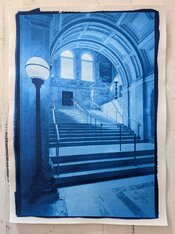
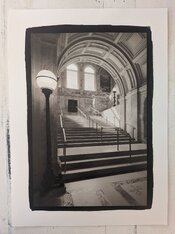
I don't know if this helps the conversation in any way, but here are some prints that at are at the standard of what I want to present. A cyanotype and platinum toned kallitype of the same image. This is of the Boston public library and the show is local to the Boston area.
 

Attachments

  • PXL_20260313_165947606.jpg
    PXL_20260313_165947606.jpg
    1.2 MB · Views: 0
  • PXL_20260318_142249633.jpg
    PXL_20260318_142249633.jpg
    838.6 KB · Views: 0
Photrio.com contains affiliate links to products. We may receive a commission for purchases made through these links.
To read our full affiliate disclosure statement please click Here.

PHOTRIO PARTNERS EQUALLY FUNDING OUR COMMUNITY:


Ilford ADOX Freestyle Photographic Stearman Press Weldon Color Lab Blue Moon Camera & Machine
Top Bottom