

• Welcome to Photrio!
    Registration is fast and free. Join today to unlock search, see fewer ads, and access all forum features.
    Click here to sign up

Precipitation pH / Distilled Water

Somewhere...

D
Somewhere...

  • 5
  • 2
  • 102
Iriana

H
Iriana

  • 7
  • 1
  • 164

Recent Classifieds

Forum statistics

Threads
202,750
Messages
2,845,060
Members
101,501
Latest member
David99
Recent bookmarks
0

kb3lms

Member
Allowing Ads
Joined
Jun 24, 2006
Messages
1,004
Location
Reading, PA
Format
35mm
Got a question about pH, DW and precipitation.

I have made two batches of a neutral emulsion that I like. The two batches have acted similarly enough to call them the same. Now, not too long ago I got myself a new Corning pH meter and probe that actually work. My first use was to check pH of the emulsion at coating time only to find out the pH is 4.3. Hardly neutral.

Checked the pH of the gallon of DW I have been using: 4.3. Guess I know where the acidity is coming from now. (The reason the pH of the DW is acidic is discussed ad-nauseum elsewhere on APUG and the web.)

It seems to me that if you want to make a neutral emulsion, the first step would be to neutralize the DW if necessary. A google search suggests sodium bicarbonate. Assuming neutralizing IS the right thing to do, is NaHCO3 the right thing to use or would NaOH be better?

I have also read that sulfur sensitization is more effective at higher pH. At an acid pH it seems to be just about ineffective. What do you use to adjust emulsion pH? NaOH seems to be good to raise pH (used as a 5% or 1% solution) but what about lowering if necessary? H2SO4 seems to be able to create fog - since it has sulfur in it I suppose. A little ascorbic will reduction sensitize (good) but easy to overdo, so not good for adjusting pH more than a little. I have acetic, citric and boric acid on hand.

I've also found out that by playing with pH too much at coating time it is very easy to create a ball of glop.
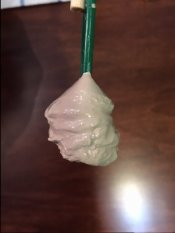
GLOP.JPG

I've done this twice. Twice is enough!

My goal here is to make batch number three later this week with the pH around 7.0 (give or take as necessary). At this point I'm starting to research where to go next.

-- Jason
 
Last edited by a moderator:
Checked the pH of the gallon of DW I have been using: 4.3. Guess I know where the acidity is coming from now. (The reason the pH of the DW is acidic is discussed ad-nauseum elsewhere on APUG and the web.)

Checking the pH of DW is a pointless exercise since it has no buffer capacity. So you will need to look elsewhere for your problem.

You are right about the ad nauseam aspect of these threads as much has been posted and practically all of it is wrong. For some reason people find buffer capacity a completely alien concept.
 
Last edited by a moderator:
Checking the pH of DW is a pointless exercise since it has no buffer capacity. So you will need to look elsewhere for your problem.

Could be. I know I need to learn more about this. But the pH is still the pH. How best to adjust it?
 
You would need to add a buffer to the distilled water which defeats the purpose of the distilled water.

OR your pH meter is wrong.
 
You would need to add a buffer to the distilled water which defeats the purpose of the distilled water.

Well, that was my thought, too.

OR your pH meter is wrong.

I don't think, so. I had just calibrated per the instructions.
 
The pH of DW is a fleeting thing. As soon as gelatin or anything else is added, it overwhelms the DW. So ignore the pH of DW. It should be about 5 anyhow so being that low indicates something wrong with the DW IMHO.

The emulsion should NOT coagulate like that unless you are using PA gelatin.

PE
 
OK, so the DW is a red herring, then. Will make sure to use a freshly opened gallon next time.

Is there value in checking and adjusting the pH of the salted gelatin solution? Or wait till after washing and adjust prior to chemical sensitization?

AFAIK pH ought to be in the range 6.2 to 7.2 for coating?
 
The @#$%&* editor is not working again. Refuses to Save or Delete!
 
Last edited by a moderator:
Jason,

Glad to see you're back at emulsion making! Now, could I convince you to start with a good recipe and hold the mad scientist stuff for later:smile:.

You have picked up the wrong idea about what a "neutral" emulsion is. Easy to do. The old guys had a lot of idiosyncratic jargon (i.e. the more things change, the more they stay the same!)

Neutral simply means not ammoniacal. Most photo gelatins have a pH of close to 4.7. Neutral bromide emulsions depend on excess bromide (an alkali) to run the emulsion. Without ammonia, the emulsion is usually ripened at a higher temp without the risk of fog. Because of that they are "cleaner" (little-to-no base fog) and punchier than ammoniacal emulsions. Also slower. There are a lot of great emulsion recipes around, all with different characteristics. No reason to reinvent the wheel just to get started. Innovations can come when you have a few basics facts and skills mastered.

I think you will have a lot of fun (the successful kind!) if you start simple and maybe do some studying (although studying isn't absolutely necessary if you find a good recipe you like and follow it to the letter.)
 
I've been back at it for a few months, just been quiet. This neutral bromoiodide formula I have been working with for two batches is really nice, but as you say, lacks speed. Batch 2 is a smidgen faster than batch 1 but still at ISO 25. It's great outside on a sunny day! I've shot up 7 or 8 rolls of it plus dozens of single frames. So been having fun with it and learning the ins and outs. As you suggest, there is no base fog to speak of and it is very fine grained. I will share some shots when I have a chance to print and scan a few.

As far as sensitization, I am still back where I was a few months ago when I wrote about washing and fog. Batch 2 got treated to what I thought was just the right amount of sulfur. (Batch 1 had no sulfur added.) Not much happened speed-wise so for the next run I am trying to figure out why that might be and I think from my reading/studying it has to do with pH. Therefore, for Batch 3, putting a few pieces of data together, it looks like the next move is to get the digestion pH closer to 7. One reason for this line of thought is that if the emulsion was ISO washed (I am not, however), the coagulated emulsion would be redispersed in new solution by adding NaOH to raise pH to the 7 range. Another is that one of my many books (Zelikman? - I forget at the moment) discussed speed gained vs pH during sensitization and that a higher pH was more effective. Of course this has to be balanced with the inevitable gain in fog as well.

That's the direction that looks promising at this point anyway. It's a work in progress.
 
Ah. I should have trusted your tinkering was informed and directed.

ISO 25. Wow! Actually, that's fantastic (by my metric :smile:.) I was out yesterday with my favorite "speedy" emulsion and got 25. By summer it will rise to 100, but that's beside the point. Speed is all about UV. If you started a few months ago, you've been working at the lowest UV levels of an annual cycle. I am really impressed. And, truthfully, I'd be satisfied enough to spend serious time behind a camera, for a while at least. Brooks Jensen of LensWork talks about the "seduction of potential". I find that a very wise and useful concept. If we are interested in making photographs, we should be very selective about what distracts us from doing that. Besides the latest greatest equipment, nothing in the "alt" game is more seductive than thinking we'll make photos when we've "perfected" our process. Worse that that, we often allow perfection to be defined by someone else. Fatal. But I'm being a philosophical nuisance, aren't I. OK, quitting that.

I've never tried gold sensitization with a plain silver (aka 'neutral') emulsion. Horses for courses, as the saying goes, and I also make ammoniacal emulsions, so those are what I sensitize. I have been remiss, though. I will experiment along those lines, with adding Steigmann's to the thoroughly washed noodles of a ammonium bromide plain silver emulsion. I've got about twenty darkroom TODO items ahead of that, so it will be a bit in the future, but I promise to report the results -- good, bad, or indifferent.
 
A few notes on this:

1. An emulsion as precipitated is acidic but turns neutral: AgNO3 + NaBr -> AgBr + NaNO3 is essentially going from acid to neutral pH as the Silver Nitrate is acid, but the Sodium Nitrate is neutral. Since the Silver Nitrate is fugitive in the kettle the pH is essentially that of the gelatin which is a moderate buffer under some conditions.

2. An emulsion as washed is generally neutral as all of the salts are being washed out.

3. Ammonia, if added, must be removed before sensitiziation and coating as it will cause fog.

4. Citric Acid is often added and sometimes left in the emulsion to gain a low pH for specific reasons.

5. A typical emulsion with AgBr/I is quite sensitive in the blue and UV regions, but modern coated lenses do filter out a LOT of the UV. So, the blue sensitivity depends on the Iodide to some extent. Sulfur will double the speed if done right, maybe triple it, with an increase in contrast and a slight chance of fog. Adding gold with sulfur will double that speed again if done right, but with lower contrast, softer toe, and a much greater chance of fog.

PE
 
Coming back to the original question: If the low pH of the “distilled” water is caused by carbonic acid, then the water can simply be degassed.
Without special equipment degassing can be done by boiling. (In a lab degassing is normally done by stirring in a vacuum, by bubbling with argon or helium or with some special ultrasound system.)

Chris
 
Photrio.com contains affiliate links to products. We may receive a commission for purchases made through these links.
To read our full affiliate disclosure statement please click Here.

PHOTRIO PARTNERS EQUALLY FUNDING OUR COMMUNITY:


Ilford ADOX Freestyle Photographic Stearman Press Weldon Color Lab Blue Moon Camera & Machine
Top Bottom
