• Welcome to Photrio!
    Registration is fast and free. Join today to unlock search, see fewer ads, and access all forum features.
    Click here to sign up

Pre-Flashing Tri-X 400 and the Push

Recent Classifieds

Forum statistics

Threads
201,881
Messages
2,831,713
Members
101,002
Latest member
Jim R
Recent bookmarks
0

Lamar

Member
Allowing Ads
Joined
Dec 22, 2008
Messages
375
Location
Georgia, USA
Format
35mm
I giving pre-flashing a shot tonight for the first time. I have a roll of Tri-X I've pre-flashed at -6 and -5 stops with another 12 frames untouched as a reference. I've read where a hard push is needed to get the contrast up. My intent is to do a 120 minute semi-stand with 1:100 Rodinal. I've had really good lower grain results with that method with no pre-flash. Anyone think I should do something different? I'll be shooting EI3200.
 
Last edited by a moderator:

cliveh

Subscriber
Allowing Ads
Joined
Oct 9, 2010
Messages
7,802
Format
35mm RF
Yes, not pre-flash and expose/develop the film for the contrast you wish to obtain.
 

Simonh82

Member
Allowing Ads
Joined
Aug 9, 2011
Messages
251
Location
London, Unit
Format
Multi Format
Using Rodinal stand development isn't good if you want to bump up the contrast after a preflash. Stand development is extremely compensating meaning you should get whatever shadow detail is there but retain the highlights due to localised developer exhaustion. This is good if you are shooting very contrasty low light scenes but if you want more contrast due to the preflash it may work against you. You will also get huge grain, although I assume this isn't a big concern to you if you've used this combination before.

Whatever you do, please post the results. I've seen very few actual examples of preflashing film.
 
Joined
Sep 10, 2002
Messages
3,676
Location
Eugene, Oregon
Format
4x5 Format
Pre-flashing film affects the shadow densities most, reducing contrast and separation in the lowest values by moving the base exposure up a bit. Although an overall exposure is given the film, it is miniscule and able to be disregarded in the higher values. Stand developing or any type of compensating development develops the shadow areas to completion and "compensates" for too much scene contrast by "underdeveloping" the higher values in relation to "normal" development.

This is exactly the opposite of what is usually desired in a "push" situation, in which film is intentionally underexposed and then overdeveloped to increase density (and contrast) in the very-low-on-the-exposure-scale-recorded high values.

Compensating development after pre-flashing may get you a really flat, useless neg...

Just thinking out loud here.

BTW, preflashing was a useful tool for me when shooting Kodachrome (and still is, I assume, for those shooting color reversal materials).

Best,

Doremus

 
OP
OP

Lamar

Member
Allowing Ads
Joined
Dec 22, 2008
Messages
375
Location
Georgia, USA
Format
35mm
My curiosity got the best of me and made me do the semi-stand development. If I hadn't done it with this roll I would have done it with another one down the line just to find out how it would look..... The film is drying now. Negatives looked good out of the tank, if you can really tell anything by eyeballing a wet 135 negative exposed at EI3200.... :smile:
 
OP
OP

Lamar

Member
Allowing Ads
Joined
Dec 22, 2008
Messages
375
Location
Georgia, USA
Format
35mm
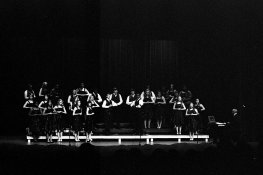
Somehow after double checking I got the frames misaligned after the pre-flash. It did have a positive effect though. I have one frame that has the -6 stop pre-flash on the left, the -5 pre-flash on the right and no pre-flash in the frame line down the center. Can't beat that to make sure there are as few exposure variables as possible..... One frame does a pretty good job of telling the story. Not sure if this is something I will routinely do but it's good to know I have something else in my bag of tricks. I'll have to try a regular push another time but with the contrast of the stage lighting here the semi-stand seemed to work ok. The "one shot tells all" frame is attached. I used VueScan with grain reduction set to "light" to scan, DxO Optics Pro to adjust contrast, and Capture NX2 to crop, sharpen and resize. Details - 1/250th, F/2.8, Meter on my FM was showing about a half stop underxposed at ISO 3200. Yes, for this shot I could have exposed at a slower shutter speed but that takes all the fun out of pushing the limits. I'll post a couple of more later.

20141211-01 Tri-X 400 PreFlash Test L-6_r-5_13_dxo9.jpg
 

Rudeofus

Member
Joined
Aug 13, 2009
Messages
5,119
Location
EU
Format
Medium Format
I see a distinct improvement in the right half over the left half, the dark curtain seems to hold more detail. For some reason I see no other image transition in that frame, where exactly is the region with no preflash?
 
OP
OP

Lamar

Member
Allowing Ads
Joined
Dec 22, 2008
Messages
375
Location
Georgia, USA
Format
35mm
Front row from left to right, the 5th girl is standing on the left edge of the frame line. Seeing it probably depends a lot on how you have you monitor brightness and contrast configured. It's a very subtle difference between no pre-flash and -6 stops. I didn't even notice the frame offset problem until I got to the -5 stop pre-flash frames. After seeing this I'm thinking of trying -4 stops pre-flash next time to get the grain lower in the dark areas. I don't think it will improve the shadow detail much but it should make for less harsh shadow grain, if I can get my frame re-alignment figured out.... :smile:

........... For some reason I see no other image transition in that frame, where exactly is the region with no preflash?
 

Rudeofus

Member
Joined
Aug 13, 2009
Messages
5,119
Location
EU
Format
Medium Format
Lamar, I did see that transition right to that girl, but that's the only transition I could see. You did mention, though, that there are three distinct areas in this frame, with -infinity, -6 and -5 stops preflash.
 
OP
OP

Lamar

Member
Allowing Ads
Joined
Dec 22, 2008
Messages
375
Location
Georgia, USA
Format
35mm
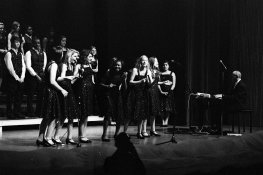
Here's one of the -5 stop pre-flash shots. I didn't do any post scan tone adjustments on it so it may be easier to see the darker area between the frames. Look along the batting at the edge of front of the stage to the left of the guy's silhouette. Should be in the same place on the earlier scan. Light grain reduction scan then cropped and re-sized with a bit of sharpening in Capture NX2.

20141211-01 Tri-X 400 PreFlash Test FM 20.jpg
 
Last edited by a moderator:

pentaxuser

Member
Joined
May 9, 2005
Messages
20,344
Location
Daventry, No
Format
35mm
I am sure you can see the difference and the benefits of the pre-flash and where the frames end and begin but it escapes me.

It is a bit like the joke about the proud budgerigar owner. The budgie is twittering away and the owner says to his neighbour: "Did you hear that? It was the Mark Anthony speech from Shakespeare's "Julius Caesar" but all the neighbour hears is a budgie twittering.:D
Not trying to make fun of what you see but while you know it is there, it is not at all clear to me, sorry

pentaxuser.
 

Rudeofus

Member
Joined
Aug 13, 2009
Messages
5,119
Location
EU
Format
Medium Format
I am sure you can see the difference and the benefits of the pre-flash and where the frames end and begin but it escapes me.

Maybe you expect too much. I have seen many claims of magical procedures which add many stops in film sensitivity and allow shooting Tri-X or HP-5 at EI3200 without loss of shadow detail. Fact is you should be able to extract about one stop of speed with whatever magic procedure you throw at this problem (preflash, gamma infinity development, modern high speed developers), but that's about it. This is not a sign that developers are too simple, quite to the contrary: modern film is that smart, all the tricks that may have worked a century ago are now part of the emulsion - and more.

Please note, that stating EI3200 means just about nothing by itself: whether you metered the black curtain in the rear or a lit face of a performer in the front makes more difference than all the magical speed enhancing procedures combined. That still doesn't mean we should try out these tricks if they give us an extra nudge of film speed.
 
Joined
Sep 10, 2002
Messages
3,676
Location
Eugene, Oregon
Format
4x5 Format
Lamar,

I think your pre-flashing experiment tells a lot. First, you learned that there is little difference between no pre-flash and your -6-stop pre-flash. Now you know just about exactly where the film's threshold exposure is. Second, you can definitely see the elevation in base density and the resulting loss of deep blacks, but also the increase in shadow detail in the deep shadows. It's always a trade-off between the two.

You now have a better knowledge of what pre-flashing will do and can decide when and if you want to use this new tool depending on the situation.

Best,

Doremus
 

pentaxuser

Member
Joined
May 9, 2005
Messages
20,344
Location
Daventry, No
Format
35mm
Yes just to be clear about what I meant. I wasn't saying that I couldn't see the point of Lamar's experiment nor that there was no difference. It was simply that on my VDU I couldn't see the differences. It might well have been my VDU which is a pity.

pentaxuser
 
Photrio.com contains affiliate links to products. We may receive a commission for purchases made through these links.
To read our full affiliate disclosure statement please click Here.

PHOTRIO PARTNERS EQUALLY FUNDING OUR COMMUNITY:


Ilford ADOX Freestyle Photographic Stearman Press Weldon Color Lab Blue Moon Camera & Machine
Top Bottom