
• Welcome to Photrio!
    Registration is fast and free. Join today to unlock search, see fewer ads, and access all forum features.
    Click here to sign up

Power and current draw

half stop lighter er.jpg

A
half stop lighter er.jpg

  • jhw
  • Jan 12, 2026
  • 7
  • 7
  • 102
sentinels of the door

A
sentinels of the door

  • 4
  • 0
  • 84

Recent Classifieds

Forum statistics

Threads
201,716
Messages
2,828,996
Members
100,908
Latest member
KiyoKiyo
Recent bookmarks
0

CMoore

Member
Joined
Aug 23, 2015
Messages
6,289
Location
USA CA
Format
35mm
I am going to be moving and need to consider (several things about) my new darkroom.
My manual for the Beseler 45 MXT says it draws 5 Amps for the lamp. That is a ton. Anybody know what kind of Load/Current that head draws when the lamp first turns on.?
The 45S just lists E and P.....82V at 250W.....i guess that is close to 3 Amps.?
I suppose i have the same question, but maybe the 45S has some better regulation at start.?
Anyway......anybody know what kind of current these two heads are likely to pull when they first kick on.?
Thank You
 

Rick A

Subscriber
Allowing Ads
Joined
Mar 31, 2009
Messages
10,030
Location
Laurel Highlands
Format
8x10 Format
Most modern circuits are 20 amp load rated, no worries about that 5 amp load. Even in my old house where some of my circuits are only 15 amp there would be zero concerns.
 

ic-racer

Member
Joined
Feb 25, 2007
Messages
16,719
Location
USA
Format
Multi Format
On a 15A circuit you can run your enlarger and also have twelve 100W lamps running.
If you are worried about inrush current damaging your power supply, I suspect the designers have incorporated a NTC thermistors or Metal Oxide Varistor for that purpose. Do you have the schematic of the power supply?
 
Last edited:

AgX

Member
Allowing Ads
Joined
Apr 5, 2007
Messages
29,972
Location
Germany
Format
Multi Format
Most modern circuits are 20 amp load rated, no worries about that 5 amp load. Even in my old house where some of my circuits are only 15 amp there would be zero concerns.

You missed the point.

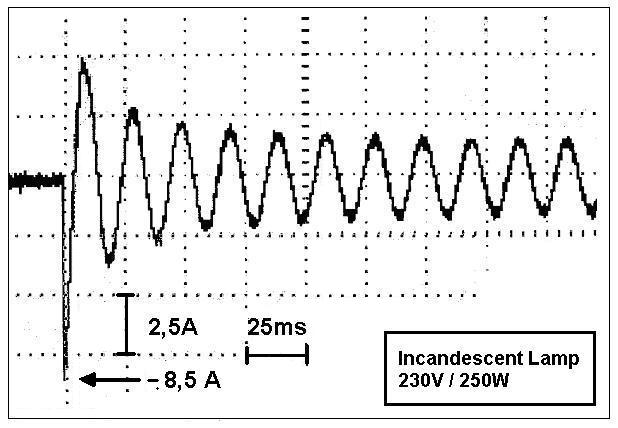
Most electrical devices have an inrush current.

Here is a schematic for an incandescant lamp:
Einsch_gluehl.jpg


However the typical circuit braker is slow and would not react on such peak. The typical issue I got in my installation is with the inrush current of some power grinder.
 

BMbikerider

Member
Allowing Ads
Joined
Jul 24, 2012
Messages
3,038
Location
UK
Format
35mm
If you can change to LED bulb do so. Cheaper to run and last a lifetime. In my living room I have 6 x 40watt equivalent LED bulbs, each of which which collectively only draw 18 watts instead of 240. Plus no perceived risk of overloading the system.
I believe US domestic voltages are only 110V AC. UK housing circuits run on 230/240v AC and for normal circuits are set at 15A with only cooking and any heating circuits set higher so I don't know if it makes a difference.

I am also working on fitting a LED bulb into my enlarger. A100w equivalent will consume about 15W and is the same size as a normal enlarger bulb. At present they will not work with electronic timers, but they will work with a clockwork one. The enlarger will run much cooler and I can finally dispense with the glass negative carrier.
 
Last edited:

David Brown

Member
Allowing Ads
Joined
Feb 16, 2004
Messages
4,060
Location
Earth
Format
Multi Format
I have both the 45S head and the standard condenser in my home darkroom on a 15 amp circuit. The same at the facility where I teach. These two enlargers have been around for decades and there have been thousands of them in service. Just plug it in and make prints. Don’t worry about it.
 

Jim Jones

Member
Allowing Ads
Joined
Jan 16, 2006
Messages
3,740
Location
Chillicothe MO
Format
Multi Format
Electrical wiring and circuit breakers should easily handle the starting surge of incandescent lamps, motors, and other appliances. Some of these surges are far greater than the one in AgX's graph above.
 

darkroommike

Subscriber
Allowing Ads
Joined
Mar 22, 2007
Messages
1,738
Location
Iowa
Format
Multi Format
If you can change to LED bulb do so. Cheaper to run and last a lifetime. In my living room I have 6 x 40watt equivalent LED bulbs, each of which which collectively only draw 18 watts instead of 240. Plus no perceived risk of overloading the system.
I believe US domestic voltages are only 110V AC. UK housing circuits run on 230/240v AC and for normal circuits are set at 15A with only cooking and any heating circuits set higher so I don't know if it makes a difference.

I am also working on fitting a LED bulb into my enlarger. A100w equivalent will consume about 15W and is the same size as a normal enlarger bulb. At present they will not work with electronic timers, but they will work with a clockwork one. The enlarger will run much cooler and I can finally dispense with the glass negative carrier.
The Beseler 45S is a dichroic color head, no LED exists for a substitute.
 

Chan Tran

Subscriber
Allowing Ads
Joined
May 10, 2006
Messages
7,147
Location
Sachse, TX
Format
35mm
Inrush current of an incandescent lamp is there but very short. I wouldn't worry about it at all. When the filament is at room temperature its resistance is quite small. When you apply the voltage to the lamp the inrush current is quite high but the filament gets hot very fast and the resistance raises and the current drops to normal. I think the inrush is about 2/10 of a second.
 

darkroommike

Subscriber
Allowing Ads
Joined
Mar 22, 2007
Messages
1,738
Location
Iowa
Format
Multi Format
Inrush current of an incandescent lamp is there but very short. I wouldn't worry about it at all.
And incandescent lamps handle short over voltage very well, enlarger lamps and photoflood lamps are driven at over line voltage for their entire life.
 

voceumana

Member
Allowing Ads
Joined
Aug 4, 2004
Messages
896
Location
USA (Utah)
Format
Multi Format
Inrush on a tungsten incandescent bulb can be up to 10 times the steady-state current. But the inrush is short enough that it does not trip circuit breakers or fuses, and your electrical circuit should be rated for the steady-state current. Circuits handle the inrush from many types of electrical appliances with no particular problems.

House 120 VAC circuits are rated at either 15 or 20 Amps, so you'll be fine with either circuit rating.

Of greater concern is the contact rating on any timers that switch the enlarger on and off. Be sure they are rated for the lamp load--they probably are, but make sure. If they are not, the switching element in the timer may fail prematurely.
 
Photrio.com contains affiliate links to products. We may receive a commission for purchases made through these links.
To read our full affiliate disclosure statement please click Here.

PHOTRIO PARTNERS EQUALLY FUNDING OUR COMMUNITY:


Ilford ADOX Freestyle Photographic Stearman Press Weldon Color Lab Blue Moon Camera & Machine
Top Bottom