• Welcome to Photrio!
    Registration is fast and free. Join today to unlock search, see fewer ads, and access all forum features.
    Click here to sign up

Potassium Bromide question

Recent Classifieds

Forum statistics

Threads
202,886
Messages
2,847,057
Members
101,529
Latest member
Flo18
Recent bookmarks
0

What About Bob

Subscriber
Joined
Aug 23, 2019
Messages
725
Location
Northampton, MA.
Format
Analog
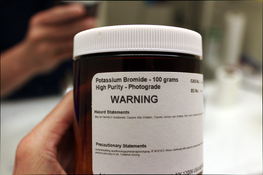
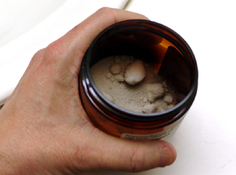
I was just wondering if slightly dark, slightly tanned, potassium bromide is still usable. I bought it a couple of months ago and it has been opened for use only twice. The container has been closed up good and put away in a dark place. Thanks.
 
Other than tending to clump on exposure to moist air, KBr is about as stable of a compound as one could hope for. Even the clumping isn't a huge issue other than making it a pain to handle.

I routinely use a a probably 40 year old bottle of it that's solid as a rock. I just chip out what I need and it works fine...
 
However, if it is starting to discolor that suggests it is decomposing - either from exposure to UV or oxygen, or even contaminants in the chemical. What brand and where did you buy it?
I am still working through a bottle of KBr I bought 5 years ago and it is as white as the day I bought it. I avoid suppliers that sell iffy chemistry that isn't the color it's supposed to be, or discolors quickly after opening.
 
I have been getting my chemistry from Artcraft. This is the only chemical that I noticed that has turned a little on the tan side.

When I first started mixing my own I ordered from B&H. I bought Metol and it was browned but it was still functional. After that I went to Artcraft.
 
Potassium bromide should be unaffected by any kind of light exposure. You can actually buy optical windows made from it, and they're intended for infrared, visible and UV use.

If it has gone brown, I can only think of two causes: either it's contaminated with something else, or it isn't potassium bromide.

It should be as stable as table salt. I have potassium bromide that's a few years old and is still as white as it was when new. As Ben described, it's lumpy, but that's the only change.
 
The browning is uniform. I will just order another 100 gram batch.
 

Attachments

  • Potassium bromide -1.jpg
    Potassium bromide -1.jpg
    244.5 KB · Views: 84
  • Potassium bromide -2.jpg
    Potassium bromide -2.jpg
    108.2 KB · Views: 88
I was given a 5 pound jar of Kodak KBr back in the 90's and I used some yesterday and it still looks good. Maybe a little clumpy, but no color change. I would just replace it if I were you.
 
When I first got the stuff it was brighter. Don't know how it could have turned. Container is stored in a dark, no light, and cool place with all of the other dry chemicals, tightly capped. I opened the container twice when making D-72, Dektol equivalent.

I will order a new batch of the stuff.
 
Potassium iodide can turn brown as a result of breakdown: iodine is brown. Maybe bromine will discolor the normally white compound. The turning brown is not like developing agents turning brown though.
 
If KBr is changing color it's contaminated. I would find a different supplier. Look on Ebay for an old bottle of Kodak, I have bottles from the 50's that are absolutely beautiful crystals. KBr will absorb moisture, and clump a bit, shouldn't turn dark.
 
KBr is chemically stable in air. You can wash it with isopropanol or other organic solvents to see if it removes the color. Or you can try to recrystallize it from water to get higher purity. Most likely you don’t need to do any of those, though.
 
The browning is uniform. I will just order another 100 gram batch.

That looks nothing like the KBr I've ever purchased. Mine looks like somewhat coarser, white crystals, very much like sugar. It also does not discolor in any way unless I accidentally contaminated with traces of developer.
Yours looks decidedly impure.
1738569753968.png
 
I've had potassium bromide supplied as larger solid crystals that I needed to crush to use. No trace of brown in that or in the stuff I have now that's like what Koraks shows. Maybe some metol got in the jar and oxidized? If your developer is working fine with it, it's likely ok. But you can always contact the manufacturer.
 
When I set up chemicals; one chemical container gets uncapped, contents spooned out, put in small plastic cup and measured on gram scale and then that container gets recapped and put off to the side then I continue on to the next chemical. When done I bring the chemicals back to my metal cabinet to put away. I try my best to be very careful to not cross contaminate. Plastic holding cups are labeled and used for only that particular chemical. Same deal with storage containers for wet chemicals.

According to the interwebs KBr can turn brown in the presence of chlorine gas. Displacement process of bromine. I don't have any chemicals that contains chlorine. No idea.

The D-72 worked fine those two times. Though the KBr wasn't as discolored as it is now.

 
According to the interwebs KBr can turn brown in the presence of chlorine gas. Displacement process of bromine. I don't have any chemicals that contains chlorine. No idea.

PVC releases small amounts of chlorine under normal conditions and bigger amounts when it's heated up. However, (1) the container that bromide is in doesn't look to be made of PVC and (2) the discoloration is too much to be explained from regular offgassing of a PVC container (even if one were used).
Contamination during manufacture is more likely. The brown discoloration need not be caused by discoloration of the KBr itself; it's just as likely (even more so) to be a contaminant that's present.
It's quite likely the performance of your KBr is indistinguishable from purer material in a real-world scenario.
 
When I set up chemicals; one chemical container gets uncapped, contents spooned out, put in small plastic cup and measured on gram scale and then that container gets recapped and put off to the side then I continue on to the next chemical. When done I bring the chemicals back to my metal cabinet to put away. I try my best to be very careful to not cross contaminate. Plastic holding cups are labeled and used for only that particular chemical. Same deal with storage containers for wet chemicals.

According to the interwebs KBr can turn brown in the presence of chlorine gas. Displacement process of bromine. I don't have any chemicals that contains chlorine. No idea.

The D-72 worked fine those two times. Though the KBr wasn't as discolored as it is now.

What about the utensil you use to spoon the chemicals out with? A different utensil for each chemical? Wash and dry the spoon between chemicals? This is an important detail as well.

What Koraks said is reasonable: though the KBr may have contaminants in it, as a developer component it will likely have no deleterious effects.
 
My KBR is in a brown glass bottle from the big , yellow Kodak company. The container gives you an idea of just how old it is. this KBR is large crystal form and in one solid clump, but it still works just fine and is not brown. I do see a few crystals that have a purple hue to them, but don't know what that's from.
 
When I used to work in an x-ray crystallography lab we sometimes used KBr as a test sample for teaching - it gives really nice clean diffraction peaks. After a few minutes exposure to copper radiation it turned a nice purple colour. The colour faded over an hour or two.

I do not recall seeing any KBr that was not white out of the bottle.
 
Potassium bromide should be unaffected by any kind of light exposure. You can actually buy optical windows made from it, and they're intended for infrared, visible and UV use.

You can go one step further than just "buying" windows from it.

It use to be standard technique for analyzing solids by IR that you'd grind up a small amount of the solid with KBR and then press it into a pellet. I was trained in doing this when I took organic chemistry and got a lot of practice early on doing some organic research, although it's now mostly a textbook reference technique as ATR(attenuated total reflectance) is much faster and easier with mostly the same results.

With that said, I don't do a ton of IR at my current job, but also can only do transmission IR. I have an ICL "mini press"(basically two heavy bolts and a die to hold them) and usually make 2-3 KBr pellets a year.

Done right, it's possible to quite literally started with powdered KBr and get a pellet that's clear as glass. They usually end up a little cloudy and still work fine-it's more just a point of pride to have one look that good.
 
As mentioned, your KBr most likely has a contaminant in it that is turning brown due to oxidation. Keep in mind that it's the contaminant, not the KBr that is being affected. The contaminant has been there since day one. You can likely keep using it and it will perform just as before, but mix up a smaller batch of D-72 first to check just in case.

I'd let Artcraft know that your KBr is turning brown. They likely don't wish to be providing contaminated chemicals. They may even replace it for you.

Best,

Doremus
 
Yes I use separate plastic spoons for each chemical then they are cleaned off before being returned to a sterlite drawer container. Periodical I dispose of the spoons and use new ones. Another reason why I like the store that I hang out at. Free utensils 🙂

I will let Artcraft know about this. Thanks everyone.

The science of KBr is interesting. Chemistry as a whole. I should really look more into it. Shouldn't get me into too much trouble. 😉
 
Photrio.com contains affiliate links to products. We may receive a commission for purchases made through these links.
To read our full affiliate disclosure statement please click Here.

PHOTRIO PARTNERS EQUALLY FUNDING OUR COMMUNITY:


Ilford ADOX Freestyle Photographic Stearman Press Weldon Color Lab Blue Moon Camera & Machine
Top Bottom