• Welcome to Photrio!
    Registration is fast and free. Join today to unlock search, see fewer ads, and access all forum features.
    Click here to sign up

Polarizing with View Camera

Recent Classifieds

Forum statistics

Threads
203,112
Messages
2,849,939
Members
101,671
Latest member
MiriTHEJake
Recent bookmarks
3

Darryl Roberts

Member
Allowing Ads
Joined
Jul 1, 2017
Messages
704
Location
Atlanta, GA
Format
Large Format
Hi,

Will it be more difficult to visualize the effect of a polarizing filter on a view camera than a smaller format?

Thank you
 
My 'fast' 8x10 lenses are f5.6 and my 'fast' 35mm lenses are 1.4. The image I see with my 35mm cameras when composing is much brighter. How about you, what do you see with your equipment?
 
My 'fast' 8x10 lenses are f5.6 and my 'fast' 35mm lenses are 1.4. The image I see with my 35mm cameras when composing is much brighter. How about you, what do you see with your equipment?

My view camera with a 5.6 lens yields a bright view. I'm wondering if a polarizing filter will be visible with rotating it.

Thank you.
 
You can see the effect by just looking through the filter and then the only thing you have to do us directing the camera the same way and to mount the filter at same rotational orientation. I do not see a difficulty in this, unless one establishes extreme movements where the angular position of the front standard is not really visible.

People using a plain finder or rangefinder camera have as only means to look through the filter directly.
 
Last edited:
You can see the effect by just looking through the filter and then the only thing you have to do us directing the camera the same way and to mount the filter at same angular orientation. I do see a difficultiy in this, unless one establishes extreme movement where the angular position of the front standard is not really obvious.

People using a plain finder or rangefinder camera have as only means to look through the filter directly.

Alright, thank you.
 
I think for finder cameras there was a special swinging filter holder that let one look through the filter in exact same orientation as if placed in front of the lens, by swinging the filter after control laterally exactly by 180°.
 
Alright, thank you.
I'll second AgX's advice. Exposure compensation will involve a little guess work that will be worked out with experience, if not already.
 
When using my fixed lens rangefinder I look through the filter, find the best orientation, then mark the two components of the polarizer with a grease pencil then use that mark to line up the lens on the camera. My view camera lens are all 5.6 and 6.3, I use figure out the amount of polarizing from the ground glass.
 
When using my fixed lens rangefinder I look through the filter, find the best orientation, then mark the two components of the polarizer with a grease pencil then use that mark to line up the lens on the camera. My view camera lens are all 5.6 and 6.3, I use figure out the amount of polarizing from the ground glass.

Wow, thank you.
 
If the groundglass is bright and even enough, you can usually figure it out by looking at the groundglass. With a wide lens, it helps to have a fresnel. Also be sure it’s dark under the darkcloth without too much light leakage, and let your eyes adjust, and you can see what’s happening even with the lens stopped down.
 
Most polarizer I think have a little white line ion them. You can look through them, adjust where you want it then note where the line is. So when you put it on the lens, just put the line back where it was.

Curious how others handle ND, polarizers and grads with LF. Do you set up the picture and focus and set the tilts first?Then add the filters?
 
If the groundglass is bright and even enough, you can usually figure it out by looking at the groundglass. With a wide lens, it helps to have a fresnel. Also be sure it’s dark under the darkcloth without too much light leakage, and let your eyes adjust, and you can see what’s happening even with the lens stopped down.
 
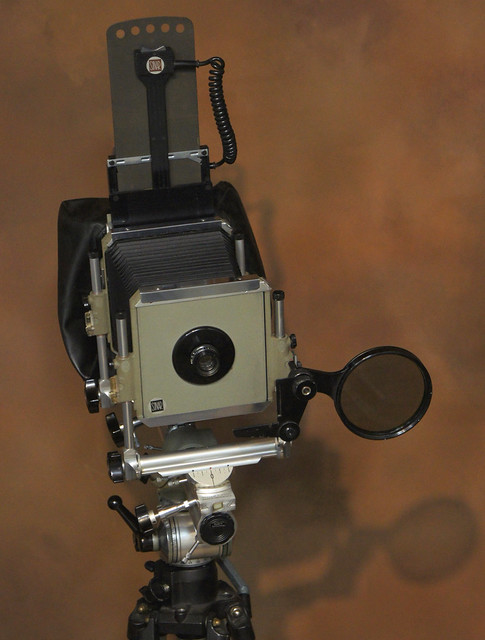
4x5 Norma Polarizer and Sinarsix by Nokton48, on Flickr

Darryl,
The Sinar Norma Polarizer rotates 180 degrees away from the lens, you can set the rotation directly. then swing it into the lens path. Also takes Norma front accessories. The Norma Sinarsix reads directly TTL accurately through the camera and eliminates spurious exposure errors. The Norma bag bellows and monocular allow good direct viewing.

You like modern embellishments but maybe this will give you ideas

The effect of the polarizer can be seen directly on the ground glass.
 
Last edited:
Hi,
Will it be more difficult to visualize the effect of a polarizing filter on a view camera than a smaller format?
Thank you

IMO it's more difficult to see it, it's always more difficult to see anything in the view camera GG than in a convenient viewfinder of a SLR :smile:

But but you can always adjust well the cross-polarization in the GG, just look at the glares in the scene from sunlight to rotate the filter. As always Pol do nothing if illumination is not polarized, in an overcast sky Pol acts mostly as a Neutral Density filter taking 30% of the light. Direct sunlight is Polarized by the Earth's magnetic field, but an overcast sky destroys the light polarization.

Personally, sometimes I did something to adjust the polarization degree (angle to the top cross polarizarion), as I use a DSLR to meter I find the angle and I use the same in the view camera. Anyway you simply can compare what happens in the SLR/DSLR view finder (as you rotate filter) to see how the same looks in the GG, to learn better the effect.


Seems linear polarizing is the way to go when needed.

With Velvia it darkens sky, preventing local overexposure. In general Velvia is saturated enough, but...

 
Last edited:
IMO it's more difficult to see it, it's always more difficult to see anything in the view camera GG than in a convenient viewfinder of a SLR :smile:

But but you can always adjust well the cross-polarization in the GG, just look at the glares in the scene from sunlight to rotate the filter. As always Pol do nothing if illumination is not polarized, in an overcast sky Pol acts mostly as a Neutral Density filter taking 30% of the light. Direct sunlight is Polarized by the Earth's magnetic field, but an overcast sky destroys the light polarization.

Personally, sometimes I did something to adjust the polarization degree (angle to the top cross polarizarion), as I use a DSLR to meter I find the angle and I use the same in the view camera. Anyway you simply can compare what happens in the SLR/DSLR view finder (as you rotate filter) to see how the same looks in the GG, to learn better the effect.


With Velvia it darkens sky, preventing local overexposure. In general Velvia is saturated enough, but...

Thank you
 
My view camera with a 5.6 lens yields a bright view. I'm wondering if a polarizing filter will be visible with rotating it.

Thank you.
If you can't see the effect on the ground glass, the light you are trying to eliminate may be scattered. The ground glass of a veiw camera, of course, allows for much more detailed analysis of a scene than, for example, a SLR viewfinder. Those are usually suitable for snapshot type images.
 
Photrio.com contains affiliate links to products. We may receive a commission for purchases made through these links.
To read our full affiliate disclosure statement please click Here.

PHOTRIO PARTNERS EQUALLY FUNDING OUR COMMUNITY:


Ilford ADOX Freestyle Photographic Stearman Press Weldon Color Lab Blue Moon Camera & Machine
Top Bottom