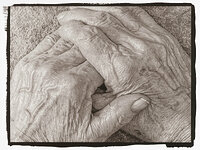
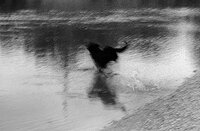


In the back of Clay Harmon's book, Polymer Photogravure, there is a section where different artists explain their methods. Both point (single bulb) and diffuse (tubes or LED) light sources are used to obvious great effect.
What I'm having trouble grasping is how a diffuse light source can give a 'sharp' image using either stochastic screens or DTP (direct to plate).
With a diffuse source, does light from anything but near vertical become shadowed by the adjacent texture on the screen?
What I'm having trouble grasping is how a diffuse light source can give a 'sharp' image using either stochastic screens or DTP (direct to plate).
With a diffuse source, does light from anything but near vertical become shadowed by the adjacent texture on the screen?


 It's a beautiful process, though, in all seriousness. What appealed to me was the freedom of choice in terms of hue and the possibilities for layering prints. I'm doing all this now with carbon transfer, which appears to suit me better. I guess I'm more of a photochemical guy than a photomechanical one!