• Welcome to Photrio!
    Registration is fast and free. Join today to unlock search, see fewer ads, and access all forum features.
    Click here to sign up

Platinum Printing at home

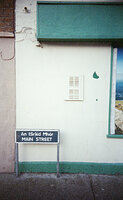
An tSráid Mhór

A
An tSráid Mhór

  • 1
  • 0
  • 39
IMG_1285.jpeg

D
IMG_1285.jpeg

  • 0
  • 0
  • 37

Forum statistics

Threads
203,125
Messages
2,850,222
Members
101,690
Latest member
nisherii
Recent bookmarks
0

pstake

Subscriber
Allowing Ads
Joined
May 5, 2005
Messages
730
Location
Lincoln, Neb.
Format
Multi Format
My experience with alt processes is limited to lith prints and once watching a guy do daggueros ...

My question is:

Is platinum printing feasible in a home darkroom?
 
Platinum printing doesn't really require a "dark" room. The emulsion is applied in subdued light and is UV sensitive. You don't expose under an enlarger, you contact print under a UV lamp.
 
Yup. No special tools required, except for a UV light source and plenty of money!
 
Oooh. Well, nevermind. I don't shoot large format so contact prints are not a very good option. I just like the tones I see in platinum prints, thought it might be fun to experiment with.

Thanks for the info!
 
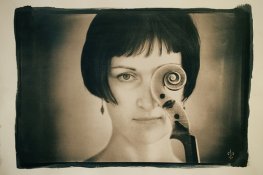
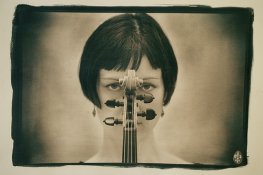
I would recommend playing with bleached/toned cyanotype as a less expensive precursor to PT/PD. It is a somewhat similar procedure and can yield quite surprising results with practice.
 

Attachments

  • 4074289326_27c5293f7c.jpg
    4074289326_27c5293f7c.jpg
    83.3 KB · Views: 248
  • 4073531901_43c6ce2321.jpg
    4073531901_43c6ce2321.jpg
    89.2 KB · Views: 219
  • 4041021793_cf07557b9c.jpg
    4041021793_cf07557b9c.jpg
    68 KB · Views: 229
Last edited by a moderator:
It's certainly feasible, but you'd do well to experiment first with the other things like cyanotypes and toned cyanotypes for cheap hands on fun and learning. Same tools and paper, different chemistry. There are many images that make a terrible silver print and an awesome alt process print. Tones, midtones, colors, can make it or break it sometimes and it's good to have the creative output options.

Many people make big negatives with a scanner and inkjet printer which they use to make alt process contact prints.
 
I echo the cyanotype suggestion. I started my alt explorations with digital negatives and cyanotypes. Now I own multiple LF cameras, and have fooled around with gum, platinum, and carbon as well.
It's a slippery slope, but a fun toboggan ride.
 
Cyanotype has a nice look to it, too. Might be worth exploring!
 
FYI: we're reconfiguring the Cyano formula at BS with better DMAX and blues, so hopefully we can get that out this summer. There's been arguments if people would be interested, but I think it's great fun. I highly recommend playing with cyanos, but be forewarned on two things:

First, cyanos are very contrasty, so your negs won't perform very well if they were developed for silver. PT/PD on the other hand, has a much more linear curve to it.

Second, it's addicting!

Both are easy to do in terms of mixing/coating/exposure, but getting it 'right' takes practice. Unfortunately, PD/PT prices aren't coming down.

There's also another process called the Athenatype that might be available soon as well, which uses silver instead, but has a very similar look to PT/PD at a huge cost savings. Hopefully I can get a write up on that as well (summer is difficult! Too much to do!)
 
Do be aware that when getting in to alt processes, each process has its own unique response curve, so what makes a good cyanotype negative makes a lousy platinum/palladium negative, and a good pt/pd neg is marginal for albumen/salt printing. This is one of the strengths of digital negatives - you can develop a curve for each process and then apply it to create a negative that fits each process. If you want more information about that, please spend some time on DPUG, our sister site. The upside is that it frees you from having to shoot large format to make platinum/palladium (or any other alt process) prints. The downside is that you still have that 35mm/medium format look to your images, which is somewhat at odds with the look you expect from a platinum/palladium print.

But yes, as a general rule, alt process prints are very straightforward to make at home without a special dedicated facility (but it always helps - I like to keep my chemistry away from food processing, clothing and bathing areas).
 
My experience with alt processes is limited to lith prints and once watching a guy do daggueros ...

My question is:

Is platinum printing feasible in a home darkroom?
Absolutely!
 
Don't have a large format camera? Try a pinhole camera using litho film! Fun with cyanotypes!

PS...avoid using a blow drier for pt prints, especially with kids in the house. Prolonged exposure to the pt salts kicked up by the hair drier can (depending on the individual) cause asthma. I air-dry mine now (after getting asthma from blow-drying pt prints for 5 years).
 
I would recommend playing with bleached/toned cyanotype as a less expensive precursor to PT/PD. It is a somewhat similar procedure and can yield quite surprising results with practice.

How do you get those great tones on your cyanotypes? I have tried using tannic acid and tea. I have let my prints dry and rest for a couple of days but all I get is a general stain to the paper and not the image. Too, I have tried everything that I have read on APUG. Any papers that are especially good with cyanotype toning? Or some to avoid?:confused:

Alan
 
You can use sodium carbonate to remove a portion or all of the blue, and the tea toning will replace what was blue. Cyanotypes should dry and rest before toning. I prefer arches platine for paper.
 
For pt/pd printing, space requirements are very minimal:
UV light source - mine is homemade fixture comprised of several BLB bulbs, and located on shelf under counter. Its connected to a Gralab.
Sensitizing/coating space - mine is just a cast-off thick sheet of glass placed on a counter.
Paper drying - I use the relatively light tight clamshell boxes from office supply, and place them on shelf above counter.
Bottles for chemicals - I have 7 one liter amber bottles for Dichro method and 3 plastic bottles for the clearing agents. Shelf above utility sink.
Space for use of 2 processing trays - one for developer and other for clearing baths.
Rinsing area - I use hose tray in utility sink for smaller prints and a larger hose tray on stand in garden area for larger prints.

As far as light, one of the nice features of alt processes is the minimal level of control of light needed for the processing area. Its not like whats needed for enlarging papers. My space is in garage, and the translucent panes in door are covered with dark-out cloth. A couple of 25W yellow bug bulbs make navigation in the space very easy.
 
Salt printing is also very cheap and a good way to get your feet wet with alt processes.
 
You can use sodium carbonate to remove a portion or all of the blue, and the tea toning will replace what was blue. Cyanotypes should dry and rest before toning. I prefer arches platine for paper.

Thanks. I have Arches Platine. I'll give it a try.

Alan
 
How do you get those great tones on your cyanotypes? I have tried using tannic acid and tea. I have let my prints dry and rest for a couple of days but all I get is a general stain to the paper and not the image. Too, I have tried everything that I have read on APUG. Any papers that are especially good with cyanotype toning? Or some to avoid?:confused:

Alan

Alan, I find my best results with Platine. I'm bleaching with sodium carbonate (commonly available here as washing soda) before toning. A little bleaching tends towards the split tone effect of the third pic, more bleaching tends towards the warm tones of the first two. You can also bleach with dilute ammonia, but it is hard on some papers and not that all that much fun as a darkroom chemical.
 
Alan, I find my best results with Platine. I'm bleaching with sodium carbonate (commonly available here as washing soda) before toning. A little bleaching tends towards the split tone effect of the third pic, more bleaching tends towards the warm tones of the first two. You can also bleach with dilute ammonia, but it is hard on some papers and not that all that much fun as a darkroom chemical.

Thanks for all of the advice.
 
Photrio.com contains affiliate links to products. We may receive a commission for purchases made through these links.
To read our full affiliate disclosure statement please click Here.

PHOTRIO PARTNERS EQUALLY FUNDING OUR COMMUNITY:



Ilford ADOX Freestyle Photographic Stearman Press Weldon Color Lab Blue Moon Camera & Machine
Top Bottom