
• Welcome to Photrio!
    Registration is fast and free. Join today to unlock search, see fewer ads, and access all forum features.
    Click here to sign up

Photographing the Homeless. What's Your Ethics On this?

Forum statistics

Threads
203,139
Messages
2,850,428
Members
101,692
Latest member
eviosl
Recent bookmarks
0

gone

Member
Allowing Ads
Joined
Jun 14, 2009
Messages
5,502
Location
gone
Format
Medium Format
I was talking to an attorney today about this subject (so take that into consideration), and he stated that when he retired he would be interested in taking some B&W photos of our city's homeless population. I told him that I thought it was not a good idea and told him why.

My thinking is quite simple....everyone is someone's son or daughter. No one would want to see their children, or their mom or dad, portrayed at such a point in their lives. I always make a conscious effort not to photograph people in a demeaning or compromising manner. Catch them at their best is my motto, not their worst. I told the guy that there was certainly a lot of character in some of the faces, and he said yes, that was what he was talking about. Somehow though he never made the connection about making a good shot and portraying someone in an unfavorable light.

Now I'm not talking about a situation where you ask someone if you could take their photo, and explain that once it was taken who knows where it might appear. There's no ethical issue there. But taking candid shots of people when they're down and then exhibiting them or posting them online seems way out of bounds. How do other photographers see this? I think we have a moral and ethical responsibility to our photos and the people portrayed in them after they're made. Once an image is made, control over it often gets away from us. I think it's better to err on the side of good taste and ethical behavior. Or, how would I like to be presented if my life came to this?
 
Last edited by a moderator:
I hope I'm not alone in thinking that lumping together homeless people as "the homeless" is itself morally problematic ?

Homeless people are not a homogeneous group; using a phrase like "the homeless" invites the idea that they are not people like the rest of us, and are therefore somehow fair game for any photographic pursuit - a bit like animals in a game park perhaps - as well as degrading any sense of empathy with their situation.

Photography of homeless and other people in difficult situations has a long and often honourable history, but the photographer who wants to do so does need to understand and question his or her motivations for doing so.

I commend the work of Don Springer in Philly - stark and empathic at the same time - as a good model for this sort of stuff.
 
Some time ago I tried to take photos of the homeless a lot of them didn't like it.

Jeff
 
You can either straight up ask their permission, or be candid and only shoot the conditions they live in. If you plan on getting the photos published you will need them to sign releases prior to shooting. If the latter, and you seek publishing, you will have to avoid showing their faces. I have seen shows of "homeless" , they were cooperative and had signed releases. I'm not sure, but they may have been compensated for cooperating.
 
Fraught with problems, not the least being the threat of an assault by one or more if they think you are 'spying' on them, or being robbed if you are seen with a nice expensive camera. Wear a good pair of running shoes!
 
there is no trouble in mymind photographing homeless people if you show them and treat them with dignity and respect
there are toomany people who walk around with a camera and photograph someone passed out on the corner
or under / on a pile of "stuff" as if to show these folks as a freak-show.
a lot of people withno place to go are there because of dire circumstances, perhaps showing them as people first
and homeless second might help ..
when i was in grad school 20+ years ago i lived in the north end of boston and had to go under the highway overpass
to get to haymarket and eventually walk to school. the tunnel was FILLED with homeless guys, mostly "sharing a smile" ( getting drunk )
by about 8am. they'd ask for money endlessly, but i was a broke student who just had FOOD, so i would give them food.
eventually i became kind of friendly with a few of them, but never made portraits, but i am sure if i did, i could have shown
then as people, not as vagrants / hobos / "bums" because thats what they were ... people.
 
To me, it's like taking a picture of a burning building with occupants, and not helping instead.
 
At this point in time, I'd say unless you have something utterly new to communicate, don't. It seems like virtually everyone at some point or another in their photographic journey (or at least one person in every Photo 101 class) has done a photo essay on the homeless, and virtually all of them are exploitative or at the very least fail to communicate anything meaningful about the people or their situation. If you want to make a difference through your camera, then spend some time volunteering at a shelter or a soup kitchen, get to know the people, then photograph them as whole people. Otherwise, you're not contributing anything - you're just creating jerk-off "artporn" of the worst kind. It's certainly not illegal to take whatever photos of the homeless you want - they're on the street, in public, with no expectation of legal privacy. But as they don't have any place to go to exercise moral privacy, taking advantage of their lack of legal privacy is to me extremely low.
 
All seriousness aside. Daughter once modeled and did some commercials. Union minimum of $125 a day then if hourly pay did not reach $125 then union minimum kicked in. You did not call the model and not pay minimum (New York). I am sure if you were 'paying' not 'taking' then the situation would be much different.
 
If it is done well I am all for it. Nothing should be done out of sensation rather if a message is shown it has to be done. The dying, the starving, the homeless needs to be shown otherwise we forget it on our comfy couches.
If one does it as an agenda to drive it home.
 
As TFC said: They do not have any legal expectation of privacy. It comes down to whether you will be guided by your morals rather than the law. I have no personal motivation to photograph "the homeless" as a theme or group, therefore I don't. That said, one sometimes meets interesting characters on one's travels, and one may be tempted in the circumstances of the moment to take that character's picture. That he/she might be homeless would be completely besides the point. I agree also with the general sentiment that one should shy away from exploitation and creating "artporn" as TFC puts it. Of all the wonderful things one can do with a camera, why would you want to use it to show vulnerable people as being weak, dependent and destitute if by doing so you do not change their prospects for the better? If you at least engage your subject, then much of the moral dilemma is dissolved. Even then, the theme sort of has been beaten to death and I hardly see the point. It is a far greater challenge to make a good portrait from any random person, to capture that person's essence without relying on all the damage the elements and hardships have done to the person's face and body.

As an aside: Many of the homeless in my country are either fugitives from law, or fugitives from creditors. They distinctly dislike having their photographs taken. So it is not a good idea to just snap away without someone's permission.
 
What's bad about taking a photo?
Ethics? Ethics about what exactly?
If it's an interesting homeless, snap away. If it's an uninteresting homeless, then don't bother wasting film.
Cute woman on the horizon? Snap away, my friend. What? A bland, fatty, generic woman on the corner? Don't bother wasting a valuable squate inch of that film that's inside your camera.

Hey look! A guy picking is nose? Snap a picture, it's so funny! What, you mean I shouldn't take his picture because he's a poor defenseless dude unable to defend himself properly with that finger halfway in his nose? I guess it's a good point.should I help him out then? Give him some change so he could buy a box of Tissue?
 
What's bad about taking a photo?
Ethics? Ethics about what exactly?
If it's an interesting homeless, snap away. If it's an uninteresting homeless, then don't bother wasting film.
Cute woman on the horizon? Snap away, my friend. What? A bland, fatty, generic woman on the corner? Don't bother wasting a valuable squate inch of that film that's inside your camera.

Hey look! A guy picking is nose? Snap a picture, it's so funny! What, you mean I shouldn't take his picture because he's a poor defenseless dude unable to defend himself properly with that finger halfway in his nose? I guess it's a good point.should I help him out then? Give him some change so he could buy a box of Tissue?

Ha ha. This was good.
 
How

How do you know these people are, in fact, homeless? I had a friend who lived in a poorer part of Hollywood and there was an old lady who used to sleep on his wide old-fashioned porch. He'd call the cops and they would say to her. "Now, Martha, you know you have a perfectly good apartment you can sleep in."
I do not take photographs of unfortunate-looking people just for a middle class-superiority thrill.
Would it be okay to take photos of homeless people in war-torn Syria? People who might be helped if the world knew of their plight?
 
From a legal point of view, if it's in public or seen easily from public access (in the U.S.) it is legal.
From an ethical point of view, treat them as you would someone who is not homeless.

Personally, I do not take pictures of people in "street photography," but I don't have anything against it. If I'm walking down the street, I cannot keep someone from taking a picture of me any more than I can prevent them from looking at me or saying "hi" - it's part of life.

Of course, different people have different "ethics" on photographing people in public (homeless or not), and this can open a debate. To me the important part is treating them all the same according to your ethics.

They are all people, so be consistent and treat them as such.
 
A friend of mine takes pictures of all sorts of people, among them homeless people. He portrays them in a very dignified way, and puts a lot of soul into the photographs. But he's also an extremely gifted people person, who manages to actually get close to these people and make friends first. Then he photographs them.
I think his work shows all of the people he photographs from a side that is perhaps unfamiliar to most, he sort of gives them a voice. That makes me think about the homeless, and how I can perhaps contribute more to making their lives better when time comes to make charitable donations, or if I have time to maybe donate my time.

If done right, I think photographing a homeless person can be beneficial to them. Indirectly, of course, because of raising the awareness, and putting a very human character to their existence. I don't see any problems with that.

What I could potentially have problems with is exploitation for the reason of benefiting from it personally. If that's the motivation behind the photographs, then I would find it distasteful and rude.
 
In general I think it is unethical and I can think of several pictures I did not take because I like to think I have some respect for fellow humans, but a lot depends on the reason behind the shot. If you are photographing homeless, starving or any disadvantaged member of society for you own artistic bent (art porn as someone mentioned), then I think it’s not on. If you are a photojournalist and your images may help to stop a war, bring food and shelter, then I think it is valid. So the context in the way the shot may be used and its multiple shades of morality therein are very important.
 
In general I think it is unethical and I can think of several pictures I did not take because I like to think I have some respect for fellow humans, but a lot depends on the reason behind the shot. If you are photographing homeless, starving or any disadvantaged member of society for you own artistic bent (art porn as someone mentioned), then I think it’s not on. If you are a photojournalist and your images may help to stop a war, bring food and shelter, then I think it is valid. So the context in the way the shot may be used and its multiple shades of morality therein are very important.
I agree with you entirely Clive, although I do do street photography I avoid shooting anyone who looks down on their luck because "their for the grace of God go I"
 
Here's my cents. What's ethical and what's legal are 2 separate things. Also, photo essays on homeless have been done before. What can you offer that is different and helpful as a photographer? As a photographer, are willing to go beyond what's on the surface? Gordon Parks photographed impoverished in the favelas of Rio. He lived with them for a while to gain their trust. How deep are you willing to go?
 
Here's my cents. What's ethical and what's legal are 2 separate things. Also, photo essays on homeless have been done before. What can you offer that is different and helpful as a photographer? As a photographer, are willing to go beyond what's on the surface? Gordon Parks photographed impoverished in the favelas of Rio. He lived with them for a while to gain their trust. How deep are you willing to go?

Exactly. To me it has to be about an honest end result, with a desired effect to accomplish something that is full of emotion, compassion, and somehow of benefit to all involved (ideallymostly of benefit to those that are homeless).
 
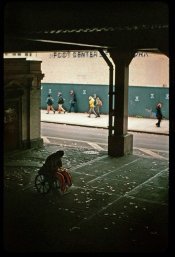
People walking in the distance, under a "foot center" sign.
And in the center, a footless and blind homeless. Ignored by all but me.

Ethics? Respect? What are you guys talking about?
 

Attachments

  • image.jpg
    image.jpg
    112.3 KB · Views: 324
NB23, this is a very respectful and ethical photo.
 
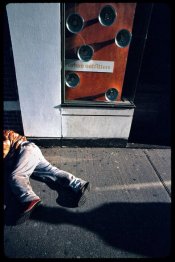
Thank you. But my point is simple: if it's worth shooting, shoot it, ethical or not.
 

Attachments

  • image.jpg
    image.jpg
    114.7 KB · Views: 289
Actually, I would qualify both of these as the aforementioned 'artporn' I spoke of, because they're in service of self-satisfaction instead of social change. This is not to say they are 'bad' images - they're strong images, and at least the one is a critique of the people passing behind the man in the wheelchair. But otherwise, how do either of these promote social change? They don't- they both reinforce the photographer's and by extension the viewer's sense of moral superiority either to the people ignoring the man in the wheelchair or to the man passed out on the sidewalk. They're artporn because they serve to gratify the photographer first before anything else. This is not to say that there is no place for self-satisfying imagery, but in the context of photographing people who lack the ability to give or withhold their consent, I'd say it is in fact unethical and inappropriate.
 
Photrio.com contains affiliate links to products. We may receive a commission for purchases made through these links.
To read our full affiliate disclosure statement please click Here.

PHOTRIO PARTNERS EQUALLY FUNDING OUR COMMUNITY:


Ilford ADOX Freestyle Photographic Stearman Press Weldon Color Lab Blue Moon Camera & Machine
Top Bottom