


• Welcome to Photrio!
    Registration is fast and free. Join today to unlock search, see fewer ads, and access all forum features.
    Click here to sign up

Photographic Printing Errors (Vintage)

Recent Classifieds

Forum statistics

Threads
203,065
Messages
2,849,362
Members
101,629
Latest member
Evgenymv
Recent bookmarks
0

AugustoJandolo

Member
Allowing Ads
Joined
Nov 16, 2024
Messages
6
Location
Roma
Format
Analog
Dear forum members,

I’m sharing two vintage photographs I’ve collected, both clearly misprinted. These small curiosities amuse me, and I’d love to hear any thoughts you might have.

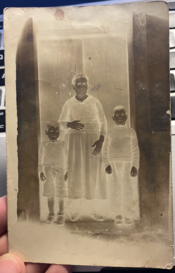
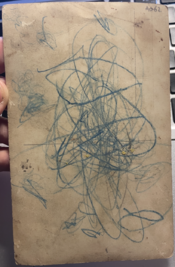
The first, dating to around the 1910s, depicts a grandmother (I presume) with her two grandchildren. It was printed in negative but wasn’t discarded—at most, it was kept within the family, and some scribbles were drawn on the back by children.

The second, dated between the 1940s and 1950s, shows an Italian family at the dinner table. There’s wine in a fiasco and in the typical Roman one-liter glass carafe, and the grandmother is wearing a veil. But how could the Kodak Enlarging Exposure Scale have ended up appearing in the print?

Just a curiosity... :smile:
 

Attachments

  • Schermata 2024-11-19 alle 19.42.56.png
    Schermata 2024-11-19 alle 19.42.56.png
    1.7 MB · Views: 141
  • Schermata 2024-11-19 alle 19.42.47.png
    Schermata 2024-11-19 alle 19.42.47.png
    1.9 MB · Views: 145
The second photo
 

Attachments

  • Schermata 2024-11-19 alle 19.51.53-min.jpg
    Schermata 2024-11-19 alle 19.51.53-min.jpg
    285.3 KB · Views: 121
[ ... ] But how could the Kodak Enlarging Exposure Scale have ended up appearing in the print?

Just a curiosity... :smile:
Normally one makes a one minute exposure through the exposure scale and then looks over the results. The numbers would then suggest seconds of exposure. One tends to conclude this was a test print. (Somebody raided dad's darkroom maybe!)
 
It was printed in negative but wasn’t discarded

Likely because it wasn't an accident. It may be an in-camera paper negative, and positive prints may have produced from it through contact printing. In any case, printing in negative is certainly not an accident.

#2 as @DWThomas points out is a test print to determine exposure.

I wouldn't qualify either as an error.
 
The second photo

That is a test print, made using one of these:
1732050824653.png

I usually use one of these when I'm working in someone else's darkroom, to help get used to the new environment. Sometimes, if I haven't been printing in my temporary setup home darkroom for an extended period of time, I'll start a session with one.
I usually discard the tests after use, unless I plan on toning prints afterwards, because they are handy for testing toning.
The items you shared are indeed the results of intermediate steps in the process of preparing final prints.
 
Fantastic! Everything is much clearer now, thank you so much.

@koraks Just one more thing escapes me, though, regarding negative printing: is contact printing possible with paper? I mean, I thought it was only possible from a negative on plate (or celluloid) onto paper, not paper onto paper.
 
is contact printing possible with paper? I mean, I thought it was only possible from a negative on plate (or celluloid) onto paper, not paper onto paper.
It can be done, perhaps not as satisfactorily. The contact printing is emulsion to emulsion, so the backing of the paper negative acts a diffuser. In bygone years some papers had brand names and such printed on the back which would show through, but fewer papers have that these days. Thicker papers may end up showing some patterns due to fiber density variations. Occasionally some folks here post pictures from paper negatives.
 
Thank you so much for the explanations; I didn’t know this specific detail, and I’ve learned something new :smile:
 
That paper negative has a word on the back, in the centre, under the scribbles, so it wouldn't be great for making a positive. It appears to be a postcard, actually. So, it's not an accident, but it also seems to be useless. I doubt it was made in-camera, since the paper would have been very slow, and those three seem to be relatively without motion (even though they appear to be standing in the sun).

I know of one successful photographer who uses the paper negative to give his prints a more pictorial rendering. He starts from a film negative, though.
 
I doubt it was made in-camera, since the paper would have been very slow, and those three seem to be relatively without motion

This concerned me, too.
It remains puzzling why they chose (as it wasn't an accident, evidently) to print a negative - apparently/maybe even as a final result.

It's conceivable someone did an experiment with a reversal process (optical, by photographing a print, or chemical) and that they chose to use a postcard paper for it. I think Ilford still make theirs (right?) and I suppose it was more common in the past.
 
Ilford no longer makes postcard paper - although they offer the same paper, the same size, without the writing on the back.
Postcard paper was extremely popular around 100 years ago. It would have been plentiful. So it's not unreasonable someone was messing around and used this piece to try something - maybe an attempt at getting a larger (or smaller) copy of a photo.
 
That paper negative has a word on the back, in the centre, under the scribbles, so it wouldn't be great for making a positive. It appears to be a postcard, actually. So, it's not an accident, but it also seems to be useless. I doubt it was made in-camera, since the paper would have been very slow, and those three seem to be relatively without motion (even though they appear to be standing in the sun).

I know of one successful photographer who uses the paper negative to give his prints a more pictorial rendering. He starts from a film negative, though.
On the back, "Ferrania" is written: an Italian photographic brand from the past: https://it.wikipedia.org/wiki/Ferrania_Technologies
 
Yes, that makes sense. FYI, Ferrania was revived some years ago; they're now again producing B&W film and are apparently on their way (if it ever materializes) towards making a color positive film. They don't make paper currently.
 
These lines appear to be address lines for a postcard:

1732149316558.png
 
Yes, it's definitely postcard paper. It's conceivable the print was used to make a diapositive by photographic it on a plate of the desired size.
 
Fantastic! Everything is much clearer now, thank you so much.

@koraks Just one more thing escapes me, though, regarding negative printing: is contact printing possible with paper? I mean, I thought it was only possible from a negative on plate (or celluloid) onto paper, not paper onto paper.

contact printing is indeed possible with paper. Take the paper negative and place it on the paper emulsion side to the emulsion side. Then, expose it through the paper at various times to test for the best exposure.
 
Photrio.com contains affiliate links to products. We may receive a commission for purchases made through these links.
To read our full affiliate disclosure statement please click Here.

PHOTRIO PARTNERS EQUALLY FUNDING OUR COMMUNITY:


Ilford ADOX Freestyle Photographic Stearman Press Weldon Color Lab Blue Moon Camera & Machine
Top Bottom
