• Welcome to Photrio!
    Registration is fast and free. Join today to unlock search, see fewer ads, and access all forum features.
    Click here to sign up

photographic print that looks like a drawing/ink painting

Recent Classifieds

Forum statistics

Threads
204,356
Messages
2,867,485
Members
102,232
Latest member
redhossu
Recent bookmarks
0

toguko

Member
Joined
Apr 29, 2014
Messages
10
Location
Taipei, Taiw
Format
Medium Format
I would like to create a photographic print that looks more like a drawing or ink painting rather than an old photograph. Does anyone have an idea how that could be achieved using traditional/alternative (non digital) processes?
 
Gum prints can have that quality, if the neg has the right look. You may have to make a high contrast neg that looks like line art to get it to look like a drawing.
 
Tone-line conversion, bas-relief. Chapter 19 in "Photographic Printing" by Ralph Hattersley.
 
Slightly off-set lith negative with lith positive?

When making a print from the NP sandwich make sure to move the light source around for best results. Typically this was done by using a phonograph turntable. The technique works quite well.
 
Sometimes just printing a bight on the light/pastel side.
 
Interesting.

For those of us not in the know, can someone direct us to examples of these processes? It's be neat to see what they look like, especially because I've never heard of it.
 
sometimes " high key" lighting will help

you might also think of making a large paper negative and cyanotypes that you can
add your own charcoal, paint .. ink to ..

have fun !
john
 
Bromoil.
 
it depends really what you are asking, what sort of ink drawing - there are so many sort of ink drawings - pen? brush?
if you could provide a link to an example of the sort of thing you're looking for it might help, otherwise all suggestions are rather in the dark.


a number of artists have looked at prints of mine similar to the attached and exclaimed "sumi-e!"

it is a salt print made using a similar process of (enlarged) intermediate positives and negatives on lith film, from a fragment of an ordinary 35mm negative, to that bsdunek mentions.
 

Attachments

  • 20151230-PC304236-1.jpg
    20151230-PC304236-1.jpg
    499.9 KB · Views: 211
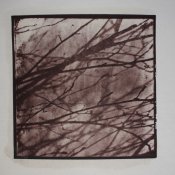
I don't know how he did it, but I love the "pencil drawing" look of this print (I have it on my wall): Kenna's trees.
 
Multi-expose grainy film in a pinhole camera (e.g. Delta P3200), one image in bright light, another in lower light, and print to fibre paper.
 
thank you very much for all the replies! Bromoil process looks truly fascinating and I think I'm gonna give it a try.

it depends really what you are asking, what sort of ink drawing - there are so many sort of ink drawings - pen? brush?
if you could provide a link to an example of the sort of thing you're looking for it might help, otherwise all suggestions are rather in the dark.


a number of artists have looked at prints of mine similar to the attached and exclaimed "sumi-e!"

it is a salt print made using a similar process of (enlarged) intermediate positives and negatives on lith film, from a fragment of an ordinary 35mm negative, to that bsdunek mentions.

You are right - I should have been more specific of what kind of results I am after. I guess I just wanted to see what are the options :smile:
I would like to get the look of a shan shui, which is a traditional Chinese ink painting.
Here are some examples of paintings that I have on my mind:
attachment.php

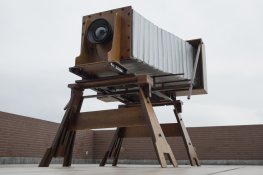
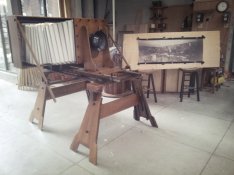
Together with a Swiss wood master, Martin Zaugg (Dogumentor on Apug), we built a huge 20"x60" camera with a custom made 1000m f14 lens (wide angle for this format) which looks like this:
attachment.php

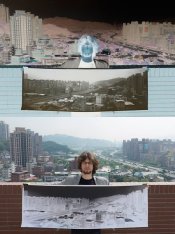
In the beginning I thought it would be very straight forward - just make a print from a paper negative which thanks to the fiber in the paper would give the final print a look I want. I made this test print before making the camera and it looked very promising:
attachment.php

This is a scan from paper negative so that's why you get all this nice texture. Unfortunately I noticed when contact printing, the texture is gone. It is obviously because modern photographic papers don't have heavy textured surfaces. When contact printing it is the surface and texture of the negative that is more important rather than the fiber inside (as I thought in the beginning).
I then tried to make my own calotypes but because the useful aperture (I mean sharp-ish) of the lens is f64-f128, the exposure would take hours in some cases. Obviously I had to abandon this idea.
I tried to put some hand made paper in between the neg and print which just made the print soft, I tried to put some on the top of the neg but that didn't work either. I tried to print on wood, heavily textured hand made paper and fabric - all the time the print looked like an old photograph rather than a painting.
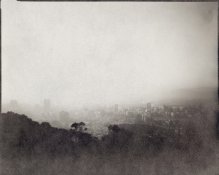
Here is one of the first paper negative from the camera:
attachment.php

And here you can see the camera together with a Vandyke print on fabric (from paper neg):
attachment.php

I saw some great salt prints so I start making vandykes (as they are similar to salt prints, cheaper and easier). Recently I bought Ilford Art 300 paper to use as a negative just to check if the texture from this paper can help. So far I am not really happy with the results. I made vandyke prints from it on hand-made paper and watercolour canson. I am still about to make a print on fabric. Also I encountered some problems with the ilford art paper - the negatives have even more contrast than already contrasty foma paper negs I used before (you loose some detail in highlights) - that could be adjusted slightly using green filter (not easy to make on such a big lens) or toning the print.
Anyway I already invested lots of time and money into this project and I feel a bit frustrated that I can't finally get the look I have in my mind. I would much more prefer to continue using vandyke prints as I like the colours and I feel already quite confident in making them so if anyone has an advice how I can achieve it in this way, I would highly appreciate. Otherwise I am also willing to learn yet another new technique like bromoil.
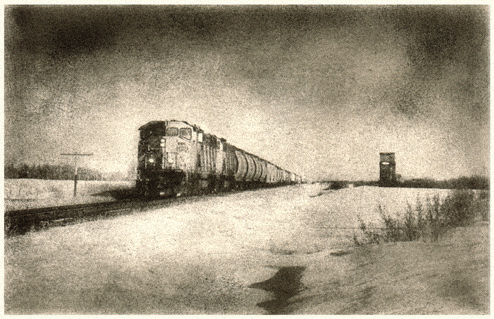
Btw here are some bromoils I found really cool:

attachment.php

attachment.php

LongHaul_ISOB.jpg
 

Attachments

  • 03.jpg
    03.jpg
    252.5 KB · Views: 266
  • DSCF2751.jpg
    DSCF2751.jpg
    318.3 KB · Views: 249
  • Jiandaoshi Shan.jpg
    Jiandaoshi Shan.jpg
    297.6 KB · Views: 268
  • first negative.jpg
    first negative.jpg
    78.5 KB · Views: 258
  • 15-12-20-15-28-47-872_deco.jpg
    15-12-20-15-28-47-872_deco.jpg
    733.4 KB · Views: 259
  • 1_2lonekycypress.JPG
    1_2lonekycypress.JPG
    223.2 KB · Views: 256
  • emile-rombaut_malines-1930-bromoil.jpg
    emile-rombaut_malines-1930-bromoil.jpg
    211.4 KB · Views: 344
Have you tried pencil on the reverse side of your paper negatives? If you put your negative (upside down) on a light table, you can use pencil to alter the mid-tones/highlights. By using a soft lead, you can add density to areas which will print lighter, when making a positive. I think you could replicate the look of the middle left, and bottom, shan shui examples you posted.
 
Also, go look at all of Gene's (there was a url link here which no longer exists), they are not all in his portfolio. Plan to spend an hour or more to work your way through them all. I've done this at least three times in the past month and it has literally changed my perspective and opened my eyes to something new.
 
For Bromoil process, there are at least a couple of books and a video available:
Gene Laughter's "Bromoil 101"
Davide Lewis "the Art of Bromoil Transfer"
Norman Gryspeerdt's DVD "the Bromoil Process"

Lewis use to sell a paper tailored for Bromoil, but don't know if its still available.
 
Photrio.com contains affiliate links to products. We may receive a commission for purchases made through these links.
To read our full affiliate disclosure statement please click Here.

PHOTRIO PARTNERS EQUALLY FUNDING OUR COMMUNITY:


Ilford ADOX Freestyle Photographic Stearman Press Weldon Color Lab Blue Moon Camera & Machine
Top Bottom