
• Welcome to Photrio!
    Registration is fast and free. Join today to unlock search, see fewer ads, and access all forum features.
    Click here to sign up

Photo Manipulation

Untitled

A
Untitled

  • 7
  • 2
  • 34

Recent Classifieds

Forum statistics

Threads
202,684
Messages
2,844,130
Members
101,467
Latest member
VladimirNik
Recent bookmarks
0

Ariston

Member
Allowing Ads
Joined
Jan 20, 2019
Messages
1,657
Location
Atlanta
Format
Multi Format
This has probably been discussed, so please excuse any redundancy.

On the photo below, I have whited out additional area to strengthen (in my opinion) the aesthetic. This is something that can be done in the darkroom, but is a blatant manipulation and misrepresentation of the true scene.

Personally, I don't like doing it, and will not print a photo in this way. I was just toying around with this image since I will revisit the place. It reminds me too much of the "sky replacements" that some digital photographers like to do. Still, I am being hypocritical, because even the long exposure is a manipulation of the real scene. That doesn't bother me for some reason. I remember reading somewhere that Adams used some darkroom trickery to hide some graffiti on a rock face, so I suppose he wasn't above it.

Where do you draw the line? It doesn't bother me (and it's none of my business) how others choose to enjoy their craft - I'm just curious.

Ignore the dust:
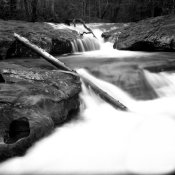
Chestatee Fake_1.jpg
 
First let me get my popcorns :D

Why should you draw the line? Is there some kind of law? Photograph is a lie from the beginning of selecting framing and timing.

Do what you want, it is your photograph.

Usually people come up with rules only to boost themselves. "I don't crop!" (because I'm so good at framing at location).. "I don't dodge and burn!" (because I can measure the light and develop my films so magically) etc.
 
If you have several years to waste, look back at the old threads on the subject.
 
I don't see any issues with darkroom (or PhotoShop) manipulation of images as long as there is no intent to deceive or mislead.

At each step of the way, photography includes manipulations which alter images. The real world rarely looks as colorful as my Velvia slides.
 
At the end of the day, it is your art. I've darkened down an entire print to change the mood and brought to bring attention to certain brighter areas. It was a misrepresentation of the actual scene... but a straight representation would have been boring and wouldn't convey my feelings...and I'm not into photo journalism.
 
I don't see any issues with darkroom (or PhotoShop) manipulation of images as long as there is no intent to deceive or mislead.

At each step of the way, photography includes manipulations which alter images. The real world rarely looks as colorful as my Velvia slides.

I totally agree.
 
It reminds me too much of the "sky replacements" that some digital photographers like to do.
Darkroom printers too.
If you read up on any darkroom printing "How To" guides you will find a plethora of dodging and burning diagrams for example prints.
A fair percentage of time I'm thinking about what I will do in the print stage while I take the photograph.
As long as you don't misrepresent the result, all is fair.
You should look up Jerry Uelsmann!
http://www.artnet.com/artists/jerry-uelsmann/
 
There is no line. A guy who worked with Ansel Adams once said that if you had seen a print of Moonrise, Hernandez, New Mexico before darkroom manipulation, you would not believe they were made from the same negative. (paraphrasing)

The only line is your mind.
 
I work my images until it meets my personal approval. I do not care what others think or believe is proper etiquette beyond completely falsified images without disclosure. Meaning, adding & deleting items in a scene. No not cloning out a beer can out of an image. But a major change. Again, as long as it is mentioned it's up to personal tastes. Just my 2 cents.
 
Well I think an image should retain the greatest integrity with the original scene. That is not to say you shouldn't crop (although I don't) or manipulate the print (although I don't). I would just suggest that any manipulation after capture should be kept to a minimum. Otherwise use photoshop and make a digital painting.
 
Well I think an image should retain the greatest integrity with the original scene. That is not to say you shouldn't crop (although I don't) or manipulate the print (although I don't). I would just suggest that any manipulation after capture should be kept to a minimum. Otherwise use photoshop and make a digital painting.
You are already manipulating the image in several ways before "capture" by photographing it on film:
1. The 3-dimensional scene has been reduced to 2-dimensions
2. The fact that you have edited (read cropped) the scene in the viewfinder, excluding parts of it
3. The choice of film, lens, shutter speed and aperture as well as angle are all edits to the original scene.
4. Any lighting or reflectors used are manipulations of the natural conditions of the scene
5. If you are shooting black and white, you have abstracted the colors in the original scene. Never mind any filtration used
6. If you shoot reversal film, it needs to be viewed by transmitted light, unlike the reflected light of the original scene.

So why should manipulation after capture be any different?
 
First let me get my popcorns :D

Why should you draw the line? Is there some kind of law? Photograph is a lie from the beginning of selecting framing and timing.

Do what you want, it is your photograph.

Usually people come up with rules only to boost themselves. "I don't crop!" (because I'm so good at framing at location).. "I don't dodge and burn!" (because I can measure the light and develop my films so magically) etc.
+1
 
You are already manipulating the image in several ways before "capture" by photographing it on film:
1. The 3-dimensional scene has been reduced to 2-dimensions
2. The fact that you have edited (read cropped) the scene in the viewfinder, excluding parts of it
3. The choice of film, lens, shutter speed and aperture as well as angle are all edits to the original scene.
4. Any lighting or reflectors used are manipulations of the natural conditions of the scene
5. If you are shooting black and white, you have abstracted the colors in the original scene. Never mind any filtration used
6. If you shoot reversal film, it needs to be viewed by transmitted light, unlike the reflected light of the original scene.

So why should manipulation after capture be any different?

Well, I agree with point 1, as all conventional photography does, as does painting and drawing.

I don't agree with point 2, as although you make selective framing, what you chose to frame still has integrity within the original scene.

I don't agree with point 3, as the scene within those boundaries still has its own integrity.

I don't agree with point 4, because if you use natural daylight without reflectors you have minimal effect on the original scene.

I don't agree with point 5, as black & white is the representation of choice, without affecting the image in question.

I don't agree with point 6, as even if you shoot reversal film you could convert back to black & white.
 
You are already manipulating the image in several ways before "capture" by photographing it on film:
1. The 3-dimensional scene has been reduced to 2-dimensions
2. The fact that you have edited (read cropped) the scene in the viewfinder, excluding parts of it
3. The choice of film, lens, shutter speed and aperture as well as angle are all edits to the original scene.
4. Any lighting or reflectors used are manipulations of the natural conditions of the scene
5. If you are shooting black and white, you have abstracted the colors in the original scene. Never mind any filtration used
6. If you shoot reversal film, it needs to be viewed by transmitted light, unlike the reflected light of the original scene.

So why should manipulation after capture be any different?

None of those are manipulation. Those are part of photography and the composition. You are just making your definition so wide so that you can justify your imagine-graphs of sharks jumping out of the ocean to eat a helicopter.
 
No, I can't see the shark and the helicopter and the UFO, only what I see in the viewfinder. Read my Francis Bacon quote below.
 
...Where do you draw the line? It doesn't bother me (and it's none of my business) how others choose to enjoy their craft - I'm just curious.

I contact print and primarily do not dodge/burn/crop...so I have soft borders (instead of lines) that I work within, with occasional excursions elsewhere. Not out of any twisted sense of purity or simplicity, but as the way of working with the light I enjoy, find challenging, and worth pursuing. So in some ways my line is drawn tight.

"...is a blatant manipulation and misrepresentation of the true scene." There is no true scene, just how the photographer wishes to represent a scene within the limitations (and with the advantages) of the tools and material available, and of their skill and sight. YMMD
 
composing an image is a form of manipulation

No composing is composing and composing is not a form of manipulation. For you to say that reduces your credibility.
 
Me thinks you forgot about the trusty fisheye lens. No just for fishes any more.

Since the they never exist together in the real world, even a fisheye could not make the photograph.
 
"...is a blatant manipulation and misrepresentation of the true scene." There is no true scene, just how the photographer wishes to represent a scene within the limitations (and with the advantages) of the tools and material available, and of their skill and sight
+1
 
No composing is composing and composing is not a form of manipulation. For you to say that reduces your credibility.
lost credibility in your eyes? you're too funny, its just an opinion. LOL

by framing an image and composing it in a viewer, positioning the camera, leveling it not leveling it &c you have manipulated the scene and picked and chosen what and how it will be in your view. manipulation is choices a person with a camera makes. just like what shutter speed and film type and f-stop and developer is being used, they all manipulate the scene and create a new context for it.
 
Last edited:
Photrio.com contains affiliate links to products. We may receive a commission for purchases made through these links.
To read our full affiliate disclosure statement please click Here.

PHOTRIO PARTNERS EQUALLY FUNDING OUR COMMUNITY:


Ilford ADOX Freestyle Photographic Stearman Press Weldon Color Lab Blue Moon Camera & Machine
Top Bottom
