This line in the article interested me:
Also cited was a 1982 ruling in which the New York Court of Appeals sided with The New York Times in a suit brought by Clarence Arrington, whose photograph, taken without his knowledge while he was walking in the Wall Street area, appeared on the cover of The New York Times Magazine in 1978 to illustrate an article titled "The Black Middle Class: Making It." Mr. Arrington said the picture was published without his consent to represent a story he didn't agree with.
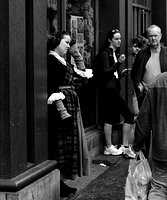
While I agree whole heartedly with the supreme court ruling, this above reference was sort of troubling. Because street photography is sort of neutral on issues, and is more of a slice of life portrayal. The above example shows what could happen when a photograph is used as an illustration and this benign aspect may disappear.
Using your image to illustrate a point of view that you may not share and could damage your livelyhood or reputation is not a victimless random sampling of street "life".
On top of that using your likeness as illustration, is heading into commerce and away from the "art" that street photography was defined to embrace.