

lxdude
Member
For protection, you want the very very rare Kruppstahl Leica, a limited series made for high Nazi officials.
Geez, I can't afford that. Would two Nikon SP's equal one Leica?

For protection, you want the very very rare Kruppstahl Leica, a limited series made for high Nazi officials.
Geez, I can't afford that. Would two Nikon SP's equal one Leica?
Yes, the first year blocks were modified stock GM. And of course they were much modified for F1 racing.The 1966 SOHC Repco-Brabham engine with which Jack Brabham won the 1966 F1 drivers' championship was built around a highly modified GM block but was far, far from the pushrod GM engine. The 1967 SOHC Repco-Brabham engine used Repco's own block. GM derived, not GM.
My Rover P6B had a Rover-made 215 GM V8. I think the big difference between Rover's version and the original was carburation, the Rover version used SUs. My example was very problematic.
Only if they are the very very rare karuta versions, made for the Emperor and his family.

Yes, the first year blocks were modified stock GM. And of course they were much modified for F1 racing.
My dad had a convertible first generation Olds F-85 in the early 70's. That was a quick little car. What everybody said back then was to not let the engine get too hot, as the heads would warp. The impression given was that that was a problem with them. I suspect now that it was a generalized concern, as a lot of regular guys were still skeptical of aluminum.
Anyway it all goes to the point I was making, that aluminum is every bit as good as "steel", done properly.

Funny how this post went from lenses to cars.
Jeff

Funny how this post went from lenses to cars.
Jeff
What everybody said back then was to not let the engine get too hot, as the heads would warp. The impression given was that that was a problem with them. I suspect now that it was a generalized concern, as a lot of regular guys were still skeptical of aluminum.

Funny how this post went from lenses to cars.
Jeff

Why don't you show us two real world examples of your lens claims? Two examples shot side by side, all other things being equal, where you can show that one photograph is clearly an improvement because of the lens. Just do ONE simple thing to back up your claim.
I have lived with Pentax and Leica cameras side by side, and I cannot make better photographs with the Leica. SHOW me what you are talking about. Please. No more words. Just SHOW me with a picture.

I am writing about this with my personal copy of the issue right here in front of me.
.
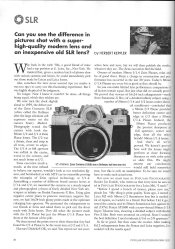
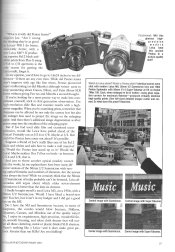
Published in the May 2001 issue of Popular Photography, Herbert Keppler did exactly that. In his "SLR" column, that month entitled, "Can You See the Difference in Pictures Shot with a Super-High-Quality Modern Lens and an Inexpensive Old SLR Lens?" Mr. Keppler compared two identical scenes, one shot with a Leica M6 with the 50/2 Summicron and the other with a Pentax Spotmatic armed with the 50mm f/1.4 Takumar, both at f/8 on Kodak TMax 100. Each were enlarged to 8x12 using glass negative carriers for maximum flatness. He displayed full-sized detailed sample images from each print, center and corner. Both samples were virtually identical. He believed you'd have to go to at least 16x24 to see differences, if any.
What does it prove? That at that particular aperture and enlargement degree, all other factors being equal, they were one and the same. Change any of the other factors and the results could change. I wish I could provide a link to the article, but I don't believe one exists. I am writing about this with my personal copy of the issue right here in front of me.
Bottom line though, it's the image that counts. The camera and lens is but a tool to interpret the mind/eye vision, nothing more. I admit to owning an M6, but I also have a Spotmatic and a Yashica TL-Electro, among myriad others in my collection. On any given day, it could be any of those that expresses my vision the way I want. More often than not, it's my Pentax MX or my simple but trusty TL-Electro I've used since 1976 that gives me the image result I was looking for.
Colors are elegant and classy like difference between chinese oil paint and Dutch Rembradt paint.
Well said Thomas! It's easy and or fun to get caught up in the technical and the equipment aspects of our passion, but ultimately, the deciding factor is our images and how we and others respond to them.But back to the bottom line, the best photographs are had with those cameras we love and are used to using. The small differences in lens quality are highly insignificant if you think about the total importance of any photograph. Would iconic photographs be less iconic if they were made with Pentax or Olympus lenses? I don't think so. Who cares?
Oil paint was never used in the Chinese pictoralist tradition. Perhaps better spend some time and money on education instead on the flashy consumer goods you apparently worship.
Ok, here are scans of Mr. Keppler's article... I beg forgiveness in advance if I am making any transgressions here. Note the samples, they tell the story. But keep in mind the only story they tell are the singular conditions of this particular comparison and no other generalities are claimed. Mr. Keppler emphasized that point in the article.
View attachment 70064
View attachment 70065
Whether this really clears anything up or not is for you to decide, perhaps it can even muddy the waters. But you can't argue with its objectivity.
Well said Thomas! It's easy and or fun to get caught up in the technical and the equipment aspects of our passion, but ultimately, the deciding factor is our images and how we and others respond to them.
Funny how this post went from lenses to cars.
Jeff

He's talking about brands of artist's oil colors.

Don't forget Saab and Volvo.
That article is merely echoing what anyone who has actually used the equipment already knows.
Thanks for posting it.
Exceptall the Toyota cars gang up every 7th of December and attack Pearl HarbourNothing. They make fantastic cars.
Exceptall the Toyota cars gang up every 7th of December and attack Pearl Harbour

| Photrio.com contains affiliate links to products. We may receive a commission for purchases made through these links. To read our full affiliate disclosure statement please click Here. |
PHOTRIO PARTNERS EQUALLY FUNDING OUR COMMUNITY:  |