• Welcome to Photrio!
    Registration is fast and free. Join today to unlock search, see fewer ads, and access all forum features.
    Click here to sign up

Paper Flashing

An tSráid Mhór

A
An tSráid Mhór

  • 0
  • 0
  • 16
IMG_1285.jpeg

D
IMG_1285.jpeg

  • 0
  • 0
  • 24

Forum statistics

Threads
203,124
Messages
2,850,182
Members
101,688
Latest member
linie4
Recent bookmarks
0

Snapshot

Member
Allowing Ads
Joined
Jan 10, 2007
Messages
913
Location
Toronto, Ont
Format
Multi Format
Hi All,

I am hoping to tap into the experience of APUG members with regards to fogging and flashing paper. Does anyone have any advice as how to perform this procedure? My approach has been to expose the paper to diffused white light for 5% to 10% of the to exposure time. For example, I would expose the paper to a 0.5 second burst of diffuse light when I'm exposing the print for a total of 10 seconds.

Any thoughts or input would be appreciated.
 
I made a frame from heavy cardboard, and then glued a sheet of drafting vellum over it. The vellum acts as a diffuser.

When I feel the need to add a bit of tonality in the highlights of a print, I will hold the frame under the enlarger (not steady - keeping it in motion assures that imperfections in the vellum don't get printed into the image) for short time. There is no hard number - usually 5 to at most 10% of the base exposure is fine. Anything more than that and the highlights start to get dull.

It isn't necessary to remove the negative from the enlarger for this manipulation - the diffusion caused by the vellum is so extreme that the image totally disappears, and all that comes through is light.

The result is roughly equivalent to a 1/4 step reduction in contrast.
 
I pump a few brief flashes from a small LED flashlight, held over my head. Sometimes I aim at the white wall nearby. The virtue of this approach - using a separate light source - is that the exposure the paper receives is not dependent on the density of the negative ... and it shouldn't, since the optimum amount of flashing depends on the paper, with only the highlight density of the negative as a slight contributing factor.

The downside of this approach is that it's hard to time accurately.

On other occasions, I've used the backlit screen of a PDA (a cell phone would work too) to flash paper when it's in the developer. I may start using that method more, since it's easier to time a weak light source like a PDA.
 
I use a small flashlight diffused with masking tape for local flashing. This works well for routine slight darkening of the edges of a print. The effect is slightly different than burning in the edges.
 
flashing

I'm fortunate enough to have 2 enlargers side by side. I use my 23cII at f16 10 seconds at a fixed height to flash my paper - I arrived at this setting by testing for the maximum time for no tonality as detailed in a previous post. Then just expose the paper normally.
Tim
 
Les, I've read your article and it was really helpful. Thanks everyone for your input.
 
Dauxlite

Calumet used to sell a Dauxlite for flashing. It's LED light based, has several intensities, attachable VC filters, different sizes of circles and squares, etc. It's the best I've seen for flashing.
 
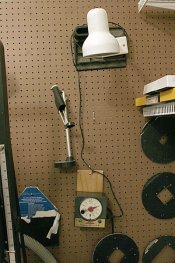
I have a Timeolite hanging on the wall attached to a small desk lamp with a dimmer on it. After calibrating I just lay the sheet on the table under the lamp and flash it before putting the paper on the easel. The lamp is about three feet above the table.
 

Attachments

  • bump-light.jpg
    bump-light.jpg
    80.3 KB · Views: 159
I've made a translucent filter that I put in the filter holder. I flash the paper and then remove the filter and proceed to make my print. It's fairly quick but the Dauxlite and Timelite setup look like good ideas.
 
Photrio.com contains affiliate links to products. We may receive a commission for purchases made through these links.
To read our full affiliate disclosure statement please click Here.

PHOTRIO PARTNERS EQUALLY FUNDING OUR COMMUNITY:


Ilford ADOX Freestyle Photographic Stearman Press Weldon Color Lab Blue Moon Camera & Machine
Top Bottom