
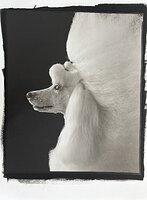
Hi! I am working on an important photographic project. I am presently using Oriental and Ilford VC Fiber based papers. For some reason the Ilford papers curl much more then the Oriental. They get the exact same archival porcessing and they are dried face down on fiberglass screens. Both papers work great for my needs but the curl I could without. Does anyone have any suggestions on what I can do to remedy this situation? Thanks!
-
Welcome to Photrio!Registration is fast and free. Join today to unlock search, see fewer ads, and access all forum features.Click here to sign up
You are using an out of date browser. It may not display this or other websites correctly.
You should upgrade or use an alternative browser.
You should upgrade or use an alternative browser.
Paper Curl
-
A
- Thread starter Grillage
- Start date

Recent Classifieds
-
Want to Buy WTB: looking for a Voigtlander hand grip
- Started by dirkfletcher
-
For Sale Omega D5 Lift Lever Assembly
- Started by mgb74
-
For Sale Omega D5 Bellows Assembly
- Started by mgb74
-
Free Jobo Sheet Film Loader 2508 No Guides
- Started by Roger Thoms
-
Want to Buy 12x20 Film and Film holder
- Started by stray227
Forum statistics

Easiest and cheapest method is under a stack of heavy books for a week or so. I interleaf my prints between archival matboard then stack books on top. If you have access to a dry mount press you can hit them with heat for a few minutes between matboard and will flatten them. Or you could drymount them.
if they're already curled, I would take a damp sponge and VERY lightly wet the back of the print before pressing and it will decrease the time needed to flatten like crazy. If you wet it too much, it will ruin the print. You want just enough that you notice the curl is giving. I used to have matting board stacked and then throw something heavy on it for a couple of days. Then I gave up and just bought a massive press and life became 43% easier.
You can also do a second wash (recommended anyway) and when you squeegee the print and put it on some paper towel or a drying rack or whatever, use a blow dryer and just keep flipping the print over and over again and you can dry it pretty flat. Then throw it between books, matting board, whatever to stay flat.
You can also do a second wash (recommended anyway) and when you squeegee the print and put it on some paper towel or a drying rack or whatever, use a blow dryer and just keep flipping the print over and over again and you can dry it pretty flat. Then throw it between books, matting board, whatever to stay flat.
Thanks so far for the comments. These images are for an eventual coffee table book so I have to be very careful on any procedure. Does anyone still make an anti-curling solution?

Not bone dry in the drymount press is the easiest thing. You can't totally eliminate curl short of drymounting them. Simplest way to reduce curl for a handmade book would be to use RC paper. It will be cleaner since it's plastic coated on both sides, it will only absorb moisture along the edge, so it's much less curly. In the darkroom, I hang up FB prints to dry back to back with each other and use some clothespins to keep them together. It's the photo equivalent of a balanced mic cable; the inevitable distortion will zero out and the paper will dry pretty flat.

Tony-S
Subscriber
We can put a man on the moon but we can't make a fiber base print that dries flat.

Dear Grillage,
Follow Brian's advice. I use blotter books rather than mat board but essentially time and pressure will do the job.
Neal Wydra
Follow Brian's advice. I use blotter books rather than mat board but essentially time and pressure will do the job.
Neal Wydra

GRHazelton
Subscriber
Print flattening solutions
Back in the day before RC paper I seem to remember a print flattening solution, IIRC it contained ethylene or propylene glycol. This rendered the print somewhat hygroscopic so it absorbed just enough moisture to stay flat. I don't know what it did to archival qualities, however! Some have also recommended dry mounting the print back to back with another sheet of the same paper, which has undergone the same processing. Kinda expensive. To my surprise David Vestal's The Craft of Photography doesn't seem to address it. Steven Anchell's Darkroom Cookbook calls for 2 oz glycerin in 32 oz water. Soak the print for at least 5 minutes after washing, then dry. Or dampen dried prints with 1 part glycerin to 3 parts of water, then dry under pressure.
Back in the day before RC paper I seem to remember a print flattening solution, IIRC it contained ethylene or propylene glycol. This rendered the print somewhat hygroscopic so it absorbed just enough moisture to stay flat. I don't know what it did to archival qualities, however! Some have also recommended dry mounting the print back to back with another sheet of the same paper, which has undergone the same processing. Kinda expensive. To my surprise David Vestal's The Craft of Photography doesn't seem to address it. Steven Anchell's Darkroom Cookbook calls for 2 oz glycerin in 32 oz water. Soak the print for at least 5 minutes after washing, then dry. Or dampen dried prints with 1 part glycerin to 3 parts of water, then dry under pressure.
- Joined
- Jul 14, 2011
- Messages
- 15,038
- Format
- 8x10 Format
I simply place my keeper prints in a stack under a big sheet of plate glass. Of course, outside that situation they'll still curl some if the humidity
changes, but very little when stacked together in a portfolio box. Finally, some of them will be drymounted, with the result temporarily placed
under that same heavy glass - ordinary correct technique. Anytime you have two different materials back to back it can warp. Countermounting
is advantageous for wet mounting, but I never bother when drymounting. The mounted prints will once again be kept in a stack in either a
flat file or print boxes, and warp very little there. And if they are ever displayed, it's always in a frame anyway, which will keep them flat.
changes, but very little when stacked together in a portfolio box. Finally, some of them will be drymounted, with the result temporarily placed
under that same heavy glass - ordinary correct technique. Anytime you have two different materials back to back it can warp. Countermounting
is advantageous for wet mounting, but I never bother when drymounting. The mounted prints will once again be kept in a stack in either a
flat file or print boxes, and warp very little there. And if they are ever displayed, it's always in a frame anyway, which will keep them flat.
What I do is dry the prints on glass panes. The procedure is simple, you need paper adhesive tape with water activated glue and a glass pane larger than the print. The adhesive tape used for repairing old books is ok as it uses PH neutral glue. You place the wet print on the sheet, face up and run strips of the wet adhesive along the edges. It is important to remove excess water from the adhesive paper with a tissue. The downside is that you need to print on larger paper size and trim the edges as there is no way to remove the adhesive tape once dry. The print takes about ten hours to dry but it is flat. Once it has dried you just cut the tape along the edges, remove the print from the glass sheet and trim the edges

What I do is dry the prints on glass panes. The procedure is simple, you need paper adhesive tape with water activated glue and a glass pane larger than the print. The adhesive tape used for repairing old books is ok as it uses PH neutral glue. You place the wet print on the sheet, face up and run strips of the wet adhesive along the edges. It is important to remove excess water from the adhesive paper with a tissue. The downside is that you need to print on larger paper size and trim the edges as there is no way to remove the adhesive tape once dry. The print takes about ten hours to dry but it is flat. Once it has dried you just cut the tape along the edges, remove the print from the glass sheet and trim the edges
There is a stickie at the beginning of this forum called, of all things, "Sticky: Getting Fiber Based Paper Flat".
It's a long thread on this topic with many techniques and solutions.
It's a long thread on this topic with many techniques and solutions.

I just tried the glass pane method after struggling for a long time with Harman DPP and Ilford FB prints curling. I squeegeed the print's front and backsides after rinsing, placed it atop a larger sheet of 1/4" plate glass, then used drafting tape to secure the edges (tape that's designed to release off paper without tearing). I barely overlapped the tape on the edge of the print, maybe 2mm. After a thorough drying I carefully removed the tape by pulling it off at an angle such that the tape was always pulling on the print outward, toward the edges, and had no issues with tearing or fraying of the edge. You can't tell tape was applied, and the print is entirely flat except for a slight rise on the edge that's several mm wide.
This is the flattest I've ever seen FB paper prints, flatter even than when it comes out of the box, prior to exposure, as there's no curve to it. I'm going to be cutting some more sheets of glass in the near future. I think I've found the method that solves the curling problem once and for all, for me. FYI, this print was one that had previously been archivally rinsed and dried in my drying cabinet under screens, and had plenty of curl, enough such that it was difficult to slip into a plastic storage sleeve. I simply rewetted the print in a shallow tray of water until it was saturated, then squeegeed it and taped it to glass. I can see going back into my archives and reflattening older prints I've made using this method.
As for someone's suggestion of a fiber paper that doesn't curl, how about this wild idea: have the backside of the paper coated with a non-silver halide impregnated gelatin film with similar temperature expansion coefficients as the frontside emulsion. When the paper dries, both front and backside emulsions will shrink at the same rate, preventing paper curl. As a side benefit, the backside gelatin film might aid the paper's archival wash ability.
~Joe
This is the flattest I've ever seen FB paper prints, flatter even than when it comes out of the box, prior to exposure, as there's no curve to it. I'm going to be cutting some more sheets of glass in the near future. I think I've found the method that solves the curling problem once and for all, for me. FYI, this print was one that had previously been archivally rinsed and dried in my drying cabinet under screens, and had plenty of curl, enough such that it was difficult to slip into a plastic storage sleeve. I simply rewetted the print in a shallow tray of water until it was saturated, then squeegeed it and taped it to glass. I can see going back into my archives and reflattening older prints I've made using this method.
As for someone's suggestion of a fiber paper that doesn't curl, how about this wild idea: have the backside of the paper coated with a non-silver halide impregnated gelatin film with similar temperature expansion coefficients as the frontside emulsion. When the paper dries, both front and backside emulsions will shrink at the same rate, preventing paper curl. As a side benefit, the backside gelatin film might aid the paper's archival wash ability.
~Joe
- Joined
- Jul 14, 2011
- Messages
- 15,038
- Format
- 8x10 Format
Gelatin is expensive, at least as a perceptible factor as paper gets more expensive anyway. And you don't want anything on the back of the print which will affect long-term mounting. Pro picture framers deal with these kinds of issues every day.
Dear Joe,
Really pleased you got your FB papers flat.
If you look back a rather long way we did R&D on a paper that stayed flatter ( if not dead flat ) after processing, but it actually had other issues that meant it could not be manufactured cost-effectively.
As per coating the back of the Baryta base, its a very sensible solution, it could be done, we coat many of our products front and back ( but not specifically to avoid curl ) but I think Drew hit it on the head...do you want to pay a great deal more for your Baryta paper, we guess not.
Whilst curling of FB papers is an age old problem ( I remember single weight paper curl ! ) the HARMAN coating machine at Mobberley ( No14 Machine ) does actually have an anti-curl device that is engaged when we coat Baryta, we are now the only manufacturer in the world still to have this step in Baryta production.
Simon ILFORD Photo / HARMAN technology Limited
Really pleased you got your FB papers flat.
If you look back a rather long way we did R&D on a paper that stayed flatter ( if not dead flat ) after processing, but it actually had other issues that meant it could not be manufactured cost-effectively.
As per coating the back of the Baryta base, its a very sensible solution, it could be done, we coat many of our products front and back ( but not specifically to avoid curl ) but I think Drew hit it on the head...do you want to pay a great deal more for your Baryta paper, we guess not.
Whilst curling of FB papers is an age old problem ( I remember single weight paper curl ! ) the HARMAN coating machine at Mobberley ( No14 Machine ) does actually have an anti-curl device that is engaged when we coat Baryta, we are now the only manufacturer in the world still to have this step in Baryta production.
Simon ILFORD Photo / HARMAN technology Limited
| Photrio.com contains affiliate links to products. We may receive a commission for purchases made through these links. To read our full affiliate disclosure statement please click Here. |
PHOTRIO PARTNERS EQUALLY FUNDING OUR COMMUNITY:  |