
• Welcome to Photrio!
    Registration is fast and free. Join today to unlock search, see fewer ads, and access all forum features.
    Click here to sign up

P3200 vs Delta 3200 comparison

Recent Classifieds

Forum statistics

Threads
201,761
Messages
2,829,639
Members
100,927
Latest member
Rudy Bachelor
Recent bookmarks
0

xtolsniffer

Member
Allowing Ads
Joined
Mar 27, 2008
Messages
681
Location
Yorkshire, U
Format
Multi Format
Hi all,
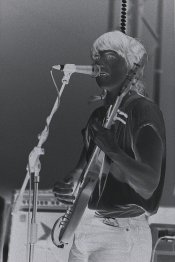
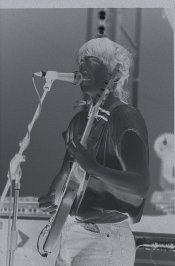
thought you might be interested in these results. I usually shoot Ilford Delta 3200 at concerts but was interested to give Kodak P3200 a go. I had some Delta 3200 in my Nikon F3, so used that on the first set, then switched to P3200 and carried on. Both rolls were both exposed and developed at box speed in Microphen using Ilford's recommended times, 9 mins for Delta 3200 and 12 mins for P3200. I've selected two frames with similar compositions (all scanning settings were the same). The lighting, exposure etc etc were all the same. P3200 is at left, Delta 3200 at right. My feeling is that the grain on the Delta is finer, less pronounced, and that Delta can hang onto the highlights and still keep shadow detail but looks a little more 'muddy', P3200 has crisper grain and more punch but shadows block up. The P3200 got three more minutes in the soup mind you. Results are close but personally I think I slightly prefer the P3200 but it's likely differences could disappear in printing.


Deershed P3200 sample.jpg Deershed Delta 3200 sample.jpg
 

Adrian Bacon

Subscriber
Allowing Ads
Joined
Oct 18, 2016
Messages
2,086
Location
Petaluma, CA.
Format
Multi Format
Interesting. The P3200 looks better to me, though, you can’t really make a judgment call on the tonalities and highlight shadow detail between the two unless they were both developed to the same contrast. Following the recommended time doesn’t necessarily mean the same contrast, for example, in XTOL, the recommended time for Ilford films results in a different contrast than the time for Kodak films. The difference is slight, but enough to make doing a tonal comparison less than ideal. I know Ilford says their time results in a “normal” contrast for Ilford films, though they don’t specify what normal is. I’d assume the ISO standard of 0.62, but without testing it, it’s hard to tell, the same goes for P3200, Ilford doesn’t really specify what you’re going to get contrast wise, which makes things like shadows blocking up or highlight retention kind of moot.
 

Rudeofus

Member
Joined
Aug 13, 2009
Messages
5,119
Location
EU
Format
Medium Format
You can not develop Delta 3200 to match contrast of any film, because its characteristic curve is very concave, i.e. it has high contrast in weakly exposed areas and very weak contrast in strongly exposed areas. This weak contrast in strongly exposed areas will not go up with longer development times either. If your main subject matter is in the mid or highlight regions, you will have to print/postprocess to higher contrast. In this comparison the P3200 scan shot looks nicer because it has better contrast to match the scene, whereas Delta3200 scan shows much better shadow contrast.

If you increase Delta 3200 scan contrast to match the P3200 scan,
  • Shadow regions may be shoved down to black
  • Highlight regions will hold up because Delta 3200 is almost flat in highlight regions
  • Grain will become more apparent
If you decrease P3200 scan contrast,
  • Shadow regions which are now pitch black may show detail again - that's the big unknown here!
  • Highlight regions will look more modest
  • Grain will become less apparent
Could you please post raw non-inverted scans of these two negatives? This would allow us to look at shadow detail. Since most of us would use either film in low light situations, half a stop more or less sensitivity would be a big deal.
 
OP
OP

xtolsniffer

Member
Allowing Ads
Joined
Mar 27, 2008
Messages
681
Location
Yorkshire, U
Format
Multi Format
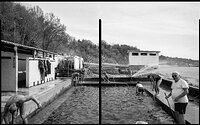
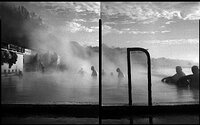
These are the same negs, as flat as I can get them (all sliders set to zero). I'm no expert in scanning mind you! Again, P3200 at left, Delta 3200 at right. To my eyes, not a great deal of difference, Delta seems to hold more detail in the shadows than P3200 at the recommended development times. Someone who is better at printing than I am may be able to make use of that, but from my experience, the P3200 looks easier to make a nice easy punchy print from. The P3200 seems to have more obvious grain though. Comparison side by side on the light box, the Delta looks a bit thin compared with my usual HP5+ and also against the P3200.

Deershed P3200 Neg.jpg Deershed Delta 3200 Neg.jpg
 

Carriage

Member
Allowing Ads
Joined
Feb 3, 2015
Messages
219
Location
Melbourne
Format
35mm
If I just invert and bring the black and white points in to the edges of the histogram, they look very similar to me. That may well reflect more on me though. I mean, they do look a bit different, as do the histograms but I suspect you could do a lot when printing.
 

Adrian Bacon

Subscriber
Allowing Ads
Joined
Oct 18, 2016
Messages
2,086
Location
Petaluma, CA.
Format
Multi Format
You can not develop Delta 3200 to match contrast of any film, because its characteristic curve is very concave, i.e. it has high contrast in weakly exposed areas and very weak contrast in strongly exposed areas. This weak contrast in strongly exposed areas will not go up with longer development times either. If your main subject matter is in the mid or highlight regions, you will have to print/postprocess to higher contrast. In this comparison the P3200 scan shot looks nicer because it has better contrast to match the scene, whereas Delta3200 scan shows much better shadow contrast.

If you increase Delta 3200 scan contrast to match the P3200 scan,
  • Shadow regions may be shoved down to black
  • Highlight regions will hold up because Delta 3200 is almost flat in highlight regions
  • Grain will become more apparent
If you decrease P3200 scan contrast,
  • Shadow regions which are now pitch black may show detail again - that's the big unknown here!
  • Highlight regions will look more modest
  • Grain will become less apparent
Could you please post raw non-inverted scans of these two negatives? This would allow us to look at shadow detail. Since most of us would use either film in low light situations, half a stop more or less sensitivity would be a big deal.

I totallly disagree. I’m actually in the middle of generating a development regime for delta 3200 for replenished XTOL because Kodak does not have any published times for delta 3200 like they do for P3200.

Kodak’s contrast index for EI 3200 is 0.72 for P3200 and you can in fact develop delta 3200 so that it’s contrast index is also 0.72 (measured exactly the same way as Kodak measures all contrast indexes). You may or may not get the same speed as P3200 at that CI, however, by that measurement regime, it will have the same contrast index.

From there you can look at tonal differences caused by things such as the shape of the characteristic curve that you mentioned, however the bigger issue will be what effective speed you get at that contrast index.
 

Rudeofus

Member
Joined
Aug 13, 2009
Messages
5,119
Location
EU
Format
Medium Format
I totallly disagree. I’m actually in the middle of generating a development regime for delta 3200 for replenished XTOL because Kodak does not have any published times for delta 3200 like they do for P3200.
Ilford's Delta 3200 data sheet gives numbers for Kodak XTol, and for some Ilford developers the data sheet also gives characteristic curve and even C.I. plots over dev time. All these characteristic curves are strongly concave and by no means well approximated or represented by a straight line.

The curves posted on fotoimport.no confirm this claim. Obviously you are free to draw a straight line through two arbitrary points of the characteristic curve and call its slope C.I., but I am not sure what you want to achieve with numbers generated like this.
Kodak’s contrast index for EI 3200 is 0.72 for P3200 and you can in fact develop delta 3200 so that it’s contrast index is also 0.72 (measured exactly the same way as Kodak measures all contrast indexes). You may or may not get the same speed as P3200 at that CI, however, by that measurement regime, it will have the same contrast index.
You will have the same C.I. but different contrast in most areas of your image - your C.I. number is completely meaningless for Delta 3200.
 

Adrian Bacon

Subscriber
Allowing Ads
Joined
Oct 18, 2016
Messages
2,086
Location
Petaluma, CA.
Format
Multi Format
You will have the same C.I. but different contrast in most areas of your image - your C.I. number is completely meaningless for Delta 3200.

That is the entire point. I’ve generated my own characteristic curves for most films available today for replenished XTOL and very few of them are actually all that straight. So, you pick a measurement standard and develop them to that same standard and look at the differences when developed to that standard. By your logic, no films can be compared because the characteristic curves don’t match. Yet somehow people have been evaluating films against each other for a lot longer than I’ve been alive.

And, yes, ilford publishes development times for XTOL, but not for replenished XTOL, which does not have the same activity level as stock or 1:1 XTOL and therefore requires a different set of times to get the same contrast.
 

fjpod

Member
Allowing Ads
Joined
Apr 24, 2018
Messages
59
Location
New York
Format
35mm
I'm certainly no expert here and can't brandish the fancy terminology, but I have a question...assuming both negatives were developed "properly" or within normal limits, can't differences in blocked up shadows and blown highlights be made up in analog printing? Using different contrast filters? Using split grade printing? Couldn't an adept analog printer make prints from these negatives look alike? Or even reverse the perceived differences in the digital representations given above?
 

WilmarcoImaging

Member
Allowing Ads
Joined
Apr 2, 2017
Messages
639
Format
Multi Format
Lots of shadow detail in the raw P3200 negative scan. Thanks for posting these.

I have a roll loaded in an SR-1 for campfire photos during family vacation next week. Can't wait to see the results.
 

ericdan

Member
Allowing Ads
Joined
Feb 28, 2014
Messages
1,359
Location
Tokyo
Format
35mm RF
I tested both films extensively.
Delta 3200 is obviously not 3200 ISO but works really well at 3200 in Microphen stock.
TMax P3200 seems slower but has tighter grain. You might be interested in this video as well for results:
 
  • Poisson Du Jour
  • Deleted
  • Reason: Comparison was of same film at 2 different speeds, not 2 different films at one or more speeds. My b

Rudeofus

Member
Joined
Aug 13, 2009
Messages
5,119
Location
EU
Format
Medium Format
That is the entire point. I’ve generated my own characteristic curves for most films available today for replenished XTOL and very few of them are actually all that straight. So, you pick a measurement standard and develop them to that same standard and look at the differences when developed to that standard.
You will agree that most film's characteristic curves have some straight section which covers most of regular subject matter except for deep shadows and strong highlights. Yes, there is a toe and a shoulder, but they are many stops apart, and in between there is a straight section in which you can establish a near constant slope and a C.I.

Delta 3200 has a shoulder which lies well within normal subject matter, and any slope you draw is either the short straight section right after the toe, or a straight line drawn between toe and some arbitrary point on the shoulder. That initial straight line slope does not represent the image, and matching this to a TMAX 400 curve is a nice but useless exercise. The second method is used to determine ISO speed, and you are welcome to use it for your "comparison". I am less than sure whether this method gives you meaningful data for your purpose, though.

Delta 3200 with its concave curve will be inevitably overdeveloped compared to straight line P3200 and will likely show better shadow detail and larger grain in such a line up. If you look at xtolsniffer's negatives, though, these films have nearly identical shadow speed, and Delta 3200 will look just as grainy once you enlarge/scan with higher contrast to match the P3200 image.

By your logic, no films can be compared because the characteristic curves don’t match. Yet somehow people have been evaluating films against each other for a lot longer than I’ve been alive.
Most films can be compared because they have long straight lines in their characteristic curves. Delta 3200 is the exception to this, and judging it with conventional procedures will do injustice to both the film and to your images.
 
Photrio.com contains affiliate links to products. We may receive a commission for purchases made through these links.
To read our full affiliate disclosure statement please click Here.

PHOTRIO PARTNERS EQUALLY FUNDING OUR COMMUNITY:


Ilford ADOX Freestyle Photographic Stearman Press Weldon Color Lab Blue Moon Camera & Machine
Top Bottom