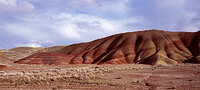
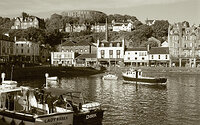
That's what I get for loading a camera and not making a note as to what I put in it. I assumed it was either VP or TMY so rated it at 100. Fortunately I had an X1 filter on and didn't apply the full factor so I could shoot at 60 at f/8. I guess that only puts me a stop or a stop and a half over. So any suggestions for processing in PMK or Rodinal so I don't block it up too badly? Should I just cut development by 10 or 15%? Or, would this be a good time to try stand development with highly dilute Rodinal?
The pictures will no doubt survive in some form. The question really is: In what form do you want this to be?
Though it really depends on the contrast ("look") you want on your prints, the contrast in the composition, and where your tones actually ended up landing, in general, without specific knowledge of how *your* Tri-X behaves with *your* camera/meter and *your* process, I would suggest underdeveloping the negatives. This is for one simple reason if nothing else: It gives you more malleable raw material to work with and more options in printing. It is easier to tweak a neg that has healthy exposure, yet may be a tad flat, than it is to try to soften a neg that is nothing but straight line and/or zone III densities and above. Your negs will certainly be printable with normal development, as film holds detail *well* above a zone VII fall. However, the normal development will give you fewer options as far as the "look" you can achieve in printing.
Assuming average contrast light and assuming that you want an average-looking print, I would, at the very least, use a published time for the film at EI 200. If, after doing this, it turns out that you want more pop on the negs, you have the option of selenium toning the frames you wish to push further. This underdevelopment will also help reduce the graininess that the overexposure will cause. For this reason, when shooting small film and striving for as little grain as possible, I almost always develop to 1 half - 1 full grade less contrast than I think I should, then tone if necessary for more push. Usually, I do the toning before I even dry the film, as I know they need the extra push anyhow. With film larger than 6x4.5, I just do it in development, as there will be no grain at any print size I will be making.
As I said at the top, there is no right answer. It depends on what you want the print to look like. Some people routinely and purposefully do the equivalent of what you did in order to shift the tonal range of the composition onto their desired stretch of the film's characteristic curve.
Think about the contrast in which you shot. If you shot in flat light, I'd develop as normal. If you shot in harsh light, I'd underdevelop two grades (or a little more if you can). If you shot in normal light, I'd underdevelop one grade (or a little more).