
• Welcome to Photrio!
    Registration is fast and free. Join today to unlock search, see fewer ads, and access all forum features.
    Click here to sign up

Over active developer

Kulwulton River in Flood

A
Kulwulton River in Flood

  • sly
  • Feb 5, 2026
  • 1
  • 0
  • 0
MV Shirley

A
MV Shirley

  • 2
  • 0
  • 11

Recent Classifieds

Forum statistics

Threads
202,173
Messages
2,836,251
Members
101,150
Latest member
Ioannes
Recent bookmarks
0

case-ie

Member
Allowing Ads
Joined
Mar 28, 2013
Messages
43
Format
Multi Format
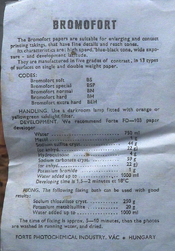
Forte fd-103 see file , A developer i like to use, lately I started mixing it with warm water and papers were developed in under 15 seconds, gives some nice irregularities but not something sustainable. development at 20ºc
My question is can mixing with warm water -40º celcius- alter the developer properties compared to mixing at room temperatures?

And in the formula it says chrystal soda 59 gr or anhydrous soda 22 gr. I use washing soda and that's not anhydrous so 59 gr. that's also how I remember making it. but is it to much, could there be a over stimulating effect?

Thanks.

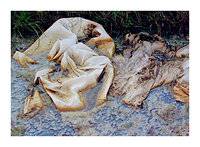
Here a paper negative
 

Attachments

  • P1210056.jpeg
    P1210056.jpeg
    1.1 MB · Views: 25

koraks

Moderator
Moderator
Joined
Nov 29, 2018
Messages
27,457
Location
Europe
Format
Multi Format
My question is can mixing with warm water -40º celcius- alter the developer properties compared to mixing at room temperatures?
You mean, you initially mix the developer at 40C to facilitate the dissolution of the ingredients, and then allow to cool down to working temperature? In that case - no, it won't affect the properties of the developer in any significant way.

And in the formula it says chrystal soda 59 gr or anhydrous soda 22 gr. I use washing soda and that's not anhydrous so 59 gr. that's also how I remember making it. but is it to much, could there be a over stimulating effect?
If your washing soda happens to be sodium carbonate monohydrate then you're using much of it, but it doesn't explain the uneven development you got. However, washing soda in my understanding is generally crystal soda, which is the decahydrate.

You mention this is a paper negative. What I see mostly is the effect of uneven wetting which can be the result of far too short a development time. Just dilute your developer lots (let's say 1+5 or 1+10 from what you have now) to slow it down. Development should ideally take at least a minute, but 2-3 minutes would be OK, too. This will reduce the effects of uneven wetting during the initial stage of development.
You could also consider adding a surfactant to the developer to break the surface tension; something like photoflo will work OK.
 

halfaman

Subscriber
Allowing Ads
Joined
Sep 22, 2012
Messages
1,520
Location
Bilbao
Format
Multi Format
If I understand correctly, the OP wants a repetable or at least predictable uneven development for artistic purpose.

I don't think the developer is the only variable here with such short time. Processing temperature, development oxidation/exhaustion grade, or as simple as how the paper is placed on the tray could be as important as the developer formulation.

Honestly, I think you should embrace and enjoy the uncertainty of your process output (like with litho printing) and value the uniqueness characteristic of each print.
 
OP
OP

case-ie

Member
Allowing Ads
Joined
Mar 28, 2013
Messages
43
Format
Multi Format
If I understand correctly, the OP wants a repetable or at least predictable uneven development for artistic purpose.

I don't think the developer is the only variable here with such short time. Processing temperature, development oxidation/exhaustion grade, or as simple as how the paper is placed on the tray could be as important as the developer formulation.

Honestly, I think you should embrace and enjoy the uncertainty of your process output (like with litho printing) and value the uniqueness characteristic of each print.

Oh, it's intentional. I see. Then frankly I don't know what the problem is.

@case-ie could you please clarify what you're trying to find out/ask?

Thanks for your answers, I see the question is not completely clear, but it is just the technical side, I'm not after unpredictical development.

And the initial development is even but very fast, the irregularities appear in the stopbath after pulling the paper quick from the developer.
 

koraks

Moderator
Moderator
Joined
Nov 29, 2018
Messages
27,457
Location
Europe
Format
Multi Format
OK, thanks. Dilute the developer so you have a longer development time. Now you probably get weird effects because some of the developer is still extremely active as it hits the stop bath but in other places it's already stopped. You're fighting an uphill battle with these short development times.
 

pentaxuser

Member
Joined
May 9, 2005
Messages
20,396
Location
Daventry, No
Format
35mm
And the initial development is even but very fast, the irregularities appear in the stopbath after pulling the paper quick from the developer.

I wonder how this happens? I always thought that stop bath instantly stops development so as long as what you see at the end of the development is what you want then the stop should retain that development

pentaxuser
 
Last edited:

Alan Townsend

Member
Joined
Dec 7, 2025
Messages
184
Location
Peoria, IL, USA
Format
Multi Format
And in the formula it says chrystal soda 59 gr or anhydrous soda 22 gr. I use washing soda and that's not anhydrous so 59 gr. that's also how I remember making it. but is it to much, could there be a over stimulating effect?

Thanks.
There are two crystal forms of sodium carbonate. The decahydrate, which Google AI says is washing soda, and the monohydrate. In the US, the Arm and Hammer brand wqshing soda is generally mostly the monohydrate form. To convert from anhydrous to monohydrate, you multiply by 1..2. If that's what you have, it would explain overactive developer. Where do you live and what kind of "washing sode" are you using.

For monohydrate, you would use 26.4 gr. (22x1.2), whether that's grams or grains.
 
OP
OP

case-ie

Member
Allowing Ads
Joined
Mar 28, 2013
Messages
43
Format
Multi Format
I wonder how this happens?
The stopbath is not everywhere at once and the development is very fast.
If you would slide it in with direct agitation you get very different and less pronounced patterns. This is what you get when you panic and you just slam it in.
 
OP
OP

case-ie

Member
Allowing Ads
Joined
Mar 28, 2013
Messages
43
Format
Multi Format
There are two crystal forms of sodium carbonate. The decahydrate, which Google AI says is washing soda, and the monohydrate. In the US, the Arm and Hammer brand wqshing soda is generally mostly the monohydrate form. To convert from anhydrous to monohydrate, you multiply by 1..2. If that's what you have, it would explain overactive developer. Where do you live and what kind of "washing sode" are you using.

For monohydrate, you would use 26.4 gr. (22x1.2), whether that's grams or grains.

Thank you, Yes, Koraks also mentioned this. I live in the Netherlands so that would be the decahydrate. The washing soda I buy is called silver soda here. I used it in this quantity before and it is quite a heap, but all was good, but I have had problems before. I will look into that.
 

koraks

Moderator
Moderator
Joined
Nov 29, 2018
Messages
27,457
Location
Europe
Format
Multi Format
I live in the Netherlands so that would be the decahydrate.
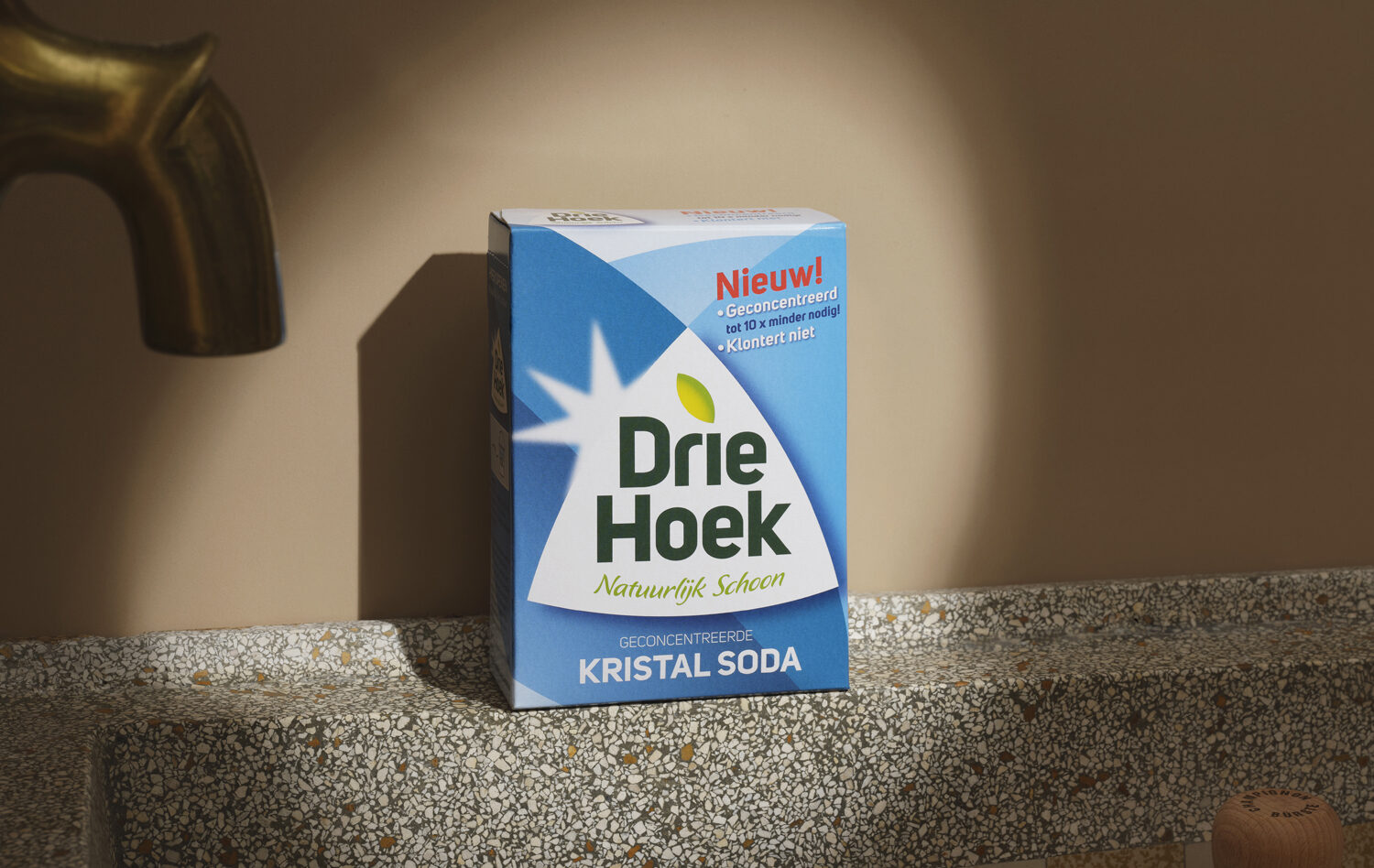
You can buy both decahydrate and anhydrous sodium carbonate in supermarkets. The "Driehoek Kristal Soda" is anyhdrous. It dissolves a little quicker than the decahydrate, and it also clumps less readily (provided you store it in a dry place!)
1770279051112.png


Of course, it doesn't matter which kind you use as long as you compensate for the difference in molar mass.

I always thought that stop bath instantly stops development so as long as what you see at the end of the development is what you want then the stop should retain that development
Under normal conditions yes, but those don't really apply in this case. OP is using a 15 second development time and the paper is not developed to completion (it's a paper negative, not a print). This means that small differences in the brief time the stop bath needs to penetrate the emulsion across the paper surface severely affect the image, since the developer can continue working in some places a second or so longer than in others. Which such a short development time (and hence, such a strong developer), this causes gross unevenness.

The solution as I've indicated before is to use a much, much slower developer and a longer development time.
 
OP
OP

case-ie

Member
Allowing Ads
Joined
Mar 28, 2013
Messages
43
Format
Multi Format
Very nice, this gets interesting, I used this one

550x719.jpg


I have had problems before and contacted the manufacturer and asked if their soda was anhydrous, they were very amused and told me that was not the case.
Anyway I will order the Driehoek soda. Thank you very much!
 

koraks

Moderator
Moderator
Joined
Nov 29, 2018
Messages
27,457
Location
Europe
Format
Multi Format
I'm familiar with that one as well; I used it back in the day when it still came in a green bag. That's decahydrate. I found it a little less convenient to work with because it clumps so badly and it takes longer to dissolve as well. The 'Driehoek' stuff is quite nice. The main problem with anhydrous sodium carbonate is that it's hygroscopic and over time (if exposed to normal air) will convert to monohydrate. This means that in practice, you never know for sure what the ratio between monohydrate and anhydrous in the box is. However, since the conversion rate is 1.17 or so, it's not a major issue in most cases and especially not in your application.
 

pentaxuser

Member
Joined
May 9, 2005
Messages
20,396
Location
Daventry, No
Format
35mm
Under normal conditions yes, but those don't really apply in this case. OP is using a 15 second development time and the paper is not developed to completion (it's a paper negative, not a print). This means that small differences in the brief time the stop bath needs to penetrate the emulsion across the paper surface severely affect the image, since the developer can continue working in some places a second or so longer than in others. Which such a short development time (and hence, such a strong developer), this causes gross unevenness.

The solution as I've indicated before is to use a much, much slower developer and a longer development time.

Thanks for the explanation I use a Nova slot processor so the paper is plunged in vertically and from the bottom to the top being covered is virtually instant ( a fraction of a second)

So OP you might want to try buying a Nova Slot Processor to see if my "virtually instant" is instant enough or the risk free and cheaper version is koraks' one

Have you tried his solution yet ?

pentaxuser
 

Raghu Kuvempunagar

Member
Allowing Ads
Joined
Jul 28, 2016
Messages
3,140
Location
India
Format
Multi Format
Why not let the development of the paper negative go to completion? Trying to control contrast of paper negative by shortening the development time and development by inspection is both inconsistent and prone to errors.
 
Photrio.com contains affiliate links to products. We may receive a commission for purchases made through these links.
To read our full affiliate disclosure statement please click Here.

PHOTRIO PARTNERS EQUALLY FUNDING OUR COMMUNITY:


Ilford ADOX Freestyle Photographic Stearman Press Weldon Color Lab Blue Moon Camera & Machine
Top Bottom