
We got an access to a lab at our university that has a commercial corona treatment unit. That worked very well for subbing PET and we were able to make coatings that survive any normal process perfectly.
We made a new emulsion, and this time it's fogless!
We used pig skin food grade gelatin and home-made silver nitrate again and used a modified version of PE's "A real formula" topic. We did the addition of silver in a similar way that is described at Jim Browning's website, but speeded up a bit.
We used a simple conductivity meter to measure wash water compared to conductivity readings of NaBr solution of 0.030 g/l, and found out that the washing step was quite quick, less than one hour. For final wash, we used NaBr at 0.100 g/l in wash water.
We used erythrosine now at 150 mg/mol of silver. Emulsion is now much more red (but still quite orange) than last time when we used 50 mg/mol.
ISO speed estimate is 25, when developed in XTOL 1+1 for 5 minutes at 24C. This was estimated by comparing to Agfapan APX100, developed in XTOL 1+1 for 7 minutes at 24C. When our film is exposed from the same stouffer step wedge but two stops more, it gives about the same shadow speed at the first visible step, thus being ISO 25. However, the toe is somewhat softer and it seems it's better shot at EI 16 or so.
Fog is almost nonexistent, like in any slow BW neg film.
Contrast is quite high. Maybe we should use the exact silver addition numbers in Jim Browning's document. Now we speeded it up by about 20%. This emulsion might be best shot at EI 16 and developed for only 4 minutes or so, with less agitation.
Film is flexible and runs well in Mamiya 7. we added sorbitol, reduced glyoxal to half and reduced blade opening to about 200 um compared to 300 um before.
Attachments:
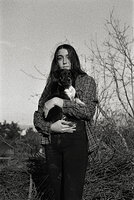
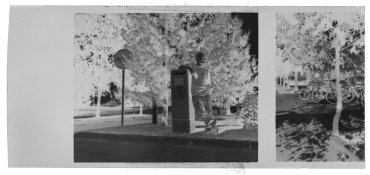
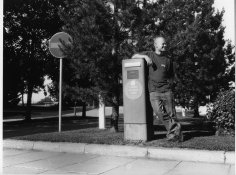
6x7 film scan - unfortunately I got only one full image since I taped the film at an incorrect position in the backing paper. Big version: http://www.students.tut.fi/~alhonena/emulsio2010/ekanega_1200dpi.jpg
Print on Kentmere 24x30 cm (9.5"x12") glossy. Contrast filtration of 0 ½. Print looks quite good, scanning is difficult as always. Big version:
http://www.students.tut.fi/~alhonena/emulsio2010/ekanegaprint_600dpi.jpg
Shadows on the left are blocked, but I metered with Mamiya 7 set at ISO 25 from the sunlit grass, so no wonder. The light was very hard. It seems from the Stouffer scale that the emulsion has 8 stops of good exposure range.
We are quite happy of these results!!! :munch:
To Be Continued!
We made a new emulsion, and this time it's fogless!
We used pig skin food grade gelatin and home-made silver nitrate again and used a modified version of PE's "A real formula" topic. We did the addition of silver in a similar way that is described at Jim Browning's website, but speeded up a bit.
We used a simple conductivity meter to measure wash water compared to conductivity readings of NaBr solution of 0.030 g/l, and found out that the washing step was quite quick, less than one hour. For final wash, we used NaBr at 0.100 g/l in wash water.
We used erythrosine now at 150 mg/mol of silver. Emulsion is now much more red (but still quite orange) than last time when we used 50 mg/mol.
ISO speed estimate is 25, when developed in XTOL 1+1 for 5 minutes at 24C. This was estimated by comparing to Agfapan APX100, developed in XTOL 1+1 for 7 minutes at 24C. When our film is exposed from the same stouffer step wedge but two stops more, it gives about the same shadow speed at the first visible step, thus being ISO 25. However, the toe is somewhat softer and it seems it's better shot at EI 16 or so.
Fog is almost nonexistent, like in any slow BW neg film.
Contrast is quite high. Maybe we should use the exact silver addition numbers in Jim Browning's document. Now we speeded it up by about 20%. This emulsion might be best shot at EI 16 and developed for only 4 minutes or so, with less agitation.
Film is flexible and runs well in Mamiya 7. we added sorbitol, reduced glyoxal to half and reduced blade opening to about 200 um compared to 300 um before.
Attachments:
6x7 film scan - unfortunately I got only one full image since I taped the film at an incorrect position in the backing paper. Big version: http://www.students.tut.fi/~alhonena/emulsio2010/ekanega_1200dpi.jpg
Print on Kentmere 24x30 cm (9.5"x12") glossy. Contrast filtration of 0 ½. Print looks quite good, scanning is difficult as always. Big version:
http://www.students.tut.fi/~alhonena/emulsio2010/ekanegaprint_600dpi.jpg
Shadows on the left are blocked, but I metered with Mamiya 7 set at ISO 25 from the sunlit grass, so no wonder. The light was very hard. It seems from the Stouffer scale that the emulsion has 8 stops of good exposure range.
We are quite happy of these results!!!
:munch: To Be Continued!
Attachments
Last edited by a moderator:

 .)
.)