• Welcome to Photrio!
    Registration is fast and free. Join today to unlock search, see fewer ads, and access all forum features.
    Click here to sign up

OM Zuiko 250mm f/2.0 (First Impressions)

Recent Classifieds

Forum statistics

Threads
202,820
Messages
2,845,933
Members
101,544
Latest member
Juergen Lossau
Recent bookmarks
0
Strange and complex interplay in the bokeh of a severely out-of-focus christmas tree. For these kinds of shots, the 250/2 works so much better than your average $10,000 50mm f/0.95 :smile:

Who ate the bokeh?
who_ate_the_bokeh__by_philosomatographer-d4l5o0c.jpg

(Zuiko 250mm at f/2.0, Ilford Delta 400, Olympus OM-1n, ugly direct scan - still need to make an optical print)
 
I like how enthusiastic you still are, two years on!
 
@philosomatographer: +1
 
I like how enthusiastic you still are, two years on!

One cannot help being perpetually enthusiastic about this solid hunk of mechanical art! I just post images to this thread as I discover them in my older negatives... Besides, the moment I stop being enthusiastic about this lens Ken N will be hounding me to donate it to his Olympus living history farm, where it would be enthusiastically appreciated indeed :laugh:
 
This comes at a massive weight cost, though it's not physically huge considering its specification. But the question remains:

WHY?

I'm not sure if your question is rhetorical, or if I am missing some nuance, but certainly most folks here understand the the relationship between the focal length, focal ratio, and the diameter of the front element. The laws of physics dictate that long, fast lenses are big and heavy; it's just the way the universe works.

If anyone knows how many of these were made it would be John Foster at www.biofos.com.

If you want to get some nice hand held color shots, Provia 400 can be pushed two stops with very good results. My problem with holding long, heavy lenses isn't so much getting the shutter speed fast enough, it is getting the focus and framing right when the shutter is snapped. I'm sure this is an excellent lens, but for practical purposes (and the few times I have need of a long lens) the 200mm f4 and wee f5 are much more practical. Add to these the T-CONs made for the IS System and you can get from 300mm to 380mm with almost no loss of aperture.
 
Great thread. Its nice to see rare equipment like this being put to good use!
 
I'm not sure if your question is rhetorical, or if I am missing some nuance, but certainly most folks here understand the the relationship between the focal length, focal ratio, and the diameter of the front element. The laws of physics dictate that long, fast lenses are big and heavy; it's just the way the universe works.

If anyone knows how many of these were made it would be John Foster at www.biofos.com.

I am afraid you misunderstood. The question, rather, is directed in the manner of "why would somebody, in this day and age, lay out a whole lot of cash for such a giant, rare lens made for a defunct camera system."

I am sure John Foster may have some answers, but his website is rather useless (and has been all these years). Page upon page of incomplete data with copy+pasted placeholders. I much more trust the collective knowledge of the Zuikoholics subscribed to the Olympus OM mailing list :cool:

all the best!
 
Very cool... :w00t:

I love how all the big and very fast telephotos can just knock out the background so easily into a creamy soup. mmmm
 
The heaviest lens I've owned to date was the Vivitar Series 1 70-210 f3.5, the first-gen Kiron 67mm version. Coupled with my Nikkormat, the duo falls 300g short of my entire Canon EF lens system plus one film body, and that includes the 70-200 f4L IS and 24-105 f4L IS. The only heavier lens I've used is the Canon EF 800mm f5.6 IS and it was on a tripod.

Canon makes a similar lens, a 200 f1.8, which is roughly as exclusive, as well as a 200 f2.0 IS, and from what I have seen it is the sharpest EF glass ever made.
 
Eventually I'll get the hang of this, Right?

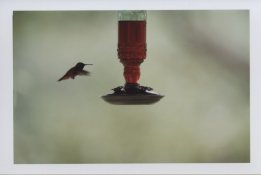
This isn't as easy as you might think. I've been playing around with one of these lenses for a little while now and the depth of field is almost non-existent at the closer distances.

Hummingbird-12.jpgHummingbird-8.jpg
 
I'm just resurrecting this thread to see if David has anything recent to show with this lovely lens. Still shooting film with it? Have you tried it adapted, on digital? If so, how's the CA?

I have the 350/28, and I find I get significant CA with it on mirrorless bodies, that I never noticed with film. Sometimes, I try to convince myself that the 350 and a Metabones Speedbooster Ultra, is the same as a 250/2. (Yea, silly me!) But the CA is still there on the Metabones.

Could it be the sensor stack interfering somehow?
 
Photrio.com contains affiliate links to products. We may receive a commission for purchases made through these links.
To read our full affiliate disclosure statement please click Here.

PHOTRIO PARTNERS EQUALLY FUNDING OUR COMMUNITY:


Ilford ADOX Freestyle Photographic Stearman Press Weldon Color Lab Blue Moon Camera & Machine
Top Bottom