



Andreas Thaler
Subscriber
In The correct flange focal distance: a prerequisite for the correct adjustment of a lens to infinity, we saw that
We will put this into practice
and measure the flange focal distance of an Olympus OM-4 with the depth gauge.
For the Olympus OM system, the flange focal distance is 46 mm.
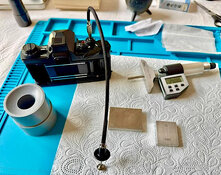
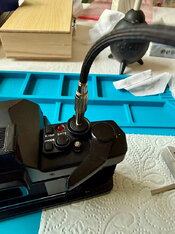
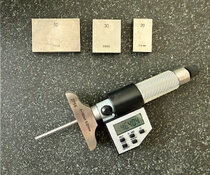
I use a lockable cable release, the depth gauge, two gauge blocks and a rubber cylinder.
Calibrating the depth gauge
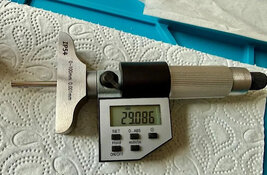
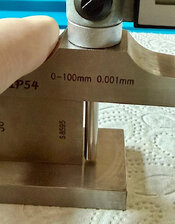
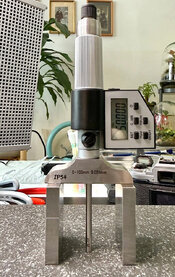
This depth gauge has a digital display. The measuring rod can be turned in and out of the bridge using a knob and handle. The device measures the movement of the rod with an accuracy of 1 micrometer (1 micrometer = 0.001 mm = 1×10⁻³ mm).
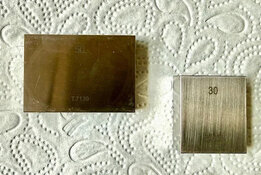
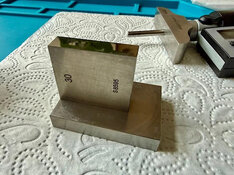
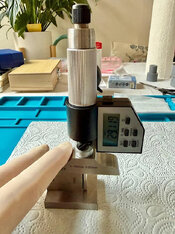
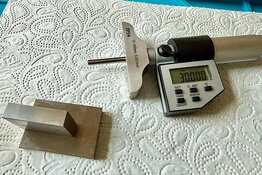
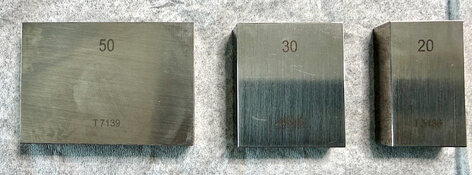
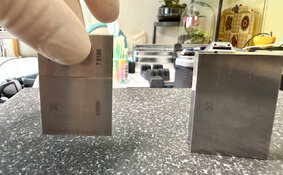
Before use, the depth gauge must be calibrated using two high-precision gauge blocks. For this purpose, I use a 30 mm high gauge block, which I place on a larger gauge block (50 mm) as a base.
Both blocks are made of steel and lightly oiled to prevent corrosion. Before use, they must be cleaned and then coated with a film of oil again. I use Ballistol, which is also known as gun oil.
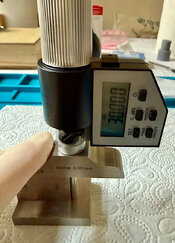
The depth gauge is firmly placed with its bridge on the smaller gauge block and the measuring rod is turned until it touches the lower gauge block and stops. This position is entered into the device as 30 mm. The depth gauge is now calibrated.
Measurement on the camera
Since we are working in the micrometer range here, even the smallest irregularities affect the measurement result.
The depth gauge must be carefully calibrated, the gauge blocks must be meticulously clean, all levels must be precisely aligned with each other.
The depth gauge must be pressed lightly against the gauge blocks and the lens mount, and the handle must be turned slowly in the final phase until the final value is displayed.
Minor deviations are unavoidable, so it is advisable to take several measurements in order to obtain a valid result.
Whether the film plane is parallel to the lens mount can be determined by taking measurements at various points on the gauge block.
The flange focal distance is the distance between the contact surface of the lens—the lens mount on the SLR—and the film plane.
This distance is precisely specified for each camera system from a manufacturer. This ensures that a correctly adjusted lens focuses accurately on the film plane at infinity. If the flange focal distance is incorrect, the image will be either in front of or behind the film plane and therefore out of focus.
We will put this into practice
and measure the flange focal distance of an Olympus OM-4 with the depth gauge.
For the Olympus OM system, the flange focal distance is 46 mm.
I use a lockable cable release, the depth gauge, two gauge blocks and a rubber cylinder.
Calibrating the depth gauge
This depth gauge has a digital display. The measuring rod can be turned in and out of the bridge using a knob and handle. The device measures the movement of the rod with an accuracy of 1 micrometer (1 micrometer = 0.001 mm = 1×10⁻³ mm).
Before use, the depth gauge must be calibrated using two high-precision gauge blocks. For this purpose, I use a 30 mm high gauge block, which I place on a larger gauge block (50 mm) as a base.
Both blocks are made of steel and lightly oiled to prevent corrosion. Before use, they must be cleaned and then coated with a film of oil again. I use Ballistol, which is also known as gun oil.
The depth gauge is firmly placed with its bridge on the smaller gauge block and the measuring rod is turned until it touches the lower gauge block and stops. This position is entered into the device as 30 mm. The depth gauge is now calibrated.
Measurement on the camera
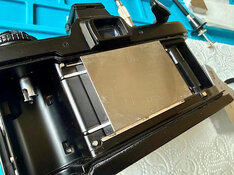
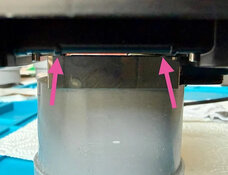
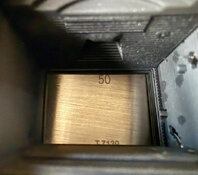
- The larger gauge block (50 mm) is placed on the two inner film rails and must lie completely flat. (There are also the outer film rails, on which the film pressure plate rests. The specific rails to which the flange focal distance refers is often listed in the manufacturer’s service manual and in the SPT Journal for the respective SLR).
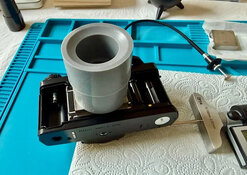
- The rubber cylinder is put on the gauge block, the camera is rotated 180 degrees and set down.
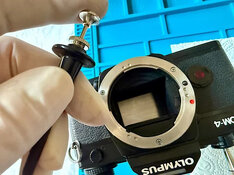
- I use the cable release to open the shutter in B(ulb) mode. The mirror flips up and the shutter opens. Both remain fixed in this position. The surface of the gauge block is now visible on the film plane.
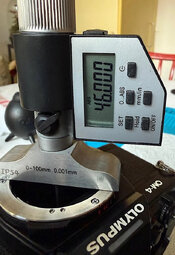
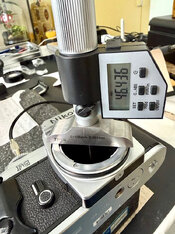
- The depth gauge is placed on the lens mount with its bridge (I measure the centre of the film plan here).
- The measuring rod is extended downwards until it touches the gauge block and stops.
- Now the measured value, the flange focal distance, can be read: 46,000 mm. That corresponds exactly to the specification.
Since we are working in the micrometer range here, even the smallest irregularities affect the measurement result.
The depth gauge must be carefully calibrated, the gauge blocks must be meticulously clean, all levels must be precisely aligned with each other.
The depth gauge must be pressed lightly against the gauge blocks and the lens mount, and the handle must be turned slowly in the final phase until the final value is displayed.
Minor deviations are unavoidable, so it is advisable to take several measurements in order to obtain a valid result.
Whether the film plane is parallel to the lens mount can be determined by taking measurements at various points on the gauge block.
Last edited:
 A word of caution