I now have some interesting information regarding this film. I had reached out to Maurice Fisher, who is the creator of the Ilford historical website at
http://www.photomemorabilia.co.uk/Ilford/Chronology.html. He consulted his references and his friend, Michael Talbert, a fellow APUG-er, who apparently owns a number of Ilford references. I also contacted Harman Technology Ltd.
Michael Talbert was very helpful, and identified the film, using an Ilford Professional catalog from the 1960's. Ilford made a special purpose film called RX Recording Film. It was used for recording traces from oscilloscopes, among other things. It had a thin, hardened emulsion suitable for high temperature processing. This is in line with the physical charactistics of my film. Michael's data also indicated that the film had an EI of 50 to 100 ASA. The film was sold on rolls of 300m (1,000 feet).
In addition, Sue from Harman Technology Ltd's technical services responded to me. She also indicated that the film was likely RX Recording film. She confirmed the 50-100 ASA working speed and the specialized nature of the film. Also, that while it was good in providing negatives, it was very good at providing reversal positives. The film was apparently also used to provide images of such things as racecourse finishes.
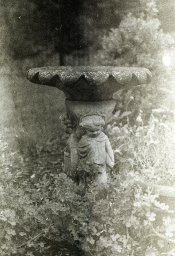
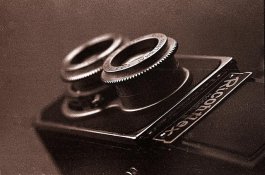
I was gratified by this information but still thought I had bought old film of doubtful use. I took some test shots this morning and developed them at lunch time. The results blew me away. The film has virtually no base fog. The negatives exposed between 25 and 50 ASA looked awesome. It was like I was looking at new film (but knowing there had been some speed loss). However, for some reason, my scanner is not doing justice to this Old School emulsion. I've attached one image, but frankly, the negatives have far more information in them than the scans. I am jammed for the next couple of weeks but will try to make some prints to scan to share here. It seems from the image that while panchromatic, the film may have a green bias, as the grass looks pale. I used a yellow filter but maybe I should try something different.
Imagine that someone leaves a digital camera SD card lying around for the next 48 years. What is the likelihood that someone could pick it up, put it into a then-current camera, and record an image? Just food for comparative thought.
Please give thanks to people like Maurice, Michael, and Sue at Harman for taking the time to do such an in-depth analysis of this single, long-obsolete emulsion. They clearly understand the value of keeping such information alive, and in my case it is especially valuable given my acquisition of about 400ft left of this very interesting and useable - emulsion.




 Seriously maybe Mr. Galley can help out. You've certainly got enough to test, why not snip some and start by treating it like Pan-F?