

• Welcome to Photrio!
    Registration is fast and free. Join today to unlock search, see fewer ads, and access all forum features.
    Click here to sign up

Old Film

Recent Classifieds

Forum statistics

Threads
203,291
Messages
2,852,468
Members
101,766
Latest member
Onetrick
Recent bookmarks
1

stevenje

Subscriber
Allowing Ads
Joined
Aug 3, 2013
Messages
71
Format
Multi Format
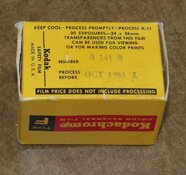
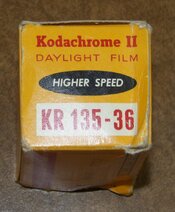
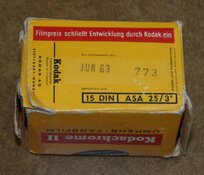
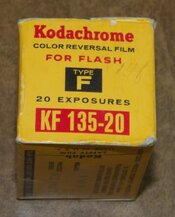
I found some old film while cleaning out a storage cabinet in the studio.

I thought it would be fun to share it with all of you.

The first roll is Kodachrome for flash. Process before Oct 1961.

The second roll is Kodachrome II daylight film-higher speed. Process before June 1963.
 

Attachments

  • #1.jpeg
    #1.jpeg
    198.2 KB · Views: 9
  • #2.jpg
    #2.jpg
    275.8 KB · Views: 8
  • #3.jpeg
    #3.jpeg
    291.5 KB · Views: 8
  • #4.jpeg
    #4.jpeg
    250.2 KB · Views: 7
Dont recall when Kodak moved from K 11 to K12 then K14, I think my first roll of Kodachrome 25 was K14m might have been K12, mid 60s.
 
The switch from Kodachrome II to Kodachrome 25 coincided with the switch from the K-12 process to the K-14 process.
I too had never realized that the K-11 process was a thing, but according to Wikipedia ...
1776199942084.png
 
My first roll must have been K12 with ASA of 40, but could have been 64. I did shoot a fair amount of ANSCO and later GAF 100 and 200, those slide have faded the Kodachrome still as bright as the day they were processed. I remember the day when would buy Kodachome with the mailer.
 
In most of the world, including Canada, all Kodachrome was sold with Kodak processing included. Both the cassettes and the film edge printing was encoded that way. Any mailer in the box was merely a convenience envelope. If you happened to send one of those rolls to a USA Kodak lab, they would process it for no extra charge - whether or not you used that convenience envelope.
 
In most of the world, including Canada, all Kodachrome was sold with Kodak processing included. Both the cassettes and the film edge printing was encoded that way. Any mailer in the box was merely a convenience envelope. If you happened to send one of those rolls to a USA Kodak lab, they would process it for no extra charge - whether or not you used that convenience envelope.

I personally did not use Kodachrome very often, the reason being you couldn´t process it yourself. And that was what I wanted to do. Only exception for this was Super8 movie film.'

I lived in Finland as a child and teenager (not in Lithuania, when it was occupied by the Soviets), and I recall Kodachrome being sold in two kind of rolls. One of them had a symbol of developed film, and the other had a symbol of a mounted slide. It meant if you bought the roll with the slide mount symbol, developing and mounting was included in the film price. If you bought the slightly less expensive roll, only developing was included.
 
When I worked in Italy processing was not included, in those days there was still a processing plant in Switzerland? I seldom shot slide film for the wires, but did shoot both Ektachrome and Kodachrome for personal use. As my house was near an U.S Air Force station my friends would buy me film at the base exchange including Kodachome with processing included. I also had a Poloroid slide process and had both color and black and white slide film. Grainy, colors were ok, but in the same league as Kodachrome.
 
Photrio.com contains affiliate links to products. We may receive a commission for purchases made through these links.
To read our full affiliate disclosure statement please click Here.

PHOTRIO PARTNERS EQUALLY FUNDING OUR COMMUNITY:


Ilford ADOX Freestyle Photographic Stearman Press Weldon Color Lab Blue Moon Camera & Machine
Top Bottom