

• Welcome to Photrio!
    Registration is fast and free. Join today to unlock search, see fewer ads, and access all forum features.
    Click here to sign up

Old Cameras in Old Movies

St Ives - UK

A
St Ives - UK

  • 4
  • 1
  • 96
Across the Liffey

H
Across the Liffey

  • Tel
  • Feb 25, 2026
  • 1
  • 2
  • 72

Recent Classifieds

Forum statistics

Threads
202,444
Messages
2,840,936
Members
101,333
Latest member
shanhw1978
Recent bookmarks
10
Not quite. The original remark was about a true stereo SLR, thus with a stereo finder. By turning your head with the camera you could experience stereoscopic view (as that camera reveiled it) even over panning.
Viewmaster only offered a static image. Seitz in contrast designed a film viewer that offered you a respective continuous stereoscopic view when you panned your film viewer.
 
Here's a classic among classics, James Stewart in "Rear Window" (1954) holding a beautiful Exakta VX ...

... and he's pressing down on the shutter speed dial, not the release.
 
... and he's pressing down on the shutter speed dial, not the release.

He's not actually shooting in this sequence, he's just using the camera as a spyglass because he cannot see close enough with his binoculars... however, now that you have pointed that out, I'll have to watch the movie again to make sure hahah
 
While watching a documentary about the trial of Japanese general Tojo, there it was. A photographer using one of my favorite cameras...a Kodak Medalist (a 6x9 120 camera with one of the best lenses made, the 100 mm Ektachrome. Couldn't tell if photographer was civilian or military, but cameras originally made to US Navy specifications during WWII.

To get that Kodak Medalist to use 120 film you would be forced to go into as completely dark room and respool the 120 onto 620 spools. All the Medalist cameras that I have dealt with took 620 film (Kodak's answer to the European's 120 film). Kodak lost. Even the 120 spools were/are superior to Kodak's 620 spools)..........Regards!
 
All the Medalist cameras that I have dealt with took 620 film (Kodak's answer to the European's 120 film). Kodak lost. Even the 120 spools were/are superior to Kodak's 620 spools)..........Regards!
I'm afraid that this isn't quite right.
Kodak invented 120 film - approximately 116 years ago.
And the Kodak Brownie No. 2 was the very first camera to use it.
See this thread for one member here's tribulations when he tried to use modern Kodak film in his somewhere between 82 and 116 year old Brownie No. 2: https://www.photrio.com/forum/index...o2-what-am-i-doing-wrong.147933/#post-1936511
(hint - some cameras that have a red window in an older location were left by the wayside when Kodak took steps to deal with wrapper offset problems with 120 film).
Kodak introduced 620 film at the same time they introduced Kodak cameras that took it. While there are some advantages flowing from the smaller 620 spool (mainly in regards to potential compactness) most likely the film and cameras were introduced together in order to assure that if someone bought the camera, they would only buy Kodak film for it.
They did the same thing with 616 film, which was otherwise identical to its fat spooled cousin, 116 film.
 
Kodak also did a similar thing with 828 film, which was basically unperforated 35mm film stock, introduced one year after 135 film. It also used a single spool and backing paper like 120.
The big difference with 828 is that it gave the user a larger negative or slide than obtained from 35mm.
Those Kodachrome 828 slides of my father's project wonderfully.
 
Eddie Constantine holding an Agfa Iso-Rapid 1F in Alphaville (1965)

Kpm50zy.png
 
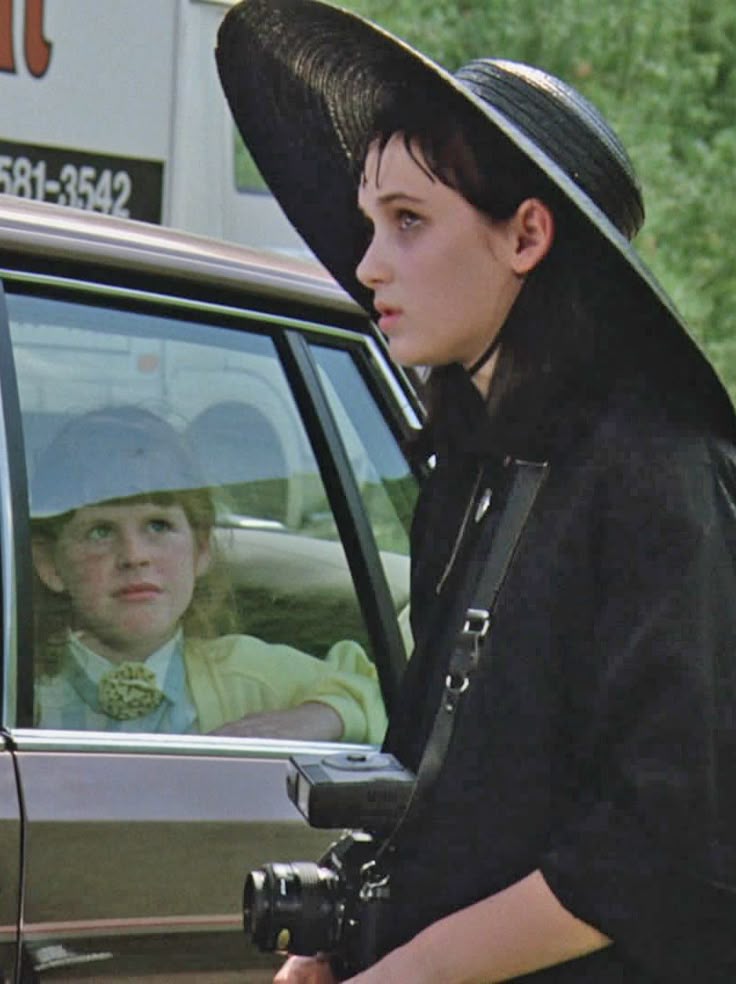
Beetlejuice (1988)

Lydia Deetz with her Nikon F301.

cf15ea194426ed4ee3f35d04bb5a25c8.jpg


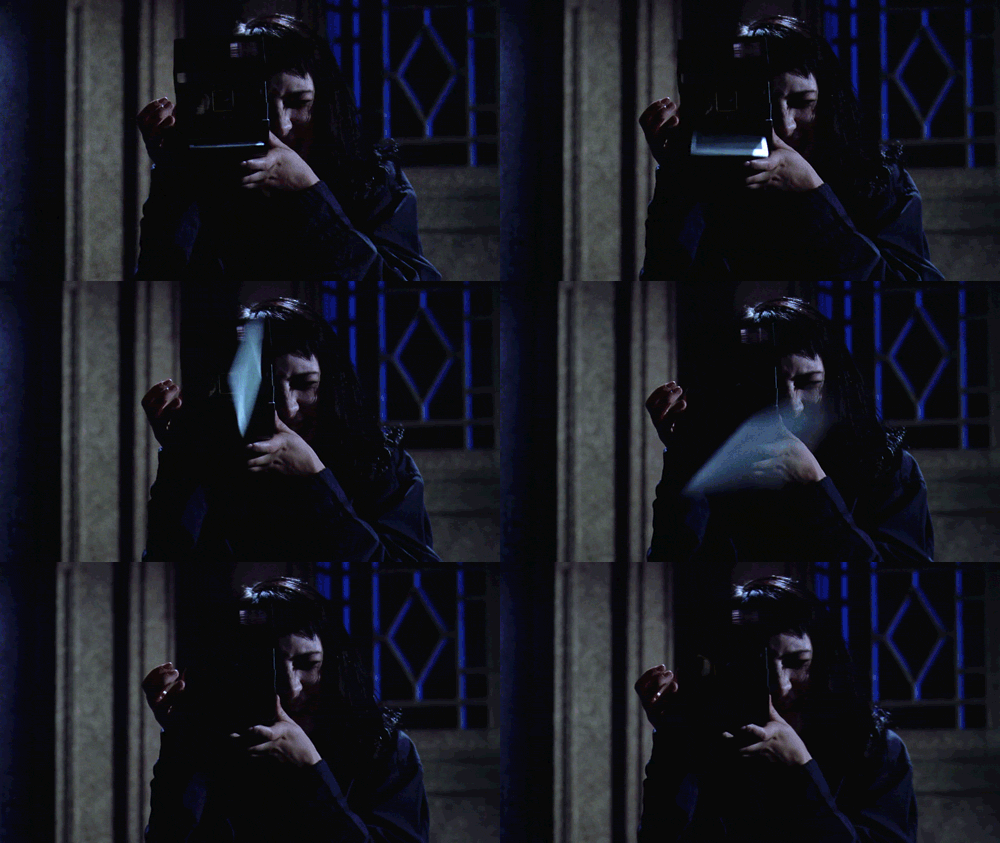
And here she use a Polaroid Sun 660

tumblr_oijxbnLQVd1vx0oo0o1_500.gif
 
I did not know that camera literally throws out the film.
 
Or it's CGI.
 
The big difference with 828 is that it gave the user a larger negative or slide than obtained from 35mm.
Those Kodachrome 828 slides of my father's project wonderfully.
I still have my Komaflex S, a leaf shutter SLR which used 127 film. The Kodachrome and Ektachrome slides from it used a conventional 35mm projector and were stunning, especially following 35mm slides. I mainly shot Ektachrome since I could process it myself. Sadly the Koma needs some shutter work, and the few, expensive 127 film hardly justify the repair cost.
 
I'm a big fan of auto racing, especially road racing -- as opposed to the roundy-rounds of NASCAR -- not that even NASCAR races can get exciting at times. A few days ago, I watched the other road racing classic -- Grand Prix (1966), starring James Garner. This movie has a lot more human drama -- and dialog -- than Lemans, but not so much as to spoil it for gear heads like me. So anyway, something else this movie has a lot of is cameras. There are several scenes where the drivers are surrounded by photojournalists, clicking madly away with their Nikons and Rolleis. So here are a few of the better ones I managed to capture.

Four stills and a Bolex:
grand_prix_screen_shot_1.jpg


A novel way to use a TLR:
grand_prix_screen_shot_2.jpg


Good ol' F with eye-level finder:
grand_prix_screen_shot_3.jpg


Pretty much a standard Hassy outfit:
grand_prix_screen_shot_6.jpg


I grabbed this frame because of the cameras in the background:
grand_prix_screen_shot_5.jpg


Three models striking poses trackside while the photographer is changing cameras:
grand_prix_screen_shot_7.jpg


There was more, but these were the best parts.
 
I'm a big fan of auto racing, especially road racing -- as opposed to the roundy-rounds ...

I'm a long-time Formula 1 and Le Mans fan - not very many movies to be found about either.

I don't even know whether the fans can still bring cameras to those events.
 
Early 50s, Destination Moon, on the moon what looks to be an unmodified Augusfelx TLR, with leather case, I think it's a Arugus. So NASA didn't need to take that expensive Hassy.
 
I missed that scene the scene I saw had one of the crew members have another stand under the earth to make it seem like he holding it up with on hand, he tripod looks like a Husky.
 
Leica M4-P and a Leica digital are featured in the 2017 film, "A Mountain Between Us."
 
How modern are you to consider a movie from this year to be old...
 
How modern are you to consider a movie from this year to be old...

I knew when I posted this movie that I would be chastised for mentioning such a new movie. However, I was so thrilled to see the Leicas prominently displayed in this movie that I was willing to risk the ridicule.
 
I knew when I posted this movie that I would be chastised for mentioning such a new movie. However, I was so thrilled to see the Leicas prominently displayed in this movie that I was willing to risk the ridicule.
It's forgivable. In fact, it's probably more interesting to see old cameras in new movies.
 
Then we should differ, are these new ones movies with a historic topic, or did a hipster or even a Apugger!!! got into the plot.
 
Photrio.com contains affiliate links to products. We may receive a commission for purchases made through these links.
To read our full affiliate disclosure statement please click Here.

PHOTRIO PARTNERS EQUALLY FUNDING OUR COMMUNITY:


Ilford ADOX Freestyle Photographic Stearman Press Weldon Color Lab Blue Moon Camera & Machine
Top Bottom