
• Welcome to Photrio!
    Registration is fast and free. Join today to unlock search, see fewer ads, and access all forum features.
    Click here to sign up

Odd Special Effect Filters, What do they do?

Forum statistics

Threads
203,442
Messages
2,854,781
Members
101,845
Latest member
azak
Recent bookmarks
0

Anthony Cronin

Subscriber
Allowing Ads
Joined
Feb 21, 2008
Messages
227
Location
Dublin Ireland
Format
Analog
I am relatively new to photography, anyway via Italy and a relation I got my hands on a lot of screw on filters. most I have figured out how and what impact they have these though elude me and as they are old the B+W site has no real information. nothing in the packets to explain.

I don't own a digital SLR camera to try them on, (except camera on smartphone) so before I go play with them with a film camera any information would be helpful.

So does anyone know, what is the impact of each filter and what conditions you might use them in or to what effect. Is it just daylight film?

lot one:


Lot 2:
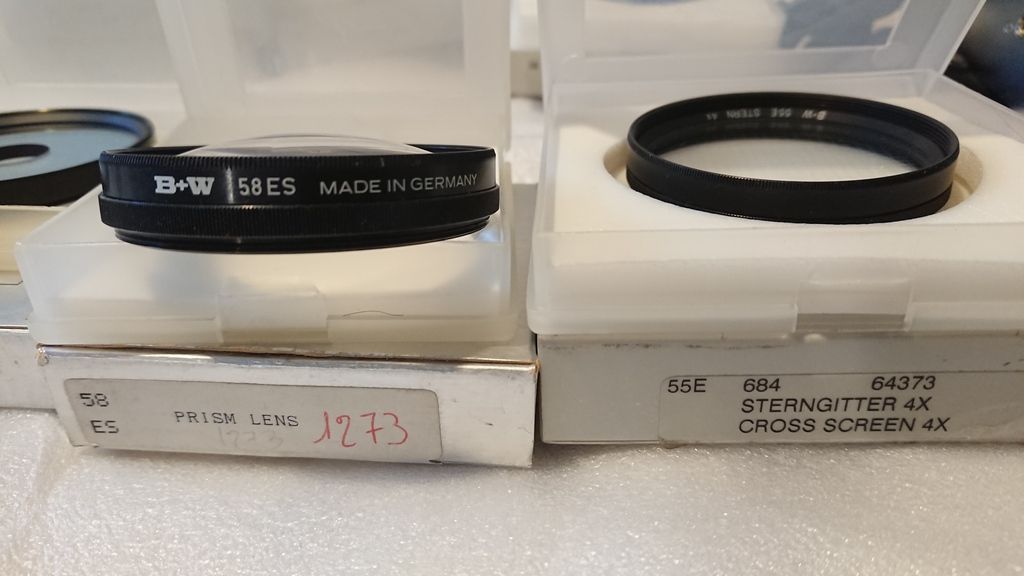


Lot 3
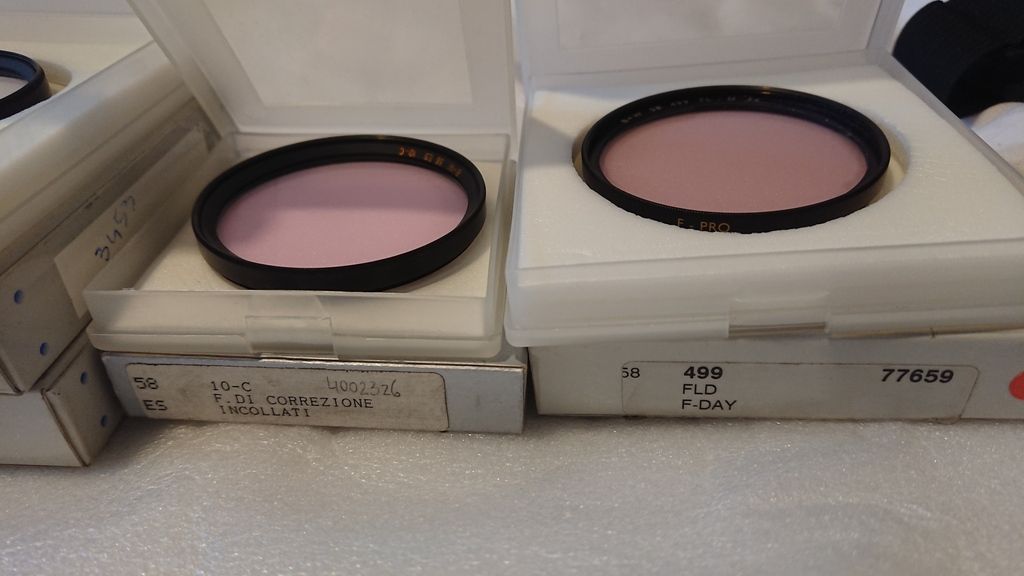


Lot 4
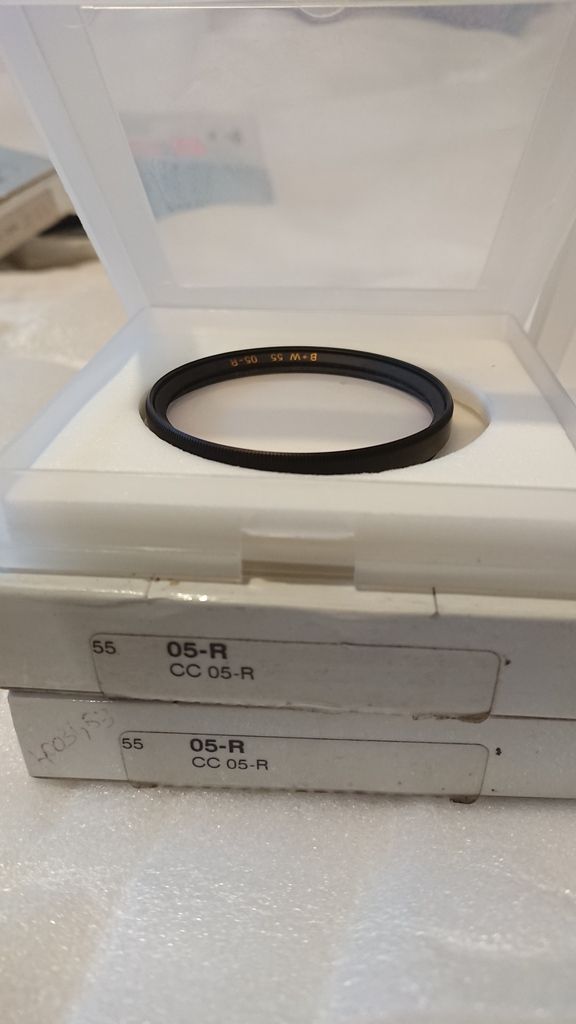

Thanks in advance.
 
-) a fun-tinted image with an unafffected center

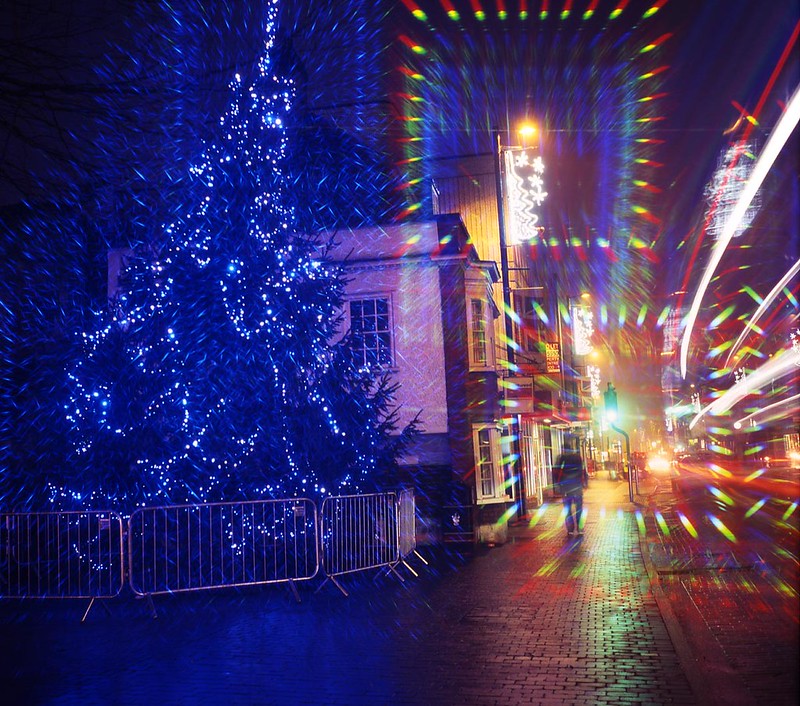
-) a repetition of images / a cross of light streaks originating at a point light source

-) ? / correcting the hue caused by daylight-TL lamps on daylight film

-) compensating slight hues


Try to find a teaching booklet on the use of filters.
 
There are some standard terms but also propriatory designations by filter manufacturers.

The designation of the TL filter is very irritating, as at least over here there are TL lamps designated Daylight which are of a spectral quality that does not need a filtration at all, but instead are even intended for photographic lighting.
But one anyway likely would not know the designation of the lamp itself unless getting it out of the luminaire. One could meter/test their spectral quality, which is not that easy, or better take photographs with and without such a filter.


Except for the TL-lamp filter all filters should show their effect on colour film visually by sight through an SLR equipped with same lens as for taking.
So, what you see is what you get...
 
Last edited:
The "Diamond Diffractor" filter is very different from what the OP has. As with his filter here rays originating at point light sources are produced. But in greater number, no longer just 4, and the rays itself are not homogeneous, as here not plain grooves or ridges are used but a giffracting grid resembling an array of microscopic prisms.

The effect of those coloured filters with a center hole varies with focal lenght and aperture.
 
Last edited:
I am relatively new to photography, anyway via Italy and a relation I got my hands on a lot of screw on filters. most I have figured out how and what impact they have these though elude me and as they are old the B+W site has no real information. nothing in the packets to explain.

I don't own a digital SLR camera to try them on, (except camera on smartphone) so before I go play with them with a film camera any information would be helpful.

So does anyone know, what is the impact of each filter and what conditions you might use them in or to what effect. Is it just daylight film?

lot one:


Lot 2:


Lot 3


Lot 4


Thanks in advance.
Sorry but, I think, they are of little use to serious photography; just fun and games; borrow a digital SLRor hold them in front of your eyes to see what they do and I'm sure 'you'll agree.
 
Well, a lot of commercial photographs were taken for instance with a cross filter of some kind.
Let alone correcting and compensating filters as shown above too.
 
Sorry but, I think, they are of little use to serious photography; just fun and games; borrow a digital SLRor hold them in front of your eyes to see what they do and I'm sure 'you'll agree.

+1

They can be used as ballast to balance a camera bag or used as coasters for drinks.
 
Actually I once acquired a large-diameter polarizer, that after wiping some smear off actually seemed to have been used as coaster, seen the scratches.

With todays prices of filters likely not even a bad idea...
 
The best idea, is "play".
They surprise, and are fun.
 
1) color surround, clear area in center.
2) Prism separates subject into X numbers of small images. X=# of sections IE five sections = five images.
4X cross screen gives a four point star from any point light or pont light reflection (sunlight on water), won't to anything to broad reflections
the effect is visible through the viewfinder and will change by changing f stop.
3) FLD used for daylight film under some fluorescent lighting. 10-C correzzione F. D1 a different fluorescent lamp?????
4) CC05 light red filter to correct slightly too much blue. For slides.
 
3) FLD used for daylight film under some fluorescent lighting.

As I indicated above, the Daylight most likely refers to the type of lamp. I cannot not find that filter in my B&W papers at the moment, they only advised to use CC-magenta filters instead, but the german importer Hama for instance in the 80s offered FL-D and FL-W filters for lighting withg Daylight and Warmlight TL tubes
 
In general though one should be very careful with filter designations. Many are just fantasy names, other are based on a propriatory ssystem. For instance ther term Schwarz may mean completely different filters.
Only if obviously the Wratten or Agfa designations are used one can may be sure. Otherwise one would have to look up the filter at the manufacturer's listing. If at hand...
 
Yup, The most accurate would be CC filters. In the US that's Wratten.
The FLD and FLB were really generic manufacturer numbers. Vivitar, Tiffen etc. These aren't used with specific
bulbs but "average" fluorescents. Proper filtration would use a combination of CC filter for a specific lamp.
The FL/FL just means the generally used lamp. The D is 5500k film, B is 3200k film.
 
Photrio.com contains affiliate links to products. We may receive a commission for purchases made through these links.
To read our full affiliate disclosure statement please click Here.

PHOTRIO PARTNERS EQUALLY FUNDING OUR COMMUNITY:


Ilford ADOX Freestyle Photographic Stearman Press Weldon Color Lab Blue Moon Camera & Machine
Top Bottom