Hi Pellicle,
By posting it here, I wasn't passing any judgements on the contents, nor that I agree or disagree. As I wrote, I just had a quick look through it, and thought it might be interesting to others, especially since I already knew another interesting article by Tim Vitale (
Film grain, resolution and fundamental film particles).
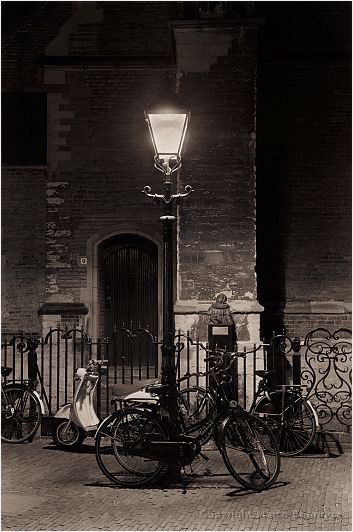
In addition, about DR, especially with BW film, there is an incredible amount that can be done to capture and manipulate it using adjusted development. Especially with pull developments in combination with deliberate overexposure like in Zone System. Just look at the image below, captured on TriX 320 with a 40% pull development and deliberately overexposed. I wish one good luck capturing such a night time image on a digital sensor, without introducing either hot pixels due to the long exposure, or terrible chroma noise due to high ISO or extended digital DR manipulation.
The good thing here with BW film is that, contrary to the digital solutions that are bound to cause at least some form of negative image degradation, the image actually
improves in the analog workflow. Doing a pull development in these high contrast night time situations significantly reduces the grain size, leading to a very nice fine grain, while the overexposure combined with the pull on the one hand allows detail to be captured even in the darkest part of the image, while at the same time limiting overall contrast. Just notice how there is detail in
both the shadows
and the highlights. The lamp light would probably have resulted in clipped pixels on a digital sensor, not so here. I haven't actually measured the total number of stops here, but I leave it for you to guess... it must have been big, and certainly much more than the average "5 stops" listed for normal development and film in general.
Obviously, with color film the situation is different, as there are generally less possibilities for push/pull development, without affecting the colorbalance negatively.
Marco