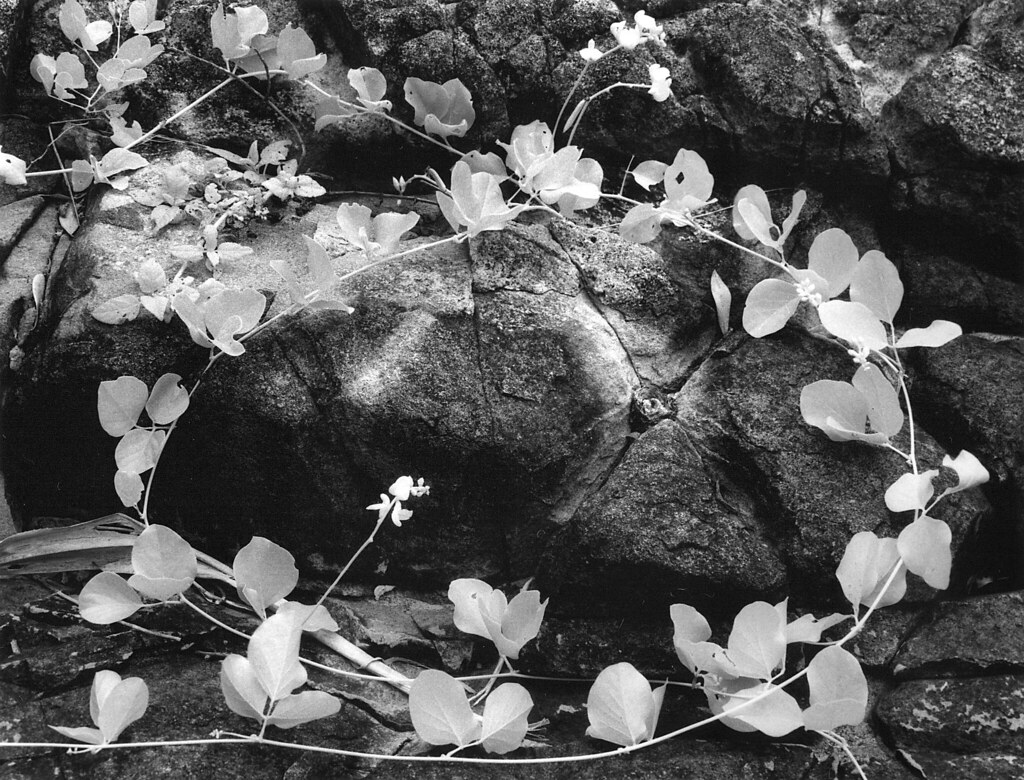
Ah yes, I left my old IR mantra out of the first note: Bracket, bracket, bracket! The film is working in a spectrum we don't see, that tosses some intuitive adjustments out the window, and there is no guarantee a meter sees the scene correctly -- for IR -- either.
In my wild younger years I shot some Kodak IR sheet film which I suspect was prior to the recently departed fast stuff. And I actually built a small meter with a silicon cell and an 89B filter on it. Being that was the early1960s, I have not even a vague recollection of if or how I calibrated it. (It's probably still in a dusty box around here somewhere.) I do have some of those shots around.
I think to get "good" IR effects you will want at least an 89B filter -- depending on where I look I see numbers around 695nm for a cutoff on that. I used 720 ("R72") pretty successfully with Rollei IR400, and a 760 worked well with the EFKE IR820 stuff. Some of the filters lingering around have cutoffs in the upper 800s and lower 900s; those I fear will act like aluminum plates in front of today's films. Just to go from a 720 filter to a 760 with the Rollei IR400 required an additional five or six stops exposure. (With an 860 filter you would need a lounge chair!) I wish I could show some A, B, C comparisons, but the three filters I have are three different sizes and either are not big enough or I lack the plumbing fittings to attach some filters to some cameras. My last efforts used my Yashica 124G with a Bay1 to Series VI, adapted up to Series 7(!) to work with the 89B. I like the TLR because one need not look through or remove the filter for composition, etc. Series 7 with a shade does put a ghostly blur across the lower quarter of the viewfinder, unfortunately. (I occasionally look through ePrey for Bay 1 IR filters, but fear if I ever do find one it will be about $100 more than I'm willing to spend.)