• Welcome to Photrio!
    Registration is fast and free. Join today to unlock search, see fewer ads, and access all forum features.
    Click here to sign up

Non silver based emulsion

Puddle

Puddle

  • 1
  • 2
  • 37

Recent Classifieds

Forum statistics

Threads
202,716
Messages
2,844,614
Members
101,485
Latest member
minhnk1990
Recent bookmarks
0
Lotsa photographic "emulsions" don't use silver: platinum.palladium,gold. Too slow for in-camera and more costly than silver.
Someone once posted a link,on this Forum, to an organization that collected fat from human lipo-suction and fed it to people in poor countries. It sure looked serious. But one never knows.
Bill
 
Also, Dose not the usefulness of pee as a developer depend on the pH of the individual's pee? I t can be acidic or alkaline, depending on one's diet.
Bill
 
So next time I produce a print that "looks like sh*t", maybe it's not all bad :smile:
 
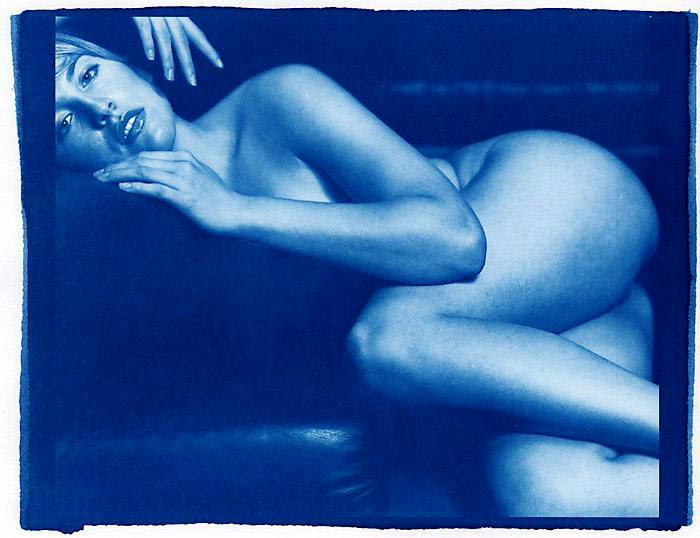
The obvious answer here is try cyanotypes. Mix potassium ferricyanide with ferric ammonium citrate in distilled water. Coat some paper with the solution, and wait for it to dry. Get a negative the size of print you wish to make and put the negative on the paper, then place the two in the sun, or other ultraviolet light source. Depending on your negative, exposure time is 10 minutes, to three hours. Practice makes perfect. No silver involved. It's iron based. The resulting image is very stable if kept out of direct sunlight. The particles are actually called Prussian Blue. But, you do have to deal with blue images.
4caf3dc13739b.jpg
469e9f486d64f.jpg
 
Last edited by a moderator:
I mix 10 grams ferric ammonium citrate in 35ml distilled water, then 4 grams potassium ferricyanide in 35ml distilled water. Store in separate containers and keep the containers in a dark drawer. When you want to make some prints, mix equal amounts of the two solutions together. The chemicals are cheap. 100 grams of ferric ammonium citrate is around $12.00 dollars U.S. A pound of potassium ferricyanide is around $15.00 U.S. That'll make many hundreds of 8x10 inch prints.
 
The obvious answer is not always the best.

How about speed and spectral sensitivity.

How about a lot of other things!!!!?

PE
 
Wow, those blue images are amazing, made me look up cyanotypes. But is there a process that makes red images??
 
Well, I have made quite a few cyanotypes which require a lot of UV radiation for exposure.

They are very nice, albeit blue, and can be toned to yield other colors.

So, on to the other things. Do you want speed? Do you want to use it in-camera? Do you want to capture the image roughly as the eye would see it? These are things that Silver Halide does for us, so we need to find another method for giving us an all round imaging material, and not just a single purpose imaging material.

PE
 
Wow, those blue images are amazing, made me look up cyanotypes. But is there a process that makes red images??
The reddest images I've seen anywhere were from very lightly gold toned POP paper made by ...I can't remember the name. I think Centennial out of Chicago. But, sadly, I'm not sure they still make paper. When they did, it was only once a year, and they sold out rather quickly.
You can get redd'ish' tones from straight gold prints, Chrysotypes they're called. But, at this time, they're extremely expensive to produce. Not exactly giving away gold at the moment. Look them up here:
http://www.alternativephotography.com/wp/processes/chrysotypes/new-chrysotype-process
If you're not familiar with at least one hand coated process, start with cyanotypes first, then move on, otherwise you'll go broke rather quickly learning with gold. The learning curve for hand coated processes is steep at the beginning.
 
Last edited by a moderator:
Well, I have made quite a few cyanotypes which require a lot of UV radiation for exposure.

They are very nice, albeit blue, and can be toned to yield other colors.

So, on to the other things. Do you want speed? Do you want to use it in-camera? Do you want to capture the image roughly as the eye would see it? These are things that Silver Halide does for us, so we need to find another method for giving us an all round imaging material, and not just a single purpose imaging material.

PE
Get a digital camera. In the original post, nothing you mention is an issue for the poster. It only seems to be an issue for you.
Ron ,

May be answer is hidden in the depths of Alternative Photography. But I want to ask , is there any chemical invention from Kodak , Agfa or any other , which chemical is available at the market for making non silver based cheaper faraway cheaper emulsions ?

I heard american companies are famous to dig deep inventors. Is there any whisper or patent , you saw , heard and share with us ?

Thank you ,

Mustafa Umut Sarac

Istanbul
Here is the OP. Maybe, you have reading comprehension issues?
 
Last edited by a moderator:
I was answering your post #34 relating to other things involved in imaging or imaging qulaity.

I am quite aware of all of the methods of making images other than Silver Halide. More than you might imagine. I was merely pointing out that of all of these methods, Silver Halide offers the most advantages when compared to these others.

You seemed to have missed the point.

Theo OP asked about alternative EMULSIONS, and you have not addressed that point, as Cyanotype is not an emulsion. I did address it in my post about Copper imaging. It is a true photographic emulsion.

PE
 
*cough cough*

If I may interject...

Those are really beautiful cyanotypes for one. I do know however that Umut is probably looking for something more exotic and esoteric, and of a theoretical vein. Umut is rarely looking for something practicable to do; but is more interested in what's possible in theory. So I think that's the point of view that PE is coming from.

I smelled something getting a little hot and thought I should open a window...

Just my 2¢
 
Photo Engineer is older than my father and crown jewel at this forum . I am very satisfied with his copper answer. Its hot and life is not easy , lets not make it harder for anyone.

Thank you PE for everything ,

Umut
 
But is there a process that makes red images??

One of the old photos mags in the 70s had an article on making reddish colored prints using copper. The color was red, with a bit ot brown tint, if I remember right. It needed UV to print, and the time I played with it I never got a very deep D-Max on the prints.

The process uses copper sulfate, sodium citrate, sodium acetate, and potassium ferricyanide.

Here's an example I found on the web:
http://www.flickr.com/photos/36743746@N07/7183103554/in/set-72157629874246054/

And a nice article on it:
http://silverghost.stanford.edu/copper/index.html
 
Has uranium printing been mentioned for red? If not... uranium.
 
Photrio.com contains affiliate links to products. We may receive a commission for purchases made through these links.
To read our full affiliate disclosure statement please click Here.

PHOTRIO PARTNERS EQUALLY FUNDING OUR COMMUNITY:


Ilford ADOX Freestyle Photographic Stearman Press Weldon Color Lab Blue Moon Camera & Machine
Top Bottom