

• Welcome to Photrio!
    Registration is fast and free. Join today to unlock search, see fewer ads, and access all forum features.
    Click here to sign up

Non-obvious reasons to use movements

Forum statistics

Threads
202,513
Messages
2,841,720
Members
101,357
Latest member
Kenscanners
Recent bookmarks
0

Poco

Member
Allowing Ads
Joined
Sep 7, 2002
Messages
652
Format
Multi Format
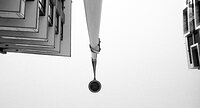
I was shooting in downtown Toronto during the APUG conference and was setting up a shot with the CN tower in one corner when I hit against the problem of how to avoid the (usually) ugly distortion of curved objects not placed dead center with the use of wides. I was looking at the ground glass and the weird shape I'd distorted the top of the tower into when a possible solution hit me. I reframed the shot with the tower dead center, which got rid of the distortion, and then used shift to get it back to the right position within the composition. Now this may have been a "duh" moment on my part, but I honestly half expected it not to work, and for the curves to go loopy on me again as I shifted ...but of course they didn't. And mediocre final photo notwithstanding, it kinda tickled me.

So let's hear it -- what other not so obvious uses have you found for camera movements? I've also used shift or rise/fall to use light fall-off to good advantage, but there must be other uses I haven't thought of.
 
Other uses of side shift include "horizontal rising front" in other words avoiding the same kind of distortion that you get from pointing the camera upwards, but on the horizontal plane, and the classic of taking a picture which appears to look straight into a mirror but in which the camera does not appear. This latter principle can be applied to any shot with a pesky reflection that you can't get rid of any other way.

Regards,

David
 
I've always enjoyed using movements to lend a bit of surrealism to my images. I appreciate and greatly enjoy "straight" photography but for my personal work, both painting and photography, I prefer reality to be just a little bit "off".

Pretty much all I shoot anymore is LF and Dianas.
 
Shift is often underused. Another case would be when you want to look straight down a corridor, but you don't want the corridor to be in the center of the frame, and the same might apply to a street or alley or a row in a field.

You can also make a pano with shift by taking two shots one shifted fully to the left (or with as much shift as makes sense for a particular lens) and one shifted fully to the right. If you've got rear shift, that's better, since the lens stays in the same place, but for landscapes without too much foreground, front shift usually works as well.

A less obvious use of front rise/fall and shift is to take advantage of the falloff of a wide lens to darken a sky or put the hotspot over the focus of visual interest.
 
Center the face in the ground glass for a portrait then axis tilt the back and swing the lens, check the center focus and shoot. this gives a sharp face and vignettes the edges. More tilt/swing more blur.
 
Here is one of my many "doh!" moments.

I have frequently shot buildings up hill using base forward tilt on both standards, with the camera base not level, but going uphill. (You do this when the incline is steep enough that front rise doesn't do the job, or leads to vignetting.) At the recent NEAPUG LF portrait workshop in March, I was trying to shoot a sitting model, and having problems, when JamesG kindly took me aside and pointed out that the symmetric setup - camera base pointing downhill, with backwards base tilt on both standards - solved the problem.

Exact same problem, only downhill instead of uphill. Doh!

-Bill
 
D'oh to ah'ha

Thanks Michael, you just explained why one of my photo's has a distorted sink in it. I asked a number of people why it happened or how to correct it. No one could give me an answer. Wish I could photograph it again but the building is gone now. Oh well, I'll be ready for the next time this problem comes up.

Michael
 
Last edited by a moderator:
m'pleasure, Michael. It always feels like a small miracle when a post of mine proves helpful to someone.

Lot's of good input from people so far. Hope others chime in with more ideas.
 
Most non-obvious reason to use movements? Because we can! (insert evil laughter sound here).
 
Many people use movements to bring something into focus. For some situations e.g. portraits, it can be used to throw an ugly background OUT of focus.
 
I did a series of photos of doors a while back, often, when there was glass in the doors, I would want it to reflect something in particular, which dictated the camera position. In that case, movements are required to frame the photo.
 
Photrio.com contains affiliate links to products. We may receive a commission for purchases made through these links.
To read our full affiliate disclosure statement please click Here.

PHOTRIO PARTNERS EQUALLY FUNDING OUR COMMUNITY:


Ilford ADOX Freestyle Photographic Stearman Press Weldon Color Lab Blue Moon Camera & Machine
Top Bottom
