OP....know this too...the focusing barrels of 3rd party manufactured lenses rotate in the opposite direction of NIkon lenses and that can be a bit confusing when focusing fast....
Depends on the third-party brand:
For the ZF and ZF.2 glass, this is certainly not true - actually, in their "Z" line of lenses Zeiss takes care that the focus always operates in the right direction as for the given OEM. ZE lenses focus the other way as ZF lenses do.
However, my one Sigma HSM lens does focus the other way around as Nikon glass.
To add to the OP's case, all Nikon mount lenses will
work on the F4 that he got. 'G-Type' lenses (w/o aperture ring) will work only in 'P' and 'S' modes, as these control the aperture from the body. 'DX-Type' lenses will work on any body that is able to control the lens' aperture from the body, as these lenses always also are 'G-Type' lenses.
'DX-Type' lenses, depending on the lens' construction, will show more or less vignetting when used on 35mm (or digital FX in full-frame mode) bodies. This may be an practical issue or may not, and even can be used to one's advantages in some cases. E.g. the 35mm/1.8 DX lens, from the samples that I've seen, shows nearly no vignetting on 35mm frame if used near the close-focus limit. It shows noticeable, albeit not too strong, vignetting at further distances. The 10.5mm DX fisheye can be modified by sawing off the lens hood and then nearly becomes a circular fisheye for the 35mm frame (a bit of the image circle seems to be cut off at the top and bottom edges, from the samples I've seen).
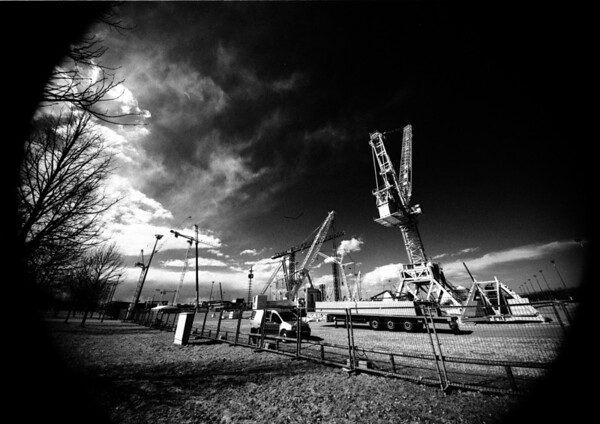
I myself have used the Sigma 10-20 DC (equivalent to 'DX' from Nikon) lens on the F5. If one takes off the lens hood, one gets a cut-off circular image on 35mm, which together with the super-wide angle (at 10mm!) offers some interesting possibilities.
See this for example (slight crop at the left and right sides):