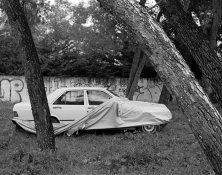
Yes, the print would be less grainy. I will try to find time to make a print next weekend.
1. The roll of film was exposed in low contrast lighting. When the lighting is flat, and you want a full range of tones in your negatives you have to look at what you're photographing, think about how it's going to print, and then expose and process the film accordingly.
Flat lighting = low contrast = no real black anywhere in the scene, and no real pure crisp white either. Normal exposure at 160 and normal development would have provided me with a flat negative. So I exposed at EI 200 to get the almost black in the scenes down to true black, and then I develop longer to raise the mid-tones and highlights up to a full tonal range. This is quite normal.
Digitaltruth is good for finding a starting point, but you can't expose and develop your film the same way regardless of what the lighting conditions were. That will give you negatives that aren't the best they can be.
2. Agitation is a tool, same as developer dilution, developing time, developer temperature, film exposure, etc. I happened to have one more roll of film in the developing tank, a roll of Acros that I had shot at EI 400, and it also needed longer developing time. But it had brighter highlights, so in order to get highlights in that roll of film that did not block up and raise the contrast too much, I had to slow down agitation.
So, the Foma roll is a bit of a compromise. I could have used Dilution H at 12 minutes and agitated every minute for almost the same results. The highlights would have been a little bit more intense, and probably a bit more interesting. This is what I would have done if I had processed only the Foma film and not shared the tank with the Acros film.
See, you have to do your own testing, contact sheets, and prints on your paper, your developer, in your lighting conditions, with your light meter, etc. There is no happy medium for every single picture. Each situation is unique.
It's pretty simple too. If you don't have enough contrast - develop longer. If you don't have enough shadow detail - expose more. If your highlights are too intense, develop less, or slow down agitation, or both. It's a system, and you develop the film to fit your paper and paper developer combination.
I developed this film targeting a good print at Grade 2.5, which is what I do with all my negatives from 35mm. Sometimes they print well at Grade 1.5, and other times at Grade 3.5. But mostly Grade 2.5 is right on target. It makes printing much easier if the negative is great.
With the Foma 200 roll I processed in HC-110 I just wanted to prove that it could be done - and it can, of course. It may not be possible to use Dilution B, because the developing times might be too short to obtain evenly developed negatives. But Dilution B isn't the only way to use this developer.
Good luck.
- Thomas