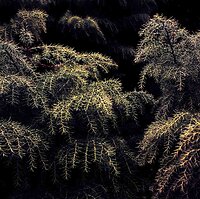
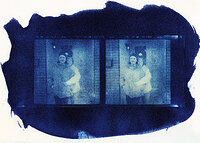
My agitation technique was basically turning the tank upside down (180 degrees) 4 times in quick succession every minute. Between agitations I would also 'swill' the tank round in a clockwise manner to flush the developer round the outside edge - not too hard but just enough to mix it around. I suppose though that that may have caused a wave like effect? I didn't shake the tank and it was on it's own with no other reels above it.
When you say that "between agitations I would also 'swill' the tank round in a clockwise manner," do you mean you did this continuously? If so, don't. That could conceivably be the cause of the problem. If you just gave the tank a single little "swill" after inversion, though, that should be OK (I do something similar myself; I give the tank a sharp twist after each set of inversions).
I did not use the little central rod to twist the reel inside round. I didn't realise I needed to. Is this where I have gone wrong perhaps?
Unlikely. Rotating the reels via the rod is an option for agitation, not a necessity. There are many different agitation styles and methods. The trick is to pick one and learn to use it. I suppose you could try twirl-stick agitation rather than inversion agitation; it's conceivable it'd work better for you. See (there was a url link here which no longer exists) for a recent discussion of this method, if you care to give it a try. If you were doing a continuous "swill" between inversions, though, I'd suggest you stop doing that before trying twirl-stick agitation.
I simply followed the intructions I read in an old weekly photographic circular dating back about 14 years called 'Camera Wise'. It just said "Tip the tank upside down several times..." with regard to agitation so I had no idea it was such a fine tuned procedure.
It is and it isn't. As I say, there are many different agitation techniques. Many work. Some don't. If what you've got is an agitation problem, you've stumbled upon an agitation method that doesn't work, and you just need to adjust it in some way to get into one of the many zones that
does work. Unfortunately, it can be hard to describe how to do agitation.
Does anybody know of a YouTube (or similar) video demonstrating film agitation? I think this is a case of "a picture's worth a thousand words," and of course a video is made up of many pictures!