
• Welcome to Photrio!
    Registration is fast and free. Join today to unlock search, see fewer ads, and access all forum features.
    Click here to sign up

My newly made MO-1925 era Film

Iriana

H
Iriana

  • 4
  • 1
  • 62
Puddle

Puddle

  • 4
  • 2
  • 101

Forum statistics

Threads
202,734
Messages
2,844,784
Members
101,489
Latest member
Sunnydoran
Recent bookmarks
0

Mark Osterman

Member
Allowing Ads
Joined
Sep 7, 2011
Messages
67
Format
Large Format
Never quite sure where to post this sort of thing. Please let me know if there is a better place.

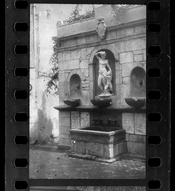
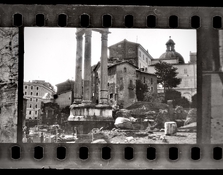
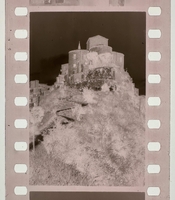
I’ve been working on a Leica Centennial Project of making the same type of film that would have been available when the Leica camera was introduced. Three weeks ago I made a run that is about where I want it. This is a violet / blue (not ortho) emulsion sensitize with sulfur to around ISO 12-15 and I coated the back with a pink hue anti-halation layer on the back.

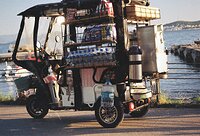
I took two rolls of my film to Sicily and Rome a couple of weeks ago to give it a test and came back with some nice imagery. Sort of felt like Oscar Barnack. Very satisfied with the results.
 

Attachments

  • IMG_0034.jpeg
    IMG_0034.jpeg
    383.6 KB · Views: 186
  • IMG_9657.jpeg
    IMG_9657.jpeg
    1.3 MB · Views: 175
  • image0.jpeg
    image0.jpeg
    1.4 MB · Views: 194
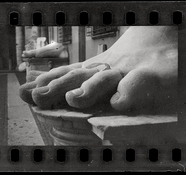
Some more pictures, taken in Rome last week. This shows the actual color of the negative with the anti-halation coating. It accounts for some visible noise in the D-min areas. It is easily removed with a dilute alcohol wash but I decided to leave it on these two rolls of film for reference.
 

Attachments

  • IMG_0049.jpeg
    IMG_0049.jpeg
    357.7 KB · Views: 134
  • IMG_9717.jpeg
    IMG_9717.jpeg
    1.6 MB · Views: 119
Extremely impressive accomplishment !

But I have to say that the images as shown seem (to my eyes) to have gone through some digital enhancement, maybe grain smoothing and edge sharpeneing? Especially for these images I feel it would be best to see them in their natural state so to speak.
Can you please give some details on the workflow from your film to the posted images?

And of course I'm sure many readers would like to know more on the fabrication.
 
Sort of felt like Oscar Barnack.
But hopefully less asthmatic! All joking aside, this is really, really great.

And of course I'm sure many readers would like to know more on the fabrication.
There's another thread on this where @Mark Osterman announced his success earlier; you might want to check it out as it contains some (maybe not all) of the answers you're looking for:
 
Extremely impressive accomplishment !

But I have to say that the images as shown seem (to my eyes) to have gone through some digital enhancement, maybe grain smoothing and edge sharpeneing? Especially for these images I feel it would be best to see them in their natural state so to speak.
Can you please give some details on the workflow from your film to the posted images?

And of course I'm sure many readers would like to know more on the fabrication.

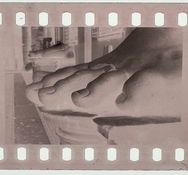
Hello. I don’t have a scanner for documenting the film I made. I shoot pictures of the negatives on a light table and then invert them to positive. One of these days I’ll look into getting better equipment for documentation but for now that’s the best I can do. Also I have left the anti-halation coating on these test rolls so that I have that coating for reference. It can leave some “noise” in the image most notable in the D-min areas. Here is one of the negatives without manipulation … hope that helps.
 

Attachments

  • IMG_0033.jpeg
    IMG_0033.jpeg
    356.8 KB · Views: 81
Hello. I don’t have a scanner for documenting the film I made. I shoot pictures of the negatives on a light table and then invert them to positive. One of these days I’ll look into getting better equipment for documentation but for now that’s the best I can do. Also I have left the anti-halation coating on these test rolls so that I have that coating for reference. It can leave some “noise” in the image most notable in the D-min areas. Here is one of the negatives without manipulation … hope that helps.

Here is the actual film without the anti-halation coating. It is a very typical silver bromo-iodide and the yellow color is characteristic of that type of emulsion. You can find this on unexposed gelatin dry plates and other very early flexible films.
 

Attachments

  • IMG_9602.jpeg
    IMG_9602.jpeg
    1 MB · Views: 78
Here is the actual film without the anti-halation coating. It is a very typical silver bromo-iodide and the yellow color is characteristic of that type of emulsion. You can find this on unexposed gelatin dry plates and other very early flexible films.

Mark,

Fabulous work!

What is the maximum length of film that your machine can coat in a single run? And how long does the film need to dry after coating?

-- Raghu
 
Mark,

Fabulous work!

What is the maximum length of film that your machine can coat in a single run? And how long does the film need to dry after coating?

-- Raghu

My machine is a experimental loop coater. It could coat around twenty feet I suppose, but I have is set for around 6 foot.
 
Photrio.com contains affiliate links to products. We may receive a commission for purchases made through these links.
To read our full affiliate disclosure statement please click Here.

PHOTRIO PARTNERS EQUALLY FUNDING OUR COMMUNITY:


Ilford ADOX Freestyle Photographic Stearman Press Weldon Color Lab Blue Moon Camera & Machine
Top Bottom