• Welcome to Photrio!
    Registration is fast and free. Join today to unlock search, see fewer ads, and access all forum features.
    Click here to sign up

My Lucky Day-100' roll of Mystery film....

Recent Classifieds

Forum statistics

Threads
202,065
Messages
2,834,564
Members
101,094
Latest member
not_cal
Recent bookmarks
0

Greg Heath

Member
Allowing Ads
Joined
Jul 13, 2008
Messages
591
Location
Racine, Wisc
Format
Medium Format
I just bid on 2 old Bakelite Lloyd's bulk film winders. They both look the same age. They were from an estate sale and were really old an dusty. The one that was empty I opened up and the steel stalk in the middle was rusted really bad. The other one was in better shape, and was allot heavier. I opened the film canister tray lid and there was a stub of film. By holding a fresh roll of Tri-X and the other empty winder, I would say there might be between 75-100 feet of unused mystery film on it. So what I did was take a guess and I wound about 10 frames on a spool and shot it today at 200. I just got done developing it in Stock D-76 for 5 minutes to see what would happen. Well the film was underexposed, so tomorrow I will try shooting it at 50 and see what happens. I am trying to date the film and I have no idea. I stopped by my Camera shop and they guy who does the processing says he's never seen this film before and he has been there awhile, as he's the old timer there. The film has no brand or frame lines but of course it has the 35mm sprocket holes. I am wondering what it is. I will post of photo of the film if anyone can identify it... I'm just happy I got free film in the winder to go with the roll of Tri-x I purchased. I will try to post the results of tomorrows test. Fun Stuff. :D
 
OP
OP
Greg Heath

Greg Heath

Member
Allowing Ads
Joined
Jul 13, 2008
Messages
591
Location
Racine, Wisc
Format
Medium Format
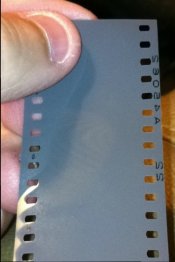
Edge shot of Mystery Film

Ok here is a shot of the unexposed film and it's markings. This is all the markings on the edges. Any ideas..


Greg
 

Attachments

  • photo.JPG
    photo.JPG
    37.3 KB · Views: 232

dehk

Member
Allowing Ads
Joined
Aug 4, 2010
Messages
881
Location
W Michigan
Format
Multi Format
I love mystery film, had my share.
 
OP
OP
Greg Heath

Greg Heath

Member
Allowing Ads
Joined
Jul 13, 2008
Messages
591
Location
Racine, Wisc
Format
Medium Format
new test

Ok, so I loaded a roll of the Mystery Film into my trusty Minty Olympus 35RC, and I will shoot it today at ISO 50. Yesterday's test was at 200 and it was completely overexposed. I developed in D76 for 5 min @20C.

So I will try again today and see what happens at 50. Not sure what cine film was rated at, but at ISO 50 I should have better results I think.

After last nights development, the film was practically see-thru. There were 4 faint images. I used the time for Efke 200 for D76.
 

dehk

Member
Allowing Ads
Joined
Aug 4, 2010
Messages
881
Location
W Michigan
Format
Multi Format
So you couldn't tell the edge markings from last night? well keep us posted and have fun.
 
OP
OP
Greg Heath

Greg Heath

Member
Allowing Ads
Joined
Jul 13, 2008
Messages
591
Location
Racine, Wisc
Format
Medium Format
nope. I added a photo of the film down below a couple of posts back. I do think it is some sort of cine film. I looked all over the net, nothing. I will just shoot it at 50 and see what happens.
 

Klainmeister

Member
Allowing Ads
Joined
Jun 2, 2010
Messages
1,504
Location
Santa Fe, NM
Format
Medium Format
Thanks Rich, I was just about to post the same thing.....

Maybe he meant it was underexposed quite a lot, which would make more sense.
 
OP
OP
Greg Heath

Greg Heath

Member
Allowing Ads
Joined
Jul 13, 2008
Messages
591
Location
Racine, Wisc
Format
Medium Format
The film when developed came out almost clear which to me would normally mean that it was developed too long. But I only developed it for 5 minutes at 20C (D76), so with clear film and some of the photos show some amount of detail, the film was underexposed, leading me to think that it needs to be exposed longer, so that it why I wanted to shoot it at 50.

Greg
 
OP
OP
Greg Heath

Greg Heath

Member
Allowing Ads
Joined
Jul 13, 2008
Messages
591
Location
Racine, Wisc
Format
Medium Format
Maybe, but I put it in my camera and I shot with it...some came out underexposed. I am going to shoot a couple frames today and see what happens...
 

zsas

Member
Allowing Ads
Joined
May 12, 2011
Messages
1,955
Location
Chicago, IL
Format
35mm RF
I have a theory that it is Ansco or Agfa color film, it begins with an 'A' and it also begins with 22, which might be C22, a color film process, long obsolete, film might be 70's color C22.
 
OP
OP
Greg Heath

Greg Heath

Member
Allowing Ads
Joined
Jul 13, 2008
Messages
591
Location
Racine, Wisc
Format
Medium Format
Last edited by a moderator:
OP
OP
Greg Heath

Greg Heath

Member
Allowing Ads
Joined
Jul 13, 2008
Messages
591
Location
Racine, Wisc
Format
Medium Format
I just sent Brian Pritchard an email at his website. I just wonder what it is...
I tried to burn the emulsion this morning with a match, because some of the older film emulsions were flammable, so it did not burn hardly at all. So I know it's not super old. I'm thinking something from the fifties ? When did manufacturers start printing the type of film on the sides of the film ?
A friend told me it might be military film. Possibly gun camera film. i dunno. I just want it to work. :smile:
 

newcan1

Member
Allowing Ads
Joined
Sep 10, 2011
Messages
719
Location
Chattanooga
Format
35mm
Well it looks like b&w film. If it were as old as the 1950's you would have incredible base fog, most likely. In fact, I just shot and developed a roll of old Ilford HP3 from the early 60's and there is hardly an image because of all the fog. I'm going to play around with benzotriazole in the developer and treat it as fairly low speed and see what happens. I had exposed it at ASA 64 and while there are images, they are competing heavily with base fog. As yours came out thin at 200ASA you may not have a lot of base fog (as that would be the same no matter what speed you shot at). So this could be some 1980's-ish b&w film and you just have to figure the correct speed. I recommend you shoot an 18% grey card at various ISO speeds and you will be able to eyeball a correct speed off just one roll. All the better if you have a densitometer.
 

cmacd123

Subscriber
Allowing Ads
Joined
May 24, 2007
Messages
4,331
Location
Stittsville, Ontario
Format
35mm
Well for waht it is worth, those are Bell and Howell Perforations, so it is likly intended for Motion picture use, almost all other 35mm film has the Square kodak Standard perfs.

And you can relax, the little dashes in in between the perfs indicate safety stock. They used that system during the transition to safety and more than 20 years after as information between the perfs does not print through on a movie printer.

The "A" in the footage number Is a code for the type of film, but my two different copies of Kodak Book H-1 don't show it. For comparison a roll of Double X 5222 would have had a C in that position back when they were using the ink numbers. Current production uses a latent image bar code which allows the use of Computer editing. The footage number is used to match the negative with the working positive used in editing so the negative can be cut into the same order.
 

cmacd123

Subscriber
Allowing Ads
Joined
May 24, 2007
Messages
4,331
Location
Stittsville, Ontario
Format
35mm
The film when developed came out almost clear which to me would normally mean that it was developed too long. But I only developed it for 5 minutes at 20C (D76), so with clear film and some of the photos show some amount of detail, the film was underexposed, leading me to think that it needs to be exposed longer, so that it why I wanted to shoot it at 50.

Greg

Er the longer you develop the darker it gets .

Taking the only current Kodak Movie film, 5222 , the massive developing chart gives at least 7 minute for straight D-76. Since it is a bit old You may want ot make that your minimum developing time.
 

Scandium

Member
Allowing Ads
Joined
Aug 14, 2006
Messages
28
Location
USA
Format
35mm
The film is B&W cine negative. The letter is the film type. Ilford FP-4 cine stock used A, B, or C. Eastman used C for 5222 Double-X, H for 5231 Plus-X, G for 4-X 5224. I don't remember an Eastman negative with A. The number is a footage number. Eastman switched to key code numbers with bar codes flashed on the edges in the 90s, I believe.

Ilford FP-4 cinema negative was ASA 80. It has probably degraded with age, so EI 40 or 50 is a good start.
 

walbergb

Member
Allowing Ads
Joined
Sep 19, 2005
Messages
429
Location
Brandon, Man
Format
Multi Format
I don't know the make of the film, but whoever made it didn't do a very good job. The edge markings are backwards:blink:
 
OP
OP
Greg Heath

Greg Heath

Member
Allowing Ads
Joined
Jul 13, 2008
Messages
591
Location
Racine, Wisc
Format
Medium Format
The PLOT thickens...

You Know, my background is not in dating old films. I had put up the undeveloped emulsion, and there were the edge numbers on it. I had also developed the film at 5 minutes at 20C with Stock D76. To test the film I didn't know where I should start with the film, so I shot it at 200. Well after development the film was almost clear but you can still see my faint images on the film. When I first pulled the film after development and rinsing, the film was pretty clear and light. I really couldn't see any lettering per se, but last night I went and reinspected the film with a loupe on the light table. Here are the facts.

"Eastman 18" I believe some kind of early movie film. There are some references online to Eastman on film pre 1925.

S" AFETY- The dot after the "S" but before the "A" shows the film was made in Rochester.

l + % A date code I am still looking up

l "square" "circle" shape.

Bell & Howell perforations (sprocket holes)

The film does not smell like vinegar-not nitrate

I tried to burn the film and it doesn't burn very easily.

It also does not tear easily, but not knowing how other film tears I don't know. I really had to yank on it to tear it so I am guessing that it is post 1950.


The film I believe was made in Rochester of course. Safety film was produced after 1950. There are some exceptions to that rule, but I don't believe for 35mm. Mostly 16mm. There are also perpendicular black tick marks on the edge every 4 sprocket holes which when perpendicular denote that the film is not nitrate base film.The film is B&W. I am still trying to figure out the speed of the film. I shot it at 50 yesterday, but have yet to develop it. I believe that I underexposed the film when I shot it at 200, because it was too light, or that I developed it to short. Even If I had developed it longer, the film base was clear, so that would mean I needed to expose it some more, so after I have developed it today, I should be closer to finding the right speed for the film.
I am still puzzled why the film says "Eastman" instead of Kodak on the side. From what I have read so far, the Eastman side signature was stopped after the late teens or mid 1920's. The biggest question is why is this film in a Lloyd Bakelite Bulk film winder. There is a name etched into the bulk winder.
"T. Egelston". So that is where I am in the Mystery film saga.

I will post some of the links I have used when I assemble them.

keep the ideas coming. I appreciate the ideas everyone has.

Greg
 
Last edited by a moderator:
Photrio.com contains affiliate links to products. We may receive a commission for purchases made through these links.
To read our full affiliate disclosure statement please click Here.

PHOTRIO PARTNERS EQUALLY FUNDING OUR COMMUNITY:


Ilford ADOX Freestyle Photographic Stearman Press Weldon Color Lab Blue Moon Camera & Machine
Top Bottom