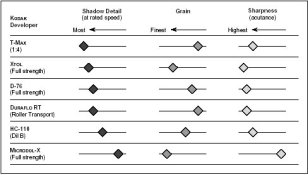


I shot a whole roll full of a scene in harsh sunlight. I used less exposure than I normally would have, since I wanted to evaluate shadow speed. I developed pieces of the film in all the developers I have using all the times I usually use. I wanted to see how the contrast varied so that I could fine-tune my development time for each developer, plus I wanted to compare the graininess, since I had noticed HC110 was grainier than D23. After developing them in a 20C water bath with 3 inversions per minute, I printed them using the same enlarger times using a grade 2 filter. I found that the D23 was much slower than the other two, so I printed an additional frame for less time so that I could fairly compare the tonality and grain. I scanned all the prints side-by-side using my basic scanner software and no processing. The image was gigantic so I had to upload it to my website. You should be able to get it here or go straight to the image:
chazmiller.com/images/devtest.jpg
First of all, Rodinal is the most grainy, clearly, but it's worth noting that the image area shown is less than a 110 frame. It's probably a 2x3 inch piece of an 11x14 print. HC110 was similar in graininess to the Rodinal, and D23 was much less grainy than either. However, the D23 was much slower. The difference looking at the negatives was subtle, the different looking at the 35mm contact prints was noticeable, and the difference when printing them at the same time was obvious. I really didn't know I was losing so much speed with D23, and it's making me wonder if I mixed it up right. I do like that it has very low graininess, yet retains detail well. I don't really see a loss of resolution with the D23 due to the solvent action, if anything it seems a bit better. But I'll have to remember that in any underexposure scenario, I'd better reach for a different developer.
Do others find that D23 is this much slower than other developers?
From looking at these prints, can you make any suggestions as to development times? To me it looks like I should either pull the HC110 time a bit, or increase the Rodinal and D23 times.
Film:TMY1, expired
Exposure: Texas sunlight, 1/500 at f/11.
Developers left to right:Rodinal 50:1 9min, HC110 50:1 9 min, D23 8 min, D23 8 min
Printing times L-R: 20s, 20s, 20s, 10s
chazmiller.com/images/devtest.jpg
First of all, Rodinal is the most grainy, clearly, but it's worth noting that the image area shown is less than a 110 frame. It's probably a 2x3 inch piece of an 11x14 print. HC110 was similar in graininess to the Rodinal, and D23 was much less grainy than either. However, the D23 was much slower. The difference looking at the negatives was subtle, the different looking at the 35mm contact prints was noticeable, and the difference when printing them at the same time was obvious. I really didn't know I was losing so much speed with D23, and it's making me wonder if I mixed it up right. I do like that it has very low graininess, yet retains detail well. I don't really see a loss of resolution with the D23 due to the solvent action, if anything it seems a bit better. But I'll have to remember that in any underexposure scenario, I'd better reach for a different developer.
Do others find that D23 is this much slower than other developers?
From looking at these prints, can you make any suggestions as to development times? To me it looks like I should either pull the HC110 time a bit, or increase the Rodinal and D23 times.
Film:TMY1, expired
Exposure: Texas sunlight, 1/500 at f/11.
Developers left to right:Rodinal 50:1 9min, HC110 50:1 9 min, D23 8 min, D23 8 min
Printing times L-R: 20s, 20s, 20s, 10s
Last edited by a moderator: