The question which springs to my mind is: given we can use either blue/green or yellow/ magenta why did Ilford chose to use yellow/green for over or under the lens filtration rather than blue/green?
pentaxuser
VC paper only cares how much green and blue it sees, and in what proportion. There are a number of ways to accomplish that.
Yellow and magenta both contain red, which the paper is blind to, but your eye can see. Using yellow and magenta filters, like the Ilford filter set, makes the image brighter and easier to work with than an image with the red removed partly or mostly by varying strengths of green and blue filters. This is the main reason VC filters are yellow and magenta.
Ilford's VC filters are also "speed matched," so that, once you learn to work with them, you can get much closer to a final correct exposure when changing filters.
I use the filtration on my color head for 95% of my VC printing, but can get more contrast from just about any paper with a #47 blue filter than maximum magenta filtration. The image on the easel, however, is quite dim.
Blue and green filters of varying transmission corresponding to VC paper grades don't exist. If one uses split-printing techniques, exposing to varying degrees with a #47 blue filter and a #58 green filter will get you any contrast gradient the paper has to offer.
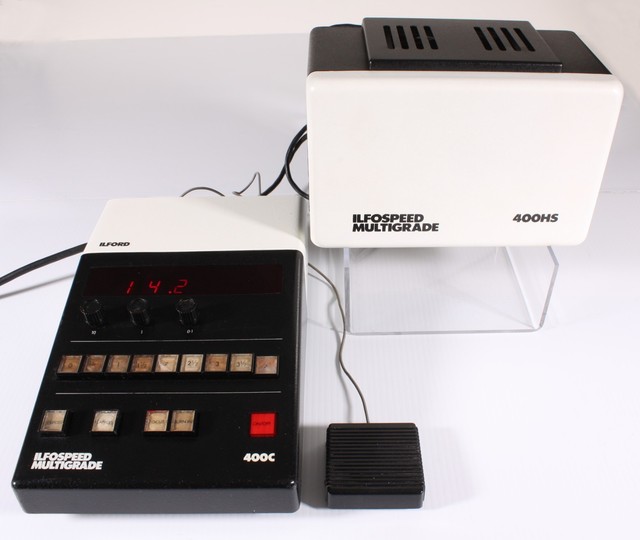
A similar approach is taken by enlarger heads with additive systems. They project a combination of blue and green light. Again, any contrast gradient is possible by varying the proportion of one to the other.
Best,
Doremus



 .
.