

• Welcome to Photrio!
    Registration is fast and free. Join today to unlock search, see fewer ads, and access all forum features.
    Click here to sign up

More Tri-X reversal failures - analysis please.

Tree Farm

H
Tree Farm

  • 0
  • 0
  • 27
A long time ago...

A
A long time ago...

  • 0
  • 0
  • 72

Forum statistics

Threads
201,209
Messages
2,820,479
Members
100,589
Latest member
rando
Recent bookmarks
1

mr.datsun

Member
Allowing Ads
Joined
Oct 27, 2008
Messages
379
Location
The End of t
Format
Sub 35mm
Subject - Testing reversal technique on 35mm Tri-X as precursor to using Super 8 Tri-X.

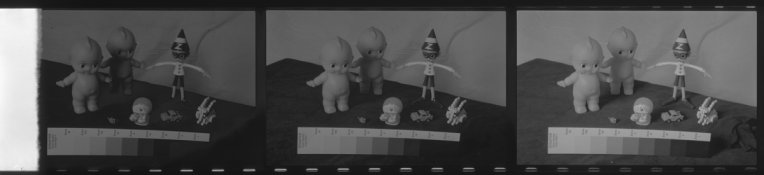
I feel like I'm up against it with Tri-X 35mm. Others get results with simple technique. I'm running a multitude of tests and get nowhere.

QUESTION - Why are my results so flat?

Dektol Liquid 1st dev 1+5 6m, 2nd dev 1+9 3 mins. 0.03g hypo in 1st dev. (0.3g had already started to wash out the film). Foma bleach bath and clearing bath. 8m and 3m.

NB. 4 mins of 1st dev 1+5 was more than adequate to get a solid black when testing negative film.

1st strip 100, 200, 400 ASA.

I started to think that maybe the bleach bath is failing? How would that present itself? Could that account for flat hilights?

Interestingly, I accidentally left a strip of film poking out of the canister before I dev'd this last test strip and it was exposed to daylight. It seems to be clear. In which case is the reversal processing working but the exposure completely out? In that case is the film far too compromised by reversal processing? Is the film losing too much film speed? But remember that Kodak rate Tri-X as 200ASA for Super 8 Reversal film.
tri-x 12m fresh 1ml hypo pp copy.jpg
 
Last edited by a moderator:

cliveh

Subscriber
Allowing Ads
Joined
Oct 9, 2010
Messages
7,705
Format
35mm RF
Subject - Testing reversal technique on 35mm Tri-X as precursor to using Super 8 Tri-X.

I feel like I'm up against it with Tri-X 35mm. Others get results with simple technique. I'm running a multitude of tests and get nowhere.

QUESTION 1 Why are my results so flat?

Dektol Liquid 1st dev 1+5 6m, 2nd dev 1+9 3 mins. 0.03g hypo in 1st dev. (0.3g had already started to wash out the film). Foma bleach bath and clearing bath. 8m and 3m.

NB. 4 mins of 1st dev was more than adequate to get a solid black when testing negative film.

1st strip 100, 200, 400 ASA.

I started to think that maybe the bleach bath is failing? How would that present itself? Could that account for flat hilights?

Interestingly, I accidentally left a strip of film poking out of the canister before I dev'd this last test strip and it was exposed to daylight. It seems to be clear. In which case is the reversal processing working but the exposure completely out? In that case is the film far too compromised by reversal processing? Is the film losing too much film speed? But remember that Kodak rate Tri-X as 200ASA for Super 8 Reversal film.

View attachment 64794

When are you exposing to light after the bleach bath and redeveloping?
 

johnielvis

Member
Allowing Ads
Joined
May 21, 2010
Messages
966
Format
Medium Format
first off--tx-400 and txr-200 are two completely different films...that being said, you should be able to expose the tx-400 at say 200 or 100 or so and get the same kind of results with txr-200 with the same development.

FIRST OFF--NO HYPO IN THE FIRST DEVELOPER--totally unnecessary--develop first deveoper for like at least 6 minutes--try 8 minutes just to be SURE.
SECOND--use the developer concentration used for prints--dektol at print strength is what you want.

bleach should not be taking 8 minutes..it should go FAST...do a test in light to see how fast it takes to bleach a dark negative or the crappy reversals you have to clear to base...then use twice or so that time to bleach after the first development...

after bleach, clear and re-expose then it's time to re-develop

since you don't have any hypo in the first developer, you can use it for a second developer.
 
OP
OP

mr.datsun

Member
Allowing Ads
Joined
Oct 27, 2008
Messages
379
Location
The End of t
Format
Sub 35mm
first off--tx-400 and txr-200 are two completely different films...that being said, you should be able to expose the tx-400 at say 200 or 100 or so and get the same kind of results with txr-200 with the same development.

FIRST OFF--NO HYPO IN THE FIRST DEVELOPER--totally unnecessary--develop first deveoper for like at least 6 minutes--try 8 minutes just to be SURE.
SECOND--use the developer concentration used for prints--dektol at print strength is what you want.

bleach should not be taking 8 minutes..it should go FAST...do a test in light to see how fast it takes to bleach a dark negative or the crappy reversals you have to clear to base...then use twice or so that time to bleach after the first development...

after bleach, clear and re-expose then it's time to re-develop

since you don't have any hypo in the first developer, you can use it for a second developer.

That's interesting. I was, perhaps, misinformed about the emulsion being the same. But you say it should work.

I think at the moment the hypo is so minute I doubt it's doing anything but I have done a number of tests without it too which still had the flatness. I'm happy to drop it until I understand what's going on.

I've working on tests which showed that 8 minutes at 1+2 (which is print strength) gave maximum black at negative stage. I tested strips at 1,2,5,7,10,20 and 40m. The exposed part of the strip got no blacker after 8 minutes, so I assumed I had got there. And in the second full reversal test I gave it 12m to makes sure. With the second developer I am using it at half strength (or for half the time if I re-use a hypo-less 1st dev), the equivalent of print strength.

8 mins in bleach is too long? I am using the Foma kit (a permanganate bleach) which says 8 minutes. In general I am following the Foma kit instructions to the 'T' but with a different developer.

Your bleach test sounds like a good suggestion.
 

johnielvis

Member
Allowing Ads
Joined
May 21, 2010
Messages
966
Format
Medium Format
OH...permananate....ok---well...8' to clear--then give it a bit MORE to be SURE that you get all that developed silver...ALSO--second development should be like 3 minutes or so..don't do too much or there's stuff "left behind" that will get developed and cause fog and flatness...this is why you must FIX after the 2nd development too.

but very strong first deveoper--you may try 1+1 actually instead of 1+2--stronger the better contrast!

but DO keep that hypo OUT of the developer!!!!!! it's only added in the olde recipies to speed the development process for movie film--when they needed a very FAST deveopment of like 2 minutes or so to process HUGE rolls of film in machines....you have the luxury of time now, in fact, you NEED as much time in the chems as possible to keep it uniform.

keep experimenting, but err in the way of HOT first deveoper with NO hypo

ALSO--change your bleach--dichromate is WAY better---WAY better.
 

Photo Engineer

Subscriber
Allowing Ads
Joined
Apr 19, 2005
Messages
29,018
Location
Rochester, NY
Format
Multi Format
Guys, the second development should go to completion so time there should not be a huge factor. The bleach should remove all of the negative silver image. So, what we are seeing is a failure in the first developer to develop a high contrast image (and then some) that leaves no silver in the highlights. Look at the positive. There is silver in the highlights.

Hypo in the first developer is there to force physical development and to get a good negative image. You do not have that nailed yet. That is where the problem lies.

PE
 

Gerald C Koch

Member
Allowing Ads
Joined
Jul 12, 2010
Messages
8,131
Location
Southern USA
Format
Multi Format
Typically the amount of sodium thiosulfate is 8 to 12 g/l in the first developer despite what a previous poster says. It is used to produce clear highlights. Read the Ilford site on reversal processing carefully.

If using the permanganate bleach be sure to follow the formula exactly. Specifically in the amount of acid used.

Since each film reacts differently it is important to practice with the cine film and not regular tri-X.
 

georgegrosu

Member
Allowing Ads
Joined
Oct 15, 2007
Messages
434
Location
Bucharest, R
Format
Multi Format
For a good information about KODAK TRI-X Reversal Film 7266 see:
http://motion.kodak.com/motion/uploadedFiles/US_plugins_acrobat_en_motion_products_bw_7266.pdf
For good information about the recommended treatment see:
http://motion.kodak.com/motion/uplo..._en_motion_support_processing_h2415_h2415.pdf pages 23.
I make tests on Kodak Double X 5222 reversible procces.
The results show somewhat similar to the one here.
I think it's important film (fogg to be small).
Then chances to get a reverse image of b&w are much larger.
I had no time to do tests on film Agfa Pan Aviphot 200 and 400 with fogg
below 0.10.

George
 
OP
OP

mr.datsun

Member
Allowing Ads
Joined
Oct 27, 2008
Messages
379
Location
The End of t
Format
Sub 35mm
For a good information about KODAK TRI-X Reversal Film 7266 see:
http://motion.kodak.com/motion/uploadedFiles/US_plugins_acrobat_en_motion_products_bw_7266.pdf
For good information about the recommended treatment see:
http://motion.kodak.com/motion/uplo..._en_motion_support_processing_h2415_h2415.pdf pages 23.
I make tests on Kodak Double X 5222 reversible procces.
The results show somewhat similar to the one here.
I think it's important film (fogg to be small).
Then chances to get a reverse image of b&w are much larger.
I had no time to do tests on film Agfa Pan Aviphot 200 and 400 with fogg
below 0.10.

George

George, thank-you I have read those documents. D94a is not available to me. I have to use a paper developer. What you seem to be saying is that the results are always going to be flat!
 
OP
OP

mr.datsun

Member
Allowing Ads
Joined
Oct 27, 2008
Messages
379
Location
The End of t
Format
Sub 35mm
Typically the amount of sodium thiosulfate is 8 to 12 g/l in the first developer despite what a previous poster says. It is used to produce clear highlights. Read the Ilford site on reversal processing carefully.

If using the permanganate bleach be sure to follow the formula exactly. Specifically in the amount of acid used.

Since each film reacts differently it is important to practice with the cine film and not regular tri-X.

Hi Gerald. I have read the Ilford docs and they were my starting point. My first test was 5g sodium thiosulfate in 330ml - I got a 20% overall density image and film edge. The second test was 0.5g in 330ml - I got a 80% density image. Even 0.1g washed the image out a bit.

Some people seem to use 30g/L without my problems .
 
OP
OP

mr.datsun

Member
Allowing Ads
Joined
Oct 27, 2008
Messages
379
Location
The End of t
Format
Sub 35mm
Guys, the second development should go to completion so time there should not be a huge factor. The bleach should remove all of the negative silver image. So, what we are seeing is a failure in the first developer to develop a high contrast image (and then some) that leaves no silver in the highlights. Look at the positive. There is silver in the highlights.

Hypo in the first developer is there to force physical development and to get a good negative image. You do not have that nailed yet. That is where the problem lies.

PE

PE. The trouble is that my sodium thiosulfate tests show a complete reversal of the notion that hypo forces anything. In my case it bleaches the positive image overall. Please refer to my response to Gerald for the amounts I am using.
 
Last edited by a moderator:
OP
OP

mr.datsun

Member
Allowing Ads
Joined
Oct 27, 2008
Messages
379
Location
The End of t
Format
Sub 35mm
OH...permananate....ok---well...8' to clear--then give it a bit MORE to be SURE that you get all that developed silver...ALSO--second development should be like 3 minutes or so..don't do too much or there's stuff "left behind" that will get developed and cause fog and flatness...this is why you must FIX after the 2nd development too.

but very strong first deveoper--you may try 1+1 actually instead of 1+2--stronger the better contrast!

but DO keep that hypo OUT of the developer!!!!!! it's only added in the olde recipies to speed the development process for movie film--when they needed a very FAST deveopment of like 2 minutes or so to process HUGE rolls of film in machines....you have the luxury of time now, in fact, you NEED as much time in the chems as possible to keep it uniform.

keep experimenting, but err in the way of HOT first deveoper with NO hypo

ALSO--change your bleach--dichromate is WAY better---WAY better.

But permanganate works. Dichromate is not allowed in UK.

I also get a flat image without the hypo.

If I have to use liquid dektol at 1+1 I can't afford to use it. That would be £10 per film. At 1+5 I'm using a dilution commensurate with other peoples' experience (double print strength) and it is apparently developing to completion at stage 1.
 
Last edited by a moderator:
OP
OP

mr.datsun

Member
Allowing Ads
Joined
Oct 27, 2008
Messages
379
Location
The End of t
Format
Sub 35mm
Since each film reacts differently it is important to practice with the cine film and not regular tri-X.

You're right, I think trying Tri-X 35mm is a total dead end. I have ordered a new re-fillable Super 8 cartridge and will load it with small strips of Tri-X Reversal and start again, hopefully a little wiser and more experienced.

If Tri-X Super 8 doesn't work then I'm certainly switching to another film!
 

georgegrosu

Member
Allowing Ads
Joined
Oct 15, 2007
Messages
434
Location
Bucharest, R
Format
Multi Format
I always use raw chemical for preparations of solutions.
Reversible process b & w you should read densities of film.
At least fog density and high density.
From memory, the Kodak Double X (as reversal process b & w) fog was ~ 0.3 and maximum density was ~ 2.6.
If you look at the characteristic curve of KODAK TRI-X 7266 is not
as rich in density curve as a negative film.
Again, I think better results can be obtained on films with small fog.
I have not worked with KODAK TRI-X.

George
 

johnielvis

Member
Allowing Ads
Joined
May 21, 2010
Messages
966
Format
Medium Format
You're right, I think trying Tri-X 35mm is a total dead end. I have ordered a new re-fillable Super 8 cartridge and will load it with small strips of Tri-X Reversal and start again, hopefully a little wiser and more experienced.

If Tri-X Super 8 doesn't work then I'm certainly switching to another film!

so it's not yourprocess, it's the film...right....ok

well, tri-x is done reversal and returns fine results all the time, that's a FACT.

bleach really doesn't matter as long as it gets the job done...obviously the permananate you're using is diluted to keep it from wrecking the film, which permanganate does since it's nasty strong. If you can't get dichromate because it's a controlled substance then so be it, but it don't matter as long as it can bleach film clear eventually and you leave it in long enough.

hypo in the first developer will likely be your undoing...leave it out and get your process to work without it--it has proven totally unnecessary for regular tank developing.
 

johnielvis

Member
Allowing Ads
Joined
May 21, 2010
Messages
966
Format
Medium Format
If I have to use liquid dektol at 1+1 I can't afford to use it. That would be £10 per film.....

no...THAT will be your undoing.

you need high contrast first deveopment--you're only developing 35mm and super 8...hardly any chemicals used at all and THAT'S too expensive? Then you can't afford to do it, sorry to say.

Every "smartcookie" macguyver genius out there thinks that the laws of physics will bend for them because they are so brilliant and they don'tWANT to have to spend money like normal "stupid" people.

good luck with that.
 

Gerald C Koch

Member
Allowing Ads
Joined
Jul 12, 2010
Messages
8,131
Location
Southern USA
Format
Multi Format
Kodak recommends using D-94 or D-94A as a first developer. This is a high contrast developer containing 9.1 ml of a solution of sodium thiocyanate. Since thiocyanate is twice as effective as thiosulfate and the solution is ~50% this corresponds to 9 g/l of sodium thiosulfate.

I would suggest using Dektol 1+1 as the first developer instead of the more dilute solution that you have been using.
 
Last edited by a moderator:

Photo Engineer

Subscriber
Allowing Ads
Joined
Apr 19, 2005
Messages
29,018
Location
Rochester, NY
Format
Multi Format
PE. The trouble is that my sodium thiosulfate tests show a complete reversal of the notion that hypo forces anything. In my case it bleaches the positive image overall. Please refer to my response to Gerald for the amounts I am using.

OTOMH, I cannot remember the formula for D94, but I do know that Dektol is a paper developer. As such it is low solvent (Sulfite) and high in restrainer (Bromide) and these two may be your problem. Remember, what you are trying to do has been done by others with success.

PE
 

Gerald C Koch

Member
Allowing Ads
Joined
Jul 12, 2010
Messages
8,131
Location
Southern USA
Format
Multi Format
Kodak D-94 reversal film first developer

Water (50C) 750 ml
Metol 0.6 g
Sodium sulfite (anh) 50 g
Hydroquinone 20 g
Potassium bromide 8 g
Sodium thiocyanate (51%) 9.1 ml
Sodium hydroxide 20 g
Water to mskr 1 l

Develop motion picture reversal film for 2 minutes at 20C
 
OP
OP

mr.datsun

Member
Allowing Ads
Joined
Oct 27, 2008
Messages
379
Location
The End of t
Format
Sub 35mm
so it's not yourprocess, it's the film...right....ok

well, tri-x is done reversal and returns fine results all the time, that's a FACT.

bleach really doesn't matter as long as it gets the job done...obviously the permananate you're using is diluted to keep it from wrecking the film, which permanganate does since it's nasty strong. If you can't get dichromate because it's a controlled substance then so be it, but it don't matter as long as it can bleach film clear eventually and you leave it in long enough.

hypo in the first developer will likely be your undoing...leave it out and get your process to work without it--it has proven totally unnecessary for regular tank developing.

No. I just did not say anything like 'it's not my process, it's the film'. I am saying that I have had no success getting it to work so maybe I should find something that does.

I have already tried it without hypo. If you read my posts you will see that I said that. As it happens hypo was recommended by other people doing reversal processing as a means of getting better hilights and hence improving contrast. So, obviously there are conflicting opinions.

It is known to work with D94. With regards other developers, if it is FACT, then I'd like to see the examples and the process that was used, please
 
Last edited by a moderator:
Photrio.com contains affiliate links to products. We may receive a commission for purchases made through these links.
To read our full affiliate disclosure statement please click Here.

PHOTRIO PARTNERS EQUALLY FUNDING OUR COMMUNITY:


Ilford ADOX Freestyle Photographic Stearman Press Weldon Color Lab Blue Moon Camera & Machine
Top Bottom
