• Welcome to Photrio!
    Registration is fast and free. Join today to unlock search, see fewer ads, and access all forum features.
    Click here to sign up

More speed, less grain

Recent Classifieds

Forum statistics

Threads
203,214
Messages
2,851,553
Members
101,729
Latest member
Luis Angel Baca
Recent bookmarks
0
1600PR is probably the most versatile emulsion that still keeps grain under control under varying EI conditions. 400PR is a mid-speed film that can also be pushed to 3200 but not with the same results as it's faster brother. Then again, 400 is also noticeably sharper and if you have no reason to push, is the money choice.

I hoard the hell out of both.
 
Another film hoarder. My kinda guy!

Steve

No joke. I still buy too, and I also support a few close friends who can't get film for cheap where they are. I do have a ridiculous amount of film, but I'm not entirely selfish with it - and hey, I'm supporting film! :smile:


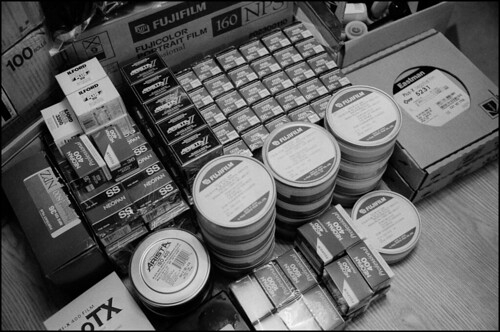
I have almost no room in my dedicated film freezer these days and am going to rip out all of the Neopan from their boxes just to gain space. The newer stuff sits in the open, older and faster stuff frozen, and all exposed stuff in the fridge (which is about 50+ rolls right now).

I don't need a digital camera - I need an intervention!

But back to the original topic - yes, use Neopan 1600 for pushing and general low light. It's such an excellent emulsion, along with all of the other classics for general light or great light: Tri-X, APX, TMX/Y/Z, etc.

We've never had better films than the ones we have now.
 
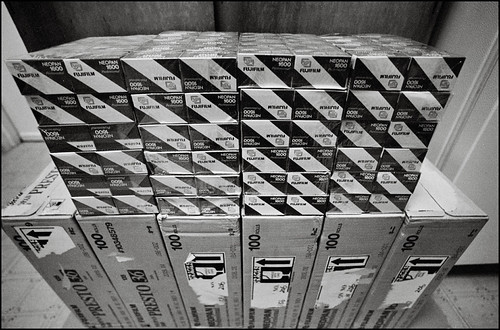
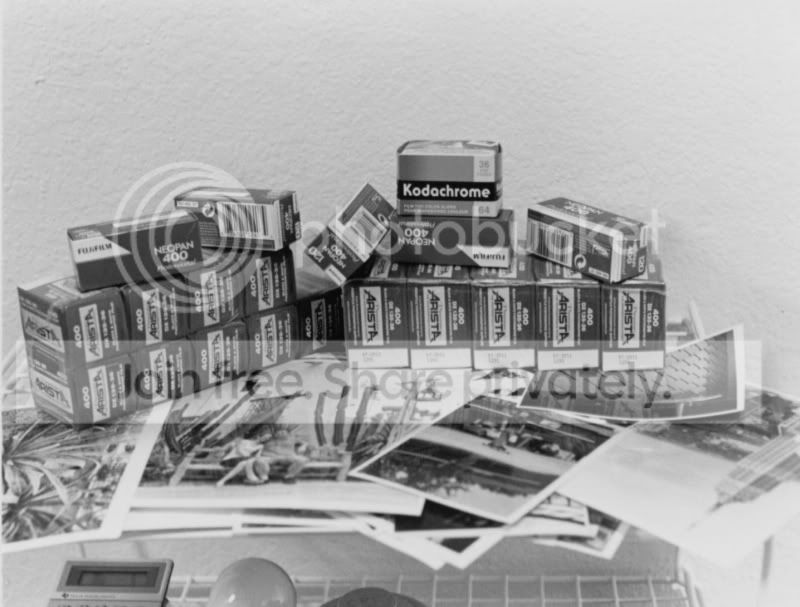
Wow, are those boxen of 100 rolls of Neopan 400 35mm? Awesome. Where do you buy it all from; do you get bulk discounts?

I use Arista Premium in 35mm, but I'm in love with Neopan 400 for 120 use. It's good and fast, faster than Foma 400 anyway, yet it has a really nice grain and resolution. And I can get it for about $3 a roll. Freestyle keeps getting it in and out of stock, so it makes me nervous. If I could afford to pile it high and stack it deep, I totally would, but for me, 15 rolls at a time is stockpiling.
replenishment.jpg
 
clayne, you have disregarded all of the markings on your presto 100 boxes, rotate 90 degrees clockwise to store them the right way up. :smile:

To the OP, I would try Neopan 1600, Delta 3200 (at 1600), Tmax 3200 (at both 16 and 3200) developed in whatever you think will suit your needs best (based on above posts).

The real question is, how fast do you need? Would you like to shoot at 800, 1600, 3200 or 6400. Set our meter to 1600, put your camera in manual and with the shutter speed and aperture you want to use and meter a typical shot. If the meter says spot on, shoot at 1600, if it says under exposed shoot at 3200, and over exposed, shoot at 800. You get the point.

I think on because this is such an individual scenario, you will gain more from experimentation than from reading these forums.
 
clayne, you have disregarded all of the markings on your presto 100 boxes, rotate 90 degrees clockwise to store them the right way up. :smile:

No way will I let that OCD develop. ;-)

I think on because this is such an individual scenario, you will gain more from experimentation than from reading these forums.

Couldn't be any closer to the truth. The only way to determine what works is to try it. Some people have excellent luck with things others have crap luck with.

As far as pushing film goes, if you're not a print sniffer or grainless angel type, then almost anything goes. I've pushed APX400 to 6400 and gotten results (albeit heavily grainy and contrasty, but still a photograph).

People are going to tell you that such and such thing won't happen or be impossible, etc. - when in reality they really mean "sub-optimal to iffy results." No amount of pushing can create shadow detail that barely hit the emulsion, but one can end up with mid-tones and highlights still intact. The key is that the mid-tones and highlights convey to the eye and mind what the shadows might have looked like - so their absence doesn't necessarily mean the frame is junked. It's why contrasty pushed film still works without looking overly artificial.
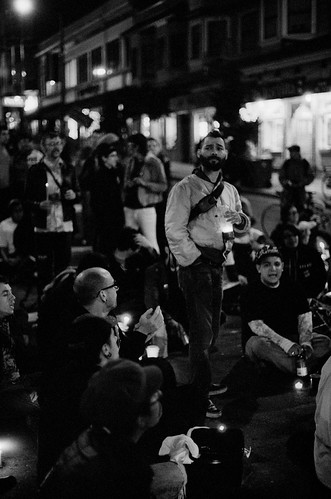

APX400@3200
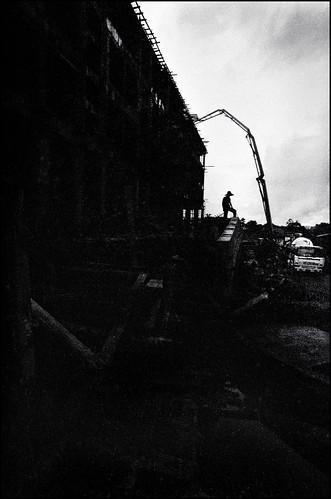

APX400@6400


The beauty of this is that even though APX is actually not one of the best choices for pushing (at least from *my* results in comparison with other emulsions like Neopan), it still produces usable results. This doesn't mean go out and push PanF50 by 8 stops. It just means that there is a broad spectrum of what's "acceptable" to most people and experimenting always teaches us something valuable.

If there was only one emulsion I had to carry around I would carry Neopan 1600 for it's awesome versatility. But it'd also be a hard choice against 400TX as it's another incredibly versatile film but more in-line with Neopan 400 in terms of sharpness.

1600PR is stellar day and night:
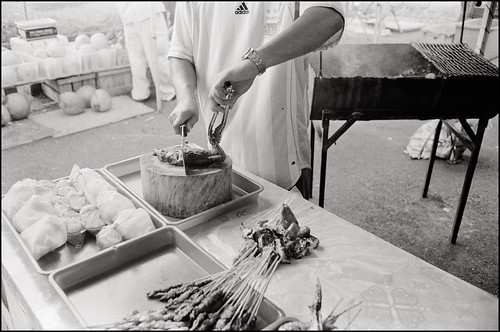

Neopan 1600@1600
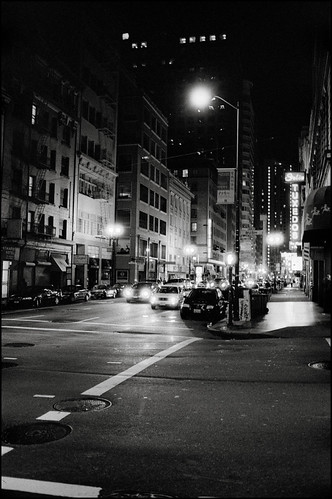

Neopan 1600@1600
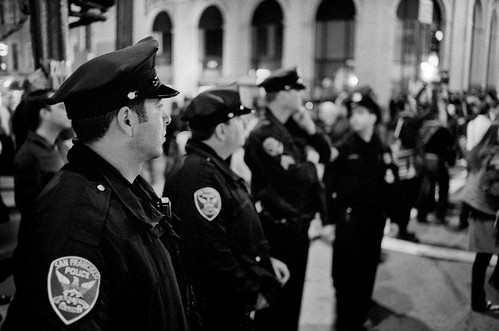

Neopan 1600@3200

Guys, I love photography as much as the next guy, but I personally don't walk around with a tripod and an incident meter. I'm usually more concerned with the moment rather than sharpness, f/22 night shots, or pictorially perfect images. This is no Tmax 100 or zone system photography. It's just photography.

We all know that familiar quote, in reference to choice of black and white vs color: "Sometimes color just gets in the way." Well sometimes the same thing goes for pushed film and general low-light shots: Sometimes shadows just get in the way. High shadow detail isn't always necessary. Neither are grainless images.

 
A VERY Simple Home Brew

Grain is largely a function of the film and the developer.
For any one film the more active the developer the
greater the grain.

D-23 is a Home Brew with only two components, It is
only moderately active. I use it VERY dilute, 1:7. At that
dilution I believe it delivers great compensation. It will
pull all the shadow detail you've recorded with out
blowing the highlights.

A starting point: A 120 roll, 500ml solution volume,
a few inversions at start then 2 or 3 at 2 or 3
minute intervals, 16 to 20 minutes. Dan
 
Tri-X developed in XTOL 1:1 is somewhat less grainy vs development in D-76. Suggest enlarging with a diffused light source and avoiding overdevelopment. That said, a monopod and FP4 rated up to 200 may work.
 
Low and Slow

Tri-X developed in XTOL 1:1 is somewhat less grainy vs development in D-76. Suggest enlarging with a diffused light source and avoiding overdevelopment. That said, a monopod and FP4 rated up to 200 may work.


Do you develop FP4 rated at 200 in XTOL 1:1? Would it make sense to try HC-110?

Also,

Are there any advantages, for any developer, in developing at lower temps for longer times in lower concentrations of developer? In terms of grain, contrast, etc.?

Best,

Rudy
 
Photrio.com contains affiliate links to products. We may receive a commission for purchases made through these links.
To read our full affiliate disclosure statement please click Here.

PHOTRIO PARTNERS EQUALLY FUNDING OUR COMMUNITY:


Ilford ADOX Freestyle Photographic Stearman Press Weldon Color Lab Blue Moon Camera & Machine
Top Bottom