• Welcome to Photrio!
    Registration is fast and free. Join today to unlock search, see fewer ads, and access all forum features.
    Click here to sign up

Mixing Mytol and other developers for longer shelf life?

ptloboscarmelEIR3.jpg

A
ptloboscarmelEIR3.jpg

  • jhw
  • Dec 15, 2025
  • 0
  • 0
  • 12
Tree Farm

H
Tree Farm

  • 1
  • 0
  • 39

Forum statistics

Threads
201,211
Messages
2,820,521
Members
100,589
Latest member
rando
Recent bookmarks
0
OP
OP

Joshua_G

Member
Allowing Ads
Joined
Jul 14, 2007
Messages
53
Location
Israel
Format
35mm
I have not had the time to do all of the required comparative sensitometric and densitometric testing - yet. I'll probably do it just to satisfy my own curiosity.
I couldn't care less about any xxx-metric tests. All I care about is pictorial qualities.

For my work (LF, MF and 35mm) I prefer staining and tanning developers.

My current staining and tanning developer choice is Pyrocat-MC.
Can you please describe in words why is it that you prefer staining and tanning developers over others?
To your view (or taste), why do you prefer Pyrocat-MC over Pyrocat-HD?

Glycol is not a photographic developer. It is a double alcohol. Propylene glycol is 1,2 propanediol. Glycerine is 1,2,3 propane glycol. You are thinking of glycin or glycine, I don't remember which.
Indeed, my mistake, I confused Glycol with Glycin.

I can make recommendations, but you would not use them.
Right now I cannot see any reason for me not using advice for mixing Mytol for longer shelf life. However, when I ask about ways of mixing Mytol, I'm not going to use formulas containing Borax (which Mytol don't have). That is, unless some one will say something like: "In my experience, developer "X" (which may contain Borax) gives better something (fine grain, sharpness, acutance, compensation, wide spread mid-tones, smooth highlights, detailed shadows, film speed, pushing ability, or tolerance to exposure mistakes or scenes with high exposure range)".

It's a different story when experienced photographer says something like: "I prefer "Y" developer, which is more to my personal taste". Since various experienced photographers prefer various developers – another's taste isn't a good enough basis for me to make my own choices upon, not without mentioning specific objective qualities of certain developer (if there is such a thing as objective qualities).

Yet another different story is when people refer me to data in books and on the Internet (without their personal experience with the mentioned developer). My predicament isn't lack of information – it is too much information with too little data upon which I can make my choices. I read the books mentioned and the Internet links mentioned before posting here. I've read recommendations about more developers than I can try at this stage, with too little comparison of qualities of different developers.

When I ask here about pictorial qualities of developers and people recommend certain developers for their low cost, or convenience – it makes my choosing process more complex. In the light the questions I'm asking myself right now – it is "white noise", or "useless data". Again, "white noise" only in the light of the questions I'm asking myself right now. At times I get the impression that some people reply their own questions, not the ones I asked.

One day I may have the time (or may not) to try and experience myself each and every developer anyone mention. Right now, coming back to B&W processing after about 30 years, still working for living full time job, with very long hours, the only sound basis for me to make choices upon, is other's experience, related to mentioned qualities of developers, rather than personal taste and preference.

All the above is with high respect to all people who dedicate time, for no material gain, to assist others.

I do hope I made myself clear here, for I mean no offence.
 

Tom Hoskinson

Member
Allowing Ads
Joined
Mar 7, 2004
Messages
3,867
Location
Southern Cal
Format
Multi Format
I couldn't care less about any xxx-metric tests. All I care about is pictorial qualities.

The xxx-metric tests are valuable tools for assessing the relative pictorial capabilities/potentials of film/developer combinations.


Can you please describe in words why is it that you prefer staining and tanning developers over others?

I contact print on Azo (silver chloride paper). At least until I run out of it - when that happens, I plan to switch to LODIMA silver chloride paper. There is also Platinum/Palladium and Carbon.

Staining and Tanning developers stain and tan the emulsion proportional to the amount of exposure. These properties are useful to me as another element/factor methodology to employ in image printing density control

To your view (or taste), why do you prefer Pyrocat-MC over Pyrocat-HD?

I like all of the Pyrocat variants because of their ability to
preserve fine detail in the highlights plus their high image acutance and their compensating ability (derived in part from the emulsion tanning properties of the Pyrocats).

I have a slight personal preference for Pyrocat-MC over Pyrocat-HD since I believe that I get slightly higher acutance with the Pyrocat-MC with the films I am currently using.
 

Jordan

Member
Allowing Ads
Joined
Sep 21, 2004
Messages
581
Location
Toronto, Can
Format
Multi Format
Right now I cannot see any reason for me not using advice for mixing Mytol for longer shelf life. However, when I ask about ways of mixing Mytol, I'm not going to use formulas containing Borax (which Mytol don't have). That is, unless some one will say something like: "In my experience, developer "X" (which may contain Borax) gives better something (fine grain, sharpness, acutance, compensation, wide spread mid-tones, smooth highlights, detailed shadows, film speed, pushing ability, or tolerance to exposure mistakes or scenes with high exposure range)".

You asked about mixing MYTOL in alcohol. Because only one or two of its ingredients are actually soluble in alcohol, this isn't possible, and so substitutions have to be made. Evaluating these on the basis of their ingredients only, as you are doing, requires you to look at salt forms, buffering effects and the roles of the different developer constituents, then consider what happens when you actually mix the ingredients together. Armed with that knowledge, I think you'll be more accepting of chemical substitutions like metaborate -> borax or triethanolamine and sodium ascorbate -> ascorbic acid.

It's a different story when experienced photographer says something like: "I prefer "Y" developer, which is more to my personal taste". Since various experienced photographers prefer various developers – another's taste isn't a good enough basis for me to make my own choices upon, not without mentioning specific objective qualities of certain developer (if there is such a thing as objective qualities).

There are such things as objective qualities in a developer -- you measure them using sensitometric tests, which you stated earlier that you aren't interested in.

When I ask here about pictorial qualities of developers and people recommend certain developers for their low cost, or convenience – it makes my choosing process more complex. In the light the questions I'm asking myself right now – it is "white noise", or "useless data". Again, "white noise" only in the light of the questions I'm asking myself right now. At times I get the impression that some people reply their own questions, not the ones I asked.

I think you may be misinterpreting the nature of APUG and photo forums in general. Everyone here is a hobbyist, and when we scratch-mix developers, we're doing it for fun. We can't tell you what to do, and just as you don't have the time or resources to try every developer and do detailed comparisons, most of us here don't either. We are trying to be helpful, but ultimately you develop your own film, using your exposure techniques, your agitation, your water supply, your thermometer, etc. so the most important opinion is your own.

One day I may have the time (or may not) to try and experience myself each and every developer anyone mention. Right now, coming back to B&W processing after about 30 years, still working for living full time job, with very long hours, the only sound basis for me to make choices upon, is other's experience, related to mentioned qualities of developers, rather than personal taste and preference.

Understood. Many of us work long hours too.

I will finish by simply stating that if you are looking for a version of MYTOL that is mostly mixed in non-aqueous solvents, "Instant MYTOL" is about as close as you are going to get. I can assure you that the substitutions I made in this formula were done with a lot of consideration for the chemical properties of the developer. Working solutions of "Instant MYTOL" are nearly identical to MYTOL in the important parameters (developing agent and sulfite concentration, pH), and, to my eyes, give excellent results that are not significantly different from MYTOL.

You are more than welcome to mix it, use it and provide your feedback here or on my site.
 

dancqu

Member
Allowing Ads
Joined
Sep 7, 2002
Messages
3,649
Location
Willamette V
Format
Medium Format
[QUOTES=Joshua_G;496737]
"I couldn't care less about any xxx-metric tests.
All I care about is pictorial qualities."

Tests comparing Xtol and instant Mytol: Perhaps Tom is
implying that by instruments alone will differences be seen.

"Right now, coming back to B&W processing after about 30
years, still working for living full time job, with very long hours, ..."

Why the Mytol fixation? Phenidone and ascorbic or ascorbate,
two of not the easiest chemicals with which to work. Many who
are processing film and paper do not have those two chemicals
in their darkrooms; from off the shelf or home-brew. Hurdles to
excellent results I see not to your needing.

For some time I used a slightly modified 8 gram metol 80 gram
sodium sulfite D-23; a one liter formula. For paper add carbonate
and if needed, a little bromide. Two chemicals for film maybe four
for paper. I believe D-23 is more popular than Xtol. The above
formula is good for 16 rolls of 120 and makes for a low sulfite
one-shot developer at that 1:7 dilution. Dan
 

gainer

Subscriber
Allowing Ads
Joined
Sep 20, 2002
Messages
3,699
I couldn't care less about any xxx-metric tests. All I care about is pictorial qualities.


When I ask here about pictorial qualities of developers and people recommend certain developers for their low cost, or convenience – it makes my choosing process more complex. In the light the questions I'm asking myself right now – it is "white noise", or "useless data". Again, "white noise" only in the light of the questions I'm asking myself right now. At times I get the impression that some people reply their own questions, not the ones I asked.

One day I may have the time (or may not) to try and experience myself each and every developer anyone mention. Right now, coming back to B&W processing after about 30 years, still working for living full time job, with very long hours, the only sound basis for me to make choices upon, is other's experience, related to mentioned qualities of developers, rather than personal taste and preference.

All the above is with high respect to all people who dedicate time, for no material gain, to assist others.

I do hope I made myself clear here, for I mean no offence.
The puzzle here is why you believe that the pictorial qualities many photographers are able to get depend on the developer. If that were so, all would be using the same developer. I am of the opinion that any good photographer will get the pictorial qualities out of any developer by hook or by crook. Developers are not magic potions. You want a version of Mytol that keeps for long periods in the belief that Mytol is the only developer that meets your requirements. The ingredients of Mytol as you list them contain redundancies, and in the long run, Mytol DOES contain borax as I explained. The metaborate, in the presence of any acid including ascorbic and the bi- part of bisulfite ot metabisulfite, will change to borax while changing the bisulfite to sulfite and the ascorbic acid to sodium ascorbate. You did not list the amounts of each, so I cannot tell anything but that the same results can be obtained by some mixture of phenidone or dimezone, sodium sulfite, ascorbic acid and borax. Phenidone or dimezone, whichever you choose, is regenerated by the ascorbate at low pH and becomes superadditive with the ascorbate at about pH = 10.

The ingredients you put in are not necessarilly the ingredients in the solution. Reactions take place. It is often possible to put two different sets of ingredients together and have the same active ingredients in the solutions.

Generally speaking, borax is easier to get and cheaper than metaborate. Ascorbic acid is cheaper than sodium ascorbate and lasts longer in storage. You want a mixture of sodium sulfite, sodium ascorbate and borax with a particular pH. Forget whether it is called Mytol , Histol, Hertol or Yourtol. If you can't get the pH where you want it, see if you can find some sodium or potassium hydroxide. Get some pH measuring strips too. You might learn something.

Meanwhile, 1 gram of phenidone, 35 grams of ascorbic acid and 100 grams of borax in a gallon of water will get you a developer that will develop most films to normal contrast in 8 minutes at 68 F.
 

Peter Schrager

Subscriber
Allowing Ads
Joined
Jul 19, 2004
Messages
4,294
Location
fairfield co
Format
Large Format
how developers work in real life

this is strictly personal but I have many thousands of hours devoted to my "hobby" I have mixed untold developers both for paper and film. learning to use one or two will justify ALL of your needs. right now it is xtol-strictly for the convenience and easy mixing-I do mine in a pail-doesn't get much easier. never had the so called failure problem and if I think the developer is overdue I just mix up some more. next is Rodinal. never would have imagined using it but because of everyone here I decided to give it a try. now I get the most knockout prints with Rodinal and Acros done in a rotary base and printed on a grade three paper.
to me this combo is my finest yet. also using the pyrocat-mc formula for AZO and alt process. why-it can sit on the shelf like Rodinal. if you don't want to make it the formulary sells it. have always kept hc110 on the shelf for backup. the stuff can be a lifesaver in certain situations and definately knows how to build density. go make some prints.....
Best, Peter
 

Tom Hoskinson

Member
Allowing Ads
Joined
Mar 7, 2004
Messages
3,867
Location
Southern Cal
Format
Multi Format
[QUOTES=Joshua_G;496737]
"I couldn't care less about any xxx-metric tests.
All I care about is pictorial qualities."

Tests comparing Xtol and instant Mytol: Perhaps Tom is
implying that by instruments alone will differences be seen.

"Right now, coming back to B&W processing after about 30
years, still working for living full time job, with very long hours, ..."

Why the Mytol fixation? Phenidone and ascorbic or ascorbate,
two of not the easiest chemicals with which to work. Many who
are processing film and paper do not have those two chemicals
in their darkrooms; from off the shelf or home-brew. Hurdles to
excellent results I see not to your needing.

For some time I used a slightly modified 8 gram metol 80 gram
sodium sulfite D-23; a one liter formula. For paper add carbonate
and if needed, a little bromide. Two chemicals for film maybe four
for paper. I believe D-23 is more popular than Xtol. The above
formula is good for 16 rolls of 120 and makes for a low sulfite
one-shot developer at that 1:7 dilution. Dan

Dan, you said: Tests comparing Xtol and instant Mytol: Perhaps Tom is
implying that by instruments alone will differences be seen.

Yes Dan, that is my implication. I do my sensitometric and densitometric testing with that goal in mind. I typically use sheet film and contact print a Stouffer step wedge on each sheet and contact print a USAF chrome on glass resolution target as well.

I also expose two sheets of the same film to a high Scene Brightness Range pictorial subject. In addition, I also expose two sheets of the same film to an open sky subject (for evaluation of development uniformity).

I use current manufacture Kodak D-76 (fresh, undiluted 0ne-shot) as my control developer.

Postscript: The shape of the D logE curve (aka Characteristic Curve) produced by a Developer/Film/Dilution/Agitation combination is pictorially important.
 
Last edited by a moderator:
OP
OP

Joshua_G

Member
Allowing Ads
Joined
Jul 14, 2007
Messages
53
Location
Israel
Format
35mm
The xxx-metric tests are valuable tools for assessing the relative pictorial capabilities/potentials of film/developer combinations.
Indeed, I realize it. What I meant was that I'm interested more in he results as seen by the human eyes on the final print. "Keeping more details in the highlights" is something that a scientifically-ignorant person like me can comprehend much better than "0.67 gamma on +1/3 exposure of 18% grey".

You asked about mixing MYTOL in alcohol. Because only one or two of its ingredients are actually soluble in alcohol, this isn't possible, and so substitutions have to be made.
Yes, referring to alcohol was a mistake on my part. I should have said just: "Longer shelf life".

We are trying to be helpful, but ultimately you develop your own film, using your exposure techniques, your agitation, your water supply, your thermometer, etc. so the most important opinion is your own.
I have no doubt about that, however, as you wrote above:
There are such things as objective qualities in a developer -- you measure them using sensitometric tests, which you stated earlier that you aren't interested in.
As for measurements, see my above reply.

Working solutions of "Instant MYTOL" are nearly identical to MYTOL in the important parameters (developing agent and sulfite concentration, pH), and, to my eyes, give excellent results that are not significantly different from MYTOL.
I got it so far. Are developing times for various films in different dilutions equal those of Xtol (for practical use)?
Can you please describe in words the differences, as appear to your eyes (or measurements), between Xtol and Instant Mytol regarding grain, sharpness (or acutance), film speed, and gradation?

Why the Mytol fixation? Phenidone and ascorbic or ascorbate, two of not the easiest chemicals with which to work. Many who
are processing film and paper do not have those two chemicals in their darkrooms; from off the shelf or home-brew. Hurdles to excellent results I see not to your needing.
I'm not sure it is a fixation on my part. In my search for an all around best developer, from reading, so far, I got the impression that probably Xtol (or one of its substitutes) is the better choice for me. Both Phenidone and Sodium Ascorbate are available where I live, so I saw no reason why not go for it. When people recommend a developer, or a formula, without stating its qualities (compared to D-76) – I cannot make any decisions on the basis of such suggestions. A basis for my decision making process may be a saying like: "I found "X" developer to have better acutance and coarser grain than D-76 1:3". In such a case, I can decide what I prefer. Again, I'm looking for a good all around developer, neither for an economical one, nor for one which is easy to mix. Only, for the developer I chose (for the time being), I wanted to hear suggestions for better shelf life.

The puzzle here is why you believe that the pictorial qualities many photographers are able to get depend on the developer.
I didn't say, didn't hint and didn't think that any developer will make me a better photographer. By "pictorial qualities of a developer" I meant "grain, film speed, acutance, gradation, shadow details, mid-tones details, highlights details, compensation and exposure latitude".

Meanwhile, 1 gram of phenidone, 35 grams of ascorbic acid and 100 grams of borax in a gallon of water will get you a developer that will develop most films to normal contrast in 8 minutes at 68 F.
What are the pictorial qualities (in the sense I mentioned above) of this brew, compared to D-76?

Alternatively, what developer do you use and why?

this is strictly personal but I have many thousands of hours devoted to my "hobby" I have mixed untold developers both for paper and film. learning to use one or two will justify ALL of your needs. right now it is xtol-strictly for the convenience and easy mixing
Alas, Xtol is unavailable in my country (Israel) and shipping it from overseas will cost me a fortune.

Dan, you said: Tests comparing Xtol and instant Mytol: Perhaps Tom is
implying that by instruments alone will differences be seen.

Yes Dan, that is my implication.
I got it now. Your meaning wasn't clear to me in your mentioned post.
 

gainer

Subscriber
Allowing Ads
Joined
Sep 20, 2002
Messages
3,699
"What are the pictorial qualities (in the sense I mentioned above) of this brew, compared to D-76?"
The grain in a 10X enlargement of FP4+ is not visible at the viewing distance for proper perspective, which would be usually be 10X the focal length of the camera lens, but no closer than the diagonal of the print. I am not a fan of artificial sharpening by chemical edge effects. I can say that the resolution with this film is all my Canon lens will provide, and that edges are sharp enough to allow the eye of the observer to see edge effects that disappear on observation with a loupe. This kind of edge effect is seen, if you are observant, by the average human eye while observing the scene directly.

The film speed as nearly as I can tell by bracketting exposures + and - 1/2 f-stop is the "box" speed for best results, but may be somewhat increased for special effect or narrow range scenes by some overdeveloping. I think you would find that reducing devekopment to accommodate wide scene brightness range will cost very little in film speed.

If you can more easilly obtain sodium ascorbate, use 1.125 times the amount of ascorbic acid. The borax will take care by its buffering action of any slight tendency toward increased pH.

You should have no difficulty getting borax at a supermarket soap department. I don't think 20 Mule Team would miss the chance to market it in Isreal.
 

Jordan

Member
Allowing Ads
Joined
Sep 21, 2004
Messages
581
Location
Toronto, Can
Format
Multi Format
I got it so far. Are developing times for various films in different dilutions equal those of Xtol (for practical use)?
Can you please describe in words the differences, as appear to your eyes (or measurements), between Xtol and Instant Mytol regarding grain, sharpness (or acutance), film speed, and gradation?

I have never used XTOL, so I can't make a direct comparison. I will say that I use the published developing times for XTOL with great success. The negatives have smooth tonality and are easy to scan.
 

gainer

Subscriber
Allowing Ads
Joined
Sep 20, 2002
Messages
3,699
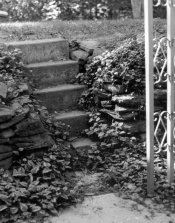
Demo of Phen-C-Borax developer.

The accompanying photo can show the gradations pretty well. It is a scan of a 10X enlargement made originally on Ilford VC RC paper. The scan is reduced in resolution to save space here, so can't tell you much about resolution, but should tell you something about pictorial abilitied. All manipulations were limited to those you could do with an enlarger. The negative was developed for 8 minutes at 71 F with agitation by 4 inversions every minute. The resulting negative contrast was a little high for this subject, so I added 30 units of yellow in the enlarger. There was no need for dodging or burning.
 

Attachments

  • Back Steps small.jpg
    Back Steps small.jpg
    100.2 KB · Views: 195

heiko

Member
Allowing Ads
Joined
Oct 17, 2007
Messages
3
Format
35mm
Hi amounts?

sorry for digging up this old thread.

Meanwhile, 1 gram of phenidone, 35 grams of ascorbic acid and 100 grams of borax in a gallon of water will get you a developer that will develop most films to normal contrast in 8 minutes at 68 F.

This sounds like pretty large amounts of everything. Is this meant to be the working solution, used undiluted?
 

gainer

Subscriber
Allowing Ads
Joined
Sep 20, 2002
Messages
3,699
Did you notice that the large amounts of everything include a gallon of water? You could as well use 4 liters. The film would not know the difference. For 1 liter, use 1/4 gram of phenidone, 8.8 grams of ascorbic acid and 25 grams of borax.
 

heiko

Member
Allowing Ads
Joined
Oct 17, 2007
Messages
3
Format
35mm
I noticed it's a gallon, but compared to pc-glycol it's still quite a lot of phenidone and ascorbic acid. If I use pc-glycol (10 gram of ascorbic acid and 0.25 gram of phenidone in 100 ml glycol), and dilute it 1:50, I have 2 gram of ascorbic acid and 0.05 gram of phenidone in a liter of working solution. Development times seem to be quite close.

So I'm wondering why the larger amounts of phenidone and ascorbic acid make such a small difference.
 

gainer

Subscriber
Allowing Ads
Joined
Sep 20, 2002
Messages
3,699
pH. Also developing time. I usually need 10 minutes in PC-TEA 1:50 to do the same job. PC-TEA you throw away after use. The PC-Borax can be reused numerous times. I still like PC-TEA. Neither has sulfite. I doubt you would get any more satisfactory results by adding a significant amount of sulfite, but that depends on what satisfies you. Photography is all about self-gratification, after all.
 

heiko

Member
Allowing Ads
Joined
Oct 17, 2007
Messages
3
Format
35mm
I was comparing the PC-Borax with PC-Glycol using a borax solution as activator. It has the same ingredients (apart from glycol), but lower amounts of P and C, and the development times are quite similar. So, as long the pH is the same, the actual amounts of ascorbic acid and phenidone don't matter as long as there's enough of it?

You say PC-Borax can be reused, so how about the storage life of it? The reason I'm using PC-Glycol is because It keeps so well.
 

ongarine

Member
Allowing Ads
Joined
Nov 9, 2003
Messages
155
Location
Avesa-Verona
Format
Large Format
I had use PC-Glycol mainly with sodium metaborate as activator or a 5+5 grams per liter of sodium carbonate and borax. results are quite the same.
I never use the borax as activator, may I know the amount of borax request per liter of working solution.
Did you notice some changes in results compared with other activators?
Have you made experiences and compared results with different activators with PC-Glycol developing FP4 and HP5?
 

gainer

Subscriber
Allowing Ads
Joined
Sep 20, 2002
Messages
3,699
I first used triethanolamine as activator for PC-Glycol. That is where I got the idea for using TEA as both solvent and activator.
I have not used borax with PC-Glycol. See the APUG Chem article "Experiments with Metol and ascorbic acid." PC-Glycol is quite a different animal when used with TEA as activator. Borax is a remarkable buffer. I have been using 25 g/l with 8 or 9 g/l of ascorbic acid and adding various amounts of Metol or Phenidone or p-aminophenol in experiments. If you want to try borax as activator for PC-Glycol, I recommend testing it with 25 g/l of working solution. That is about saturated, so there's no use trying to make a concentrate, but you can keep a saturated borax solution for a long time, so if it works to your satisfaction, make a lot of it and use it full strength to dilute the PC-Glycol. Meanwhile, I will give it a try. Borax is pretty cheap and is available many places where TEA would have to be mail-ordered.
 

gainer

Subscriber
Allowing Ads
Joined
Sep 20, 2002
Messages
3,699
Borax works well with PC-Glycol. If I tell you all an exact amount, you will get the idea that the precision and accuracy of measurement are critical. I will just say that 1/4 measuring cup of borax to a gallon or 4 liters is good for diluting PC-Glycol. I am not saying that 1 gallon = 4 liters, but that the pH of the working solution will not be different over at least that range of measurement precision.

I think that the major effect of concentration of a borax activator is on the time constant of the local change of pH due to developer activity. This rate will change also with agitation. The equilibrium pH before and after development will be the same for practical purposes.

I used Arista 400 EDU Ultra for this first test. I bracketted exposures + and - 1 stop in shutter speed. All three were usable. Resolution and sharpness were quite good. Next I will try FP4+.
 

gainer

Subscriber
Allowing Ads
Joined
Sep 20, 2002
Messages
3,699
I really like FP4+ with either PC-TEA diluted with water or PC-Glycol diluted with the saturated borax solution. I developed it 10 minutes at 70 F with agitation for 10 seconds of every minute.
 

ongarine

Member
Allowing Ads
Joined
Nov 9, 2003
Messages
155
Location
Avesa-Verona
Format
Large Format
Finally Pat I completed the experiment with PC-Glycol with 25 grams of borax per liter of working solution as activator and to complete the test, since I have now a good amount of TEA,
PC-Glycol+TEA as activator.
For first test I developed two 120 rolls, one HP5 other Forte 400, developing time 9 minutes at 20C with 30 seconds of agitation at the start and gentle 10 sec. every minute, the results was good for the HP5, Forte 400 needs a minute and half more.
I made some comparison prints with other HP5 developed in PC-Glycol with Sodium metaborate and Sodium carbonate (not together) as activator and the one with borax is the worst of the three, the contrast is not so good and tone a little bit too faint.
The PC-Glycol with TEA as activator is very, very good always used with HP5, for this experiment I have not yet a comparison
So at the end I will use borax with lye to have a "home made" sodium metaborate and I will mix next batch of PC in TEA.
 
Photrio.com contains affiliate links to products. We may receive a commission for purchases made through these links.
To read our full affiliate disclosure statement please click Here.

PHOTRIO PARTNERS EQUALLY FUNDING OUR COMMUNITY:


Ilford ADOX Freestyle Photographic Stearman Press Weldon Color Lab Blue Moon Camera & Machine
Top Bottom