
• Welcome to Photrio!
    Registration is fast and free. Join today to unlock search, see fewer ads, and access all forum features.
    Click here to sign up

Minolta SRTxxx

Tompkins Square Park

A
Tompkins Square Park

  • 8
  • 0
  • 75
Siesta Time

A
Siesta Time

  • 2
  • 1
  • 57

Recent Classifieds

Forum statistics

Threads
202,859
Messages
2,846,699
Members
101,573
Latest member
IanSeehorn
Recent bookmarks
0
I guess time could be a BIG factor.....perhaps 2 seconds Vs. 25 seconds.
But with a Decent/Steady tripod, does the mirror movement really cause that much concern.?
Thank You

The old photo magazines tested this. For long exposures, the mirror induced vibration is such a small part of the exposure that any effect is minimal. It's been so long, I don't recall why there would be much vibration if the camera is on a sturdy tripod - maybe the mirror bounces?
 
Just quoting your post for reference.......So, let me ask.
I read this all the time...see it mentioned, but i do not think i have ever read any "big" discussion about it.
I guess time could be a BIG factor.....perhaps 2 seconds Vs. 25 seconds.
But with a Decent/Steady tripod, does the mirror movement really cause that much concern.?
Thank You

I had the camera adjusted for 2 seconds if I set it in Bulb and used the self timer. From 1/second to two seconds would show any camera shaking. I also tripped with the self timer and then continued the exposure all the way up to 30 minutes, and even more. Blowing up the slides to 10 to 15 feet never showed any vibration from the mirror. The most important part is a stable tripod. I never found that locking up the mirror of the Minolta SR[T]xxx ever mattered.

By the way I have found that the same is true for the Hasselblad.
 
I have a few.

Actually I sold all my Leicas and RF Canons and put the money back in the bank. Then I bought these.

I like this idea. The problem is that there are times when the quiet shutter from my M-A is actually pretty handy.

EDIT - I used the SRT-101 while on my High School yearbook staff. It worked well enough that I bought one with a 50mm lens for myself when I graduated.

It was stolen a few years later but I certainly enjoyed it while I owned it. It did a great job and I do not remember any complaints in how it operated or in the quality of the photographs.

But that is probably true of most of the cameras being produced and sold during that period. They were all pretty good and the lenses were very capable of producing good photographs if you did your part.

Even the infamous K1000 which I bought after the Minolta was stolen and still enjoy working with today.
 
Last edited:
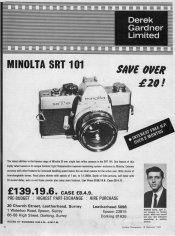
Coincidentally, I recently came across a couple of pages from Amateur Photographer, dated 18th September 1968. The price of a Minolta SRT 101 was (pre-decimal) £139 19s 6d - say £140. A Google search suggests that in today's money that would be something close to £2400 (US $3000).

By comparison, a Rolleiflex 2.8f was being advertised at £207 (roughly £3500) and a Rolleiflex SL66 was a whopping £511 (over £8700).

Michael
 

Attachments

  • img850.jpg
    img850.jpg
    584.6 KB · Views: 114
Coincidentally, I recently came across a couple of pages from Amateur Photographer, dated 18th September 1968. The price of a Minolta SRT 101 was (pre-decimal) £139 19s 6d - say £140. A Google search suggests that in today's money that would be something close to £2400 (US $3000).

By comparison, a Rolleiflex 2.8f was being advertised at £207 (roughly £3500) and a Rolleiflex SL66 was a whopping £511 (over £8700).

Michael

Financing available...yes they were expensive! Today they can be bought for few bucks therefore we don't appreciate it.
 
Coincidentally, I recently came across a couple of pages from Amateur Photographer, dated 18th September 1968. The price of a Minolta SRT 101 was (pre-decimal) £139 19s 6d - say £140. A Google search suggests that in today's money that would be something close to £2400 (US $3000).

By comparison, a Rolleiflex 2.8f was being advertised at £207 (roughly £3500) and a Rolleiflex SL66 was a whopping £511 (over £8700).

Michael
I don't remember the price on my SRT 101 but I was paying mine off on lay a way for seven months as I recall before I actually got to take it home.
 
I don't remember the price on my SRT 101 but I was paying mine off on lay a way for seven months as I recall before I actually got to take it home.
You live in Elko.?
Me and my son went shooting there a few times.
I cannot remember the street number.....i want to say it was 4th... that you took straight out of town, then i guess it turned to dirt.?
Not sure if it was Elko, but there was a lady running for office...Jane Bond.
All the way back to Fernley i had to listen to my son say..... "Bond, Jane Bond" :smile:
 
Coincidentally, I recently came across a couple of pages from Amateur Photographer, dated 18th September 1968. The price of a Minolta SRT 101 was (pre-decimal) £139 19s 6d - say £140. A Google search suggests that in today's money that would be something close to £2400 (US $3000).

By comparison, a Rolleiflex 2.8f was being advertised at £207 (roughly £3500) and a Rolleiflex SL66 was a whopping £511 (over £8700).

Michael
In 1968, I bought a Nikkormat FTn with 50mm f/2 Nikkor lens at the Boston (Massachusetts) discounter, Lechmere Sales, for $210. The SRT101 was very similar in price. The Spotmatic was slightly cheaper. Lechmere did not sell medium format cameras then, and I can't recall Rollei prices at other stores.
 
I have an SRT201 and a bunch of Rokkor lenses to go with this and my other bodies (X370, X700, XD-11). Great quality, typical of Minolta. Also have a MODIII enlarger, C.E. Rokkor enlarger lenses, Hi-matic 7S, and a Flash Meter III. All working well all these years later. Garryscamera.com still advertises repair of XD-11s as well as the other Minolta manual focus cameras. I had all my bodies CLA'd by him about 10 years ago, none with any problems (except a film counter replacement on the X-700), and was happy with the service.

The 1977-78 Sears catalog, available on Butkus, shows an SRT201 cost $199.50 with a 1.7 lens (equivalent to $844 today) and $240 with a 1.4 lens (equivalent to $1,013 today). That was a lot of money then. Inflation calculator: https://www.bls.gov/data/inflation_calculator.htm.
 
I have many SRTs and like then all. I think my favorite is the 102 with mirror lock-up. The SRT Super model is the same but has that nice Super word in the name. In this collection I have a fleet of SRT 201s. I gave one with the split image screen to my son and I think all of the rest have the microprism screen. John Titterington has brought a number of SRT cameras back to life for me. It's true that most SRT bodies sell today for very little but having them overhauled makes them much nicer to use and more dependable. I don't have any XK/XM cameras so when I want a higher shutter speed than 1/1000 and I want to stay with Minolta I'll use a Maxxum 600si.
 
About the cost of cameras years ago and inflation, this is a difficult calculation. My first good camera was a Konica Autoreflex T2 with a 57/1.4 lens. I got it in 1971 for about $225. I was young them and I don't know if I appreciated how much money that was at the time. The reason I think comparing inflation adjusted figures over time is difficult is that cameras, like computers, became much more capable over time. In my thinking about 35mm cameras I consider the period before 1965 (approx) as the time of rangefinder and rudimentary SLRs. From 1965 to 1985 we had the ever changing and more modern SLRs. From 1985 to about 2000 we had the AF SLRs. After that DSLRs took over. It's hard to compare the Minolta Maxxum of 1985 to any earlier 35mm SLR cameras because it was the first integrated AF SLR system. It had provision for TTL flash. It had motorized film advance and rewind. It had program and other metering modes. It had interchangeable focusing screens. It had an available data back. It had fast acting silicon meter cells. With the exception of the AF system, many of these features were available on other cameras but this was the first time they were all available in one camera. When we look at inflation adjustments over time we think about what things we might be able to buy today with an inflation adjusted amount of X dollars. Between advances in technology and various currency fluctuations over time, film cameras became more of a bargain over time than other things. I prefer using a camera to using a cell phone camera but the image quality a cell phone camera is capable of is shockingly high. The quality of these images is still not as good as it could be in low light situations but I'm sure that's bring worked on.
 
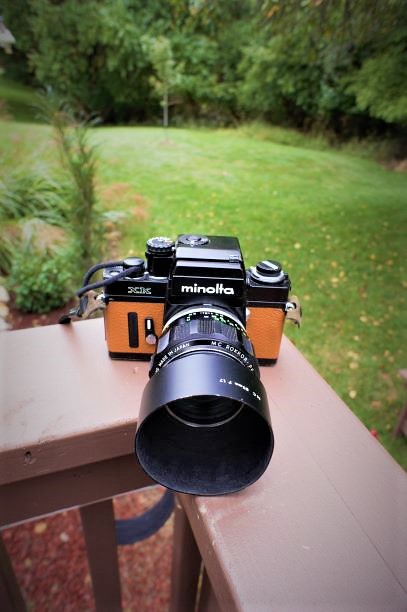
HugoStudios Tan Morocco XK (2) by Nokton48, on Flickr

My XK in HugoStudios tan leather. Good XK's are hard to find. I lucked out on this one, but sent it to Essex in NJ, turns out right about when Hurricane Katrina hit. I got the camera back in time which was my good luck.

I don't know anybody else who repairs XK's. Believe me I searched.
 
About the cost of cameras years ago and inflation, this is a difficult calculation.

I agree, good points. All the calculation represents is the time value of money, i.e., what you would pay in today's dollars for that camera new, representing that technology. But most of those cameras today are not in new condition so the updated value usually doesn't represent its actual value (used SRTs don't sell for $800-1,000). And if you agree today's DSLRs represent better technology and image quality, convenience, and features, you can get a 2-lens entry level Nikon DSLR for that $800-1,000 today, i.e., better value for the money. That's why I think these cameras were pretty expensive back then.
 
I agree, good points. All the calculation represents is the time value of money, i.e., what you would pay in today's dollars for that camera new, representing that technology. But most of those cameras today are not in new condition so the updated value usually doesn't represent its actual value (used SRTs don't sell for $800-1,000). And if you agree today's DSLRs represent better technology and image quality, convenience, and features, you can get a 2-lens entry level Nikon DSLR for that $800-1,000 today, i.e., better value for the money. That's why I think these cameras were pretty expensive back then.
Technology valued today is not the same as 40 years ago. Back then, an auto exposure mode was a big deal and could put serious numbers on the ticket price. Same with auto advance and rewind, and eventually autofocus. Now few people care about those things, because technologically motivated folk have long moved to digital. Cameras were often hamstrung to bring the price down, the Pentax SP500 being a case in point, where the 1/1000 setting was unmarked but still on the dial. The Canon AT-1 was a fully manual camera with the tech of the AE-1 removed to keep costs down in price sensitive overseas territories. I doubt whether the AT-1 cost any less to produce, but it kept differentials with the auto models.
 
I was given a Minolta when their US camera headquarters were on Union Square in NYC around 1960.Used it for a while, then traded in for a Leica. Minolta lenses were very good. Minolta was one of the oldest lens manufacturers in Japan. However, at the time, with limited financial resources, a Leica suited me better. The camera was one of the first Minolta SLRs.
 
I was given a Minolta when their US camera headquarters were on Union Square in NYC around 1960.Used it for a while, then traded in for a Leica. Minolta lenses were very good. Minolta was one of the oldest lens manufacturers in Japan. However, at the time, with limited financial resources, a Leica suited me better. The camera was one of the first Minolta SLRs.

You couldn't afford a free Minolta, but you could buy a Leica... I don't get it.
 
You couldn't afford a free Minolta, but you could buy a Leica... I don't get it.

After using Minolta for a short while, Minolta was used as partial payment towards a used Leica. At the time, that particular Leica would have been way beyond my means without significant reduction of cash layout due to trade in of lightly used, almost new Minolta. My wife and I did Minolta a favor that helped their publicity. Just didn’t find a Minolta SLR suited my needs nor as ergonomic as a Nikon F with plain prism. And I wanted that Leica. Nothing negative about Minolta camera or lenses. Decades old working Minoltas speaks for their build quality. Yet, choice of camera is very personal.
Along the same line of thought, if Cadillac gave me a brand new car, I would trade in or sell for cash towards a car I have always wanted...a well maintained Citroen DS from 60s or 70s. Simply because I consider contemporary Cadillacs rather tacky looking, inside and out, and the Citroen DS on of the most beautiful (but terribly underpowered) cars ever made. Other folks might keep Cady, or put towards a Porsche or Jeep. (Or sell and buy a new Leica and a couple lenses...at today’s prices, maybe even break even!)
 
OK, I was just confused there...
 
...
a car I have always wanted...a well maintained Citroen DS from 60s or 70s. ...

A favorite of mine as well. I have several books on the DS and even sales brochures in French. My dream is to get a ride in a DS21 some day. I did get to ride in a CX, not quite the same thing but it does have the oleopneumatic suspension. I love the fact that the startup and shifting of the car is not intuitive, so not just anyone can get in it and drive it (same situation with Model T). I have had and still have a few European mid-engine sports cars (never owned an American car), but I'd be cautious about buying a DS because there are so few places that could work on the complex oleopneumatic system.

my009~3.jpg
 
A favorite of mine as well. I have several books on the DS and even sales brochures in French. My dream is to get a ride in a DS21 some day. I did get to ride in a CX, not quite the same thing but it does have the oleopneumatic suspension. I love the fact that the startup and shifting of the car is not intuitive, so not just anyone can get in it and drive it (same situation with Model T). I have had and still have a few European mid-engine sports cars (never owned an American car), but I'd be cautious about buying a DS because there are so few places that could work on the complex oleopneumatic system.

View attachment 227021
What I have read about obtaining and using a DS, is that the oleopheumatic suspension is that it is the most durable and trouble free part of the car. The biggest problem seems to be rust. There is a garage in New York State that specializes in DS cars. Not much help if the car is in Germany.
The car I really enjoy driving is my MB 300 TD. Bought in 1983, the cheapest car I have ever owned ( think Nikon F or Leica M3)... repairs have been only normal replacement items, windshield wiper blades, brake pads, an occasional rubber hose.... Every piece of metal seems to have been painted. No rust. One drawback: 0 to 60 mph in about 12 seconds, about on par with DS.
A secret 300 TD ploy. If stopped with tailgating driver directly behind, stomping on accelerator on takeoff envelopes tailgater in cloud of diesel exhaust. From then on, car no longer tailgates.p
 
I stacked SRTs up on this floating shelf until it threatened to tear out of the wall.

Sill have 5 or 6 more floating around...

minoltas.jpg
 
Photrio.com contains affiliate links to products. We may receive a commission for purchases made through these links.
To read our full affiliate disclosure statement please click Here.

PHOTRIO PARTNERS EQUALLY FUNDING OUR COMMUNITY:


Ilford ADOX Freestyle Photographic Stearman Press Weldon Color Lab Blue Moon Camera & Machine
Top Bottom