


Andreas Thaler
Subscriber
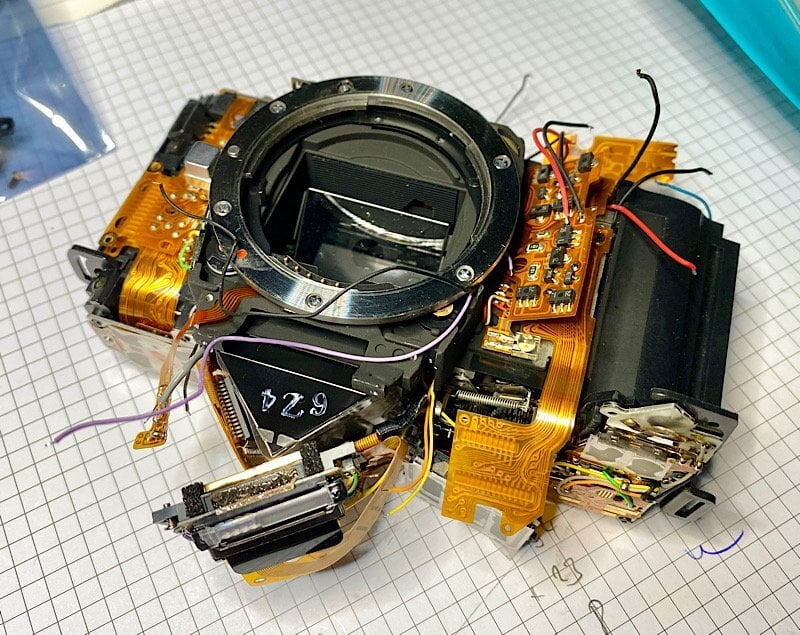
After four years of intensive service and repair of SLRs from the 1980s, I'd like to summarize my experiences with the Minolta 7000 AF.
The Minolta (Maxxum, Alpha) 7000 AF was introduced in 1985 and was
... the first camera to feature both integrated autofocus (AF) and motorised film advance, the standard configuration for later amateur and professional single lens reflex cameras. (ibid.)
It represented the semi-professional model; alongside it were the Minolta 9000 AF and 5000 AF.
The chassis of the Minolta 7000 AF is made of plastic, the front panel with the mirror box is made of diecast; it is robust and durable.
Minolta no longer exists today, therefore there is no service or repairs available, neither from the manufacturer nor from its successor organizations.
In my experience, repair shops usually reject the 7000 AF because it's considered too complicated.
DIY remains an option, and the good news is that most work on the 7000 AF can be performed by yourself.
Available technical documentation comprises the Minolta Service Manual for the 7000 AF, an issue of the SPT Journal from 1997 covering the 7000 AF in detail including disassembly, adjustments and troubleshooting as well as the C & C Troubleshooting Guide for the 7000 AF.
Requirements
Performing service and repairs requires a minimum level of repair experience as well as basic knowledge of precision mechanics and electronics. You can acquire the necessary knowledge and skills on your own; excellent specialist literature is available. Courses in analog and digital electronics can support this. Important skills include interest, a willingness to learn, patience, perseverance, and resilience, and, of course, a steady hand. Knowledge and skills in soldering are important for all electronic SLRs.
No shortcuts
I'd like to emphasize that there are no shortcuts to service and repair, as is often the case, especially in videos on the web. The 7000 AF almost always requires more or less thorough disassembly in order to clean, lubricate/oil, and adjust it. This also applies to troubleshooting. The documents mentioned provide all the necessary instructions.
Without these instructions, I consider any attempts at service and repair pointless, as the 7000 AF must be disassembled in a specific sequence. This involves unscrewing parts and removing solder joints. It's not immediately obvious how to proceed, as the 7000 AF is densely packed with parts and flexible printed circuit boards (FPCs), some of which overlap.
A basic set of tools, equipment and materials is required to carry out the work. A digital multimeter and an oscilloscope are required for electronic measurements.
Practice
Before you start working on the 7000 AF you're repairing, you should practice all the procedures on a decommissioned 7000 AF. This will help you learn how the camera is constructed and gain valuable experience. Mistakes don't matter; you'll always end up with valuable spare parts.
CLA - Clean, lube, adjust
Service refers to the well-known CLA, which includes cleaning the outside and inside, lubricating/oiling, and adjusting a camera.
For thorough external cleaning, the covers are removed and cleaned with cleaning foam.
For internal cleaning, the mirror box must be removed. This gives access to the mirror box mechanism as well as the shutter. Unlike the Minolta 9000 AF, the shutter does not have a plastic damper that becomes sticky over the decades and needs to be removed.
The three solenoids of the 7000 AF also need to be cleaned on a CLA. The aperture solenoid is located on the inside of the mirror box, the other two on the shutter. If the contact surfaces of the solenoids are dirty, their function is impaired or even nonexistent, as the solenoids no longer separate properly or even at all. I clean the contact surfaces with benzine.
On the subject of lubrication and oiling, I refer you to Thomas Tomosy, who, in his first book, "Camera Maintenance and Repair," provides, among other things, a table listing lubricants and their applications. I follow the principle "less is more," and oil, in particular, should be applied sparingly, as it tends to spread. Old grease must be removed first. I also use bezine for this. Information on cleaning mechanical components can also be found in Tomosy's book.
Adjustments affect both the shutter and the electronics. The factory settings should only be changed if you know exactly what they do. Information on this can be found in the technical documents mentioned. A camera tester is required to adjust the shutter. See the links below.
According to the service manual, the autofocus of the 7000 AF could only be adjusted by Minolta using a special camera tester (I/O tester). An alternative method for adjusting the autofocus is described in the C & C Associates Troubleshooting Guide for the Minolta 7000 AF.
Troubleshooting
A known problem with the 7000 AF is a faulty aperture control. In this case, the aperture does not close to the set value.
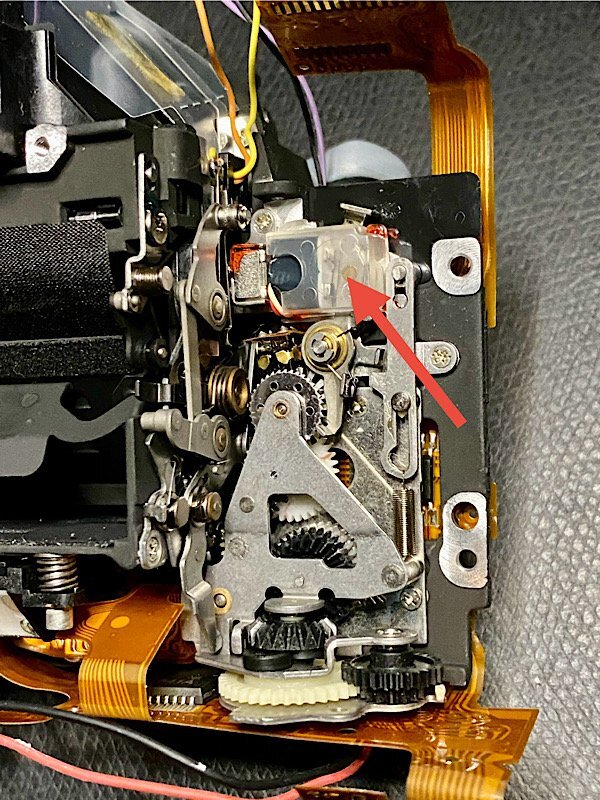
Aperture control with aperture solenoid (red arrow), inside of mirror box, wind side.
I suspect the cause is contamination of the contact surfaces of the solenoid that controls the aperture.
However, it could also be that the properties of the magnet(s) used in the solenoid have changed over time.
As a solution, I recommend cleaning the contact surfaces with benzine or replacing the solenoid with a functioning one (from a decommissioned 7000 AF). Note that there are at least two variants of the solenoid that are not compatible.
Other problems may include:
- Viewfinder LCD no longer shows all or any digits.
- Viewfinder LCD is displayed with tilt.
- Main LCD on the top of the camera leaked (black spots).
- Brittle plastic cover.
Minolta (Maxxum/Alpha) 7000 AF: Recommendations and notes, extended technical details for DIY repairs
Further information on service and repair can be found here:
Minolta (Maxxum/Alpha) 7000 AF: Checking and adjusting
Minolta (Maxxum/Alpha) 7000 AF: Recommendations and notes, extended technical details for DIY repairs
Minolta (Maxxum/Alpha) 7000 AF: Tutorial for removing the mirror box and shutter unit, notes on assembly, adjusting the Copal S shutter
The Minolta 7000 AF repair marathon
Minolta (Maxxum/Alpha) 7000 AF: Aperture issues resolved/shortcut; LCDs, aperture ring, shutter unit replaced; aperture solenoid cleaned
Minolta 7000: Memory backup lithium battery, main batteries, functionality, 7000 or 9000, disintegrated plastic, cleaning contacts, voltages
Minolta 7000: Behavior of the aperture
Minolta (Maxxum, Alpha) 7000 and 9000 AF: Comparison of repair options
+++
 A word of caution
Please keep in mind that you’ll be using highly flammable solvents for service work, and their fumes are harmful to your health. Soldering also produces fumes that should not be inhaled. Dangerous high voltages can be present when handling electronics, especially in conjunction with electronic flash units and mains. Therefore, familiarize yourself with the safety regulations beforehand and ensure your safety. Depending on the activity, protective gear may be advisable.
All information provided without guarantee and use at your own risk.
Acknowledgments
Without the work of Master Larry Lyells, in particular, we wouldn’t have the detailed technical information we need today for service/repair of SLRs.
The SPT Journal and The Camera Craftsman, which he helped shape significantly as an author, and which contain all the necessary information and instructions are available for a fee through Learn Camera Repair.
We owe our access to them to Eugene Pate, the founder of Learn Camera Repair.
Last edited:
