• Welcome to Photrio!
    Registration is fast and free. Join today to unlock search, see fewer ads, and access all forum features.
    Click here to sign up

Military issued Kodak film?

Tractor & Tulips

A
Tractor & Tulips

  • 1
  • 1
  • 30
Tree with Big Shadows

Tree with Big Shadows

  • 3
  • 0
  • 81

Forum statistics

Threads
203,457
Messages
2,855,068
Members
101,853
Latest member
DJFOX
Recent bookmarks
0

Bioflex

Member
Allowing Ads
Joined
Feb 21, 2020
Messages
113
Location
Brewster ny
Format
35mm
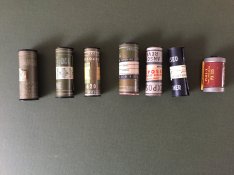
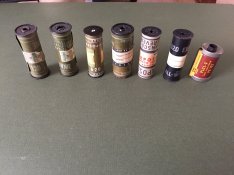
DAA6A814-FD91-4CB3-B972-2C4AA8A9B438.jpeg CDD62CFB-078F-4AA2-80DA-67BD92196184.jpeg I bought these seven rolls of exposed film recently at a flea market along with some photo equipment.I was surprised to see four of the rolls are Kodak SuperXX with Army olive green paper backing.One roll is Ansco All Weather, one roll Ansco Color Reversible , one roll Kodak Plus-x 35mm.I was informed that they were taken in Korea during the war.I didn’t realize Kodak made film just for military use. I am presently researching best process for the b&w film I am thinking about Kodak HC-110 dilution B for around 18 mins. For the SuperXX. Not sure how curled it will be, might have develop by “see-saw” method as opposed to Patterson or SS reels.Any suggestions for a lab for the Ansco color reversible? I’m thinking it is a slide film? Thank you
 
I think you'll find "see-saw" to be even more of a problem than reels for film that's been on the roll for seventy years.

For the 1950s slide film, Rocky Mountain Film Lab advertises that they process old film of all kinds -- but like other labs that handle old film (Blue Moon Photo in Portland, Oregon, for instance) they'll generally process the film as black and white negatives and then attempt to retrieve the image by scanning. Problem with that is that many old color films had a silver filter layer, which will show as heavy fog in B&W process, making it very hard to recover the images. It's likely you'd get equal or better results processing the film yourself, in B&W chemistry, but then very carefully (by inspection) using Farmer's Reducer to bleach away the silver filter layer (and fog) just until the rebates (mostly) clear.

 
I'd be interested in what you find out about film being made for US Army. I am not aware that the green was for the US Army. This was before my time so I don't know for sure.

Bob Shanebrook
www.makingKODAKfilm.com
 
Well, they made more aerial stuff for the military. But this thread, to my understanding, is about standard films in an alledged special military conversion.
 
The green might reflect shortages during the war, rather than military issue film.
I think I've seen more recent green Kodak backing paper in 616 size ....
 
I think you'll find "see-saw" to be even more of a problem than reels for film that's been on the roll for seventy years.

For the 1950s slide film, Rocky Mountain Film Lab advertises that they process old film of all kinds -- but like other labs that handle old film (Blue Moon Photo in Portland, Oregon, for instance) they'll generally process the film as black and white negatives and then attempt to retrieve the image by scanning. Problem with that is that many old color films had a silver filter layer, which will show as heavy fog in B&W process, making it very hard to recover the images. It's likely you'd get equal or better results processing the film yourself, in B&W chemistry, but then very carefully (by inspection) using Farmer's Reducer to bleach away the silver filter layer (and fog) just until the rebates (mostly) clear.
Thank you
 
During WWII, Kodak packaged roll films in lead foil for the military. My dad had a few rolls of Super-XX in 620.
 
As late as the 70s we got cans of 100 feet bulk load film, nothing fancy but the labeled stated it was made for the Air Force with a procurement code of somesort, I recall being told that move 16mm and 35mm film was so labeled as was recon film.
 
During WWII, Kodak packaged roll films in lead foil for the military. My dad had a few rolls of Super-XX in 620.
They called that tropical packaging. I have a few rolls like that, it actually seems to preserve the film pretty good.
 
That’s interesting because I rember instructions or a formula for tropical processing in a Photo Lad Index years ago.
 
That’s interesting because I remember instructions or a formula for tropical processing in a Photo Lad Index years ago.

Kodak DK15, should always be used at temp above 75 degrees,

Water 24 oz at 125 degrees
Elon 82 grains
Sodium sulfite 3 oz
Kodalk 1 oz
Potassium bromide 27 grains
Sodium sulfate 1 1/2 oz
Cold water to make 32 oz

Tropical Harding Bath
Waster 32 oz
Potassium Chrome alum 1 oz
Sodium sulfite

John Carroll in Photographic Facts reports that contrast can be adjusted b varying amount of Kodalk and can be used with or with sodium sulfate.
 
Photrio.com contains affiliate links to products. We may receive a commission for purchases made through these links.
To read our full affiliate disclosure statement please click Here.

PHOTRIO PARTNERS EQUALLY FUNDING OUR COMMUNITY:


Ilford ADOX Freestyle Photographic Stearman Press Weldon Color Lab Blue Moon Camera & Machine
Top Bottom