• Welcome to Photrio!
    Registration is fast and free. Join today to unlock search, see fewer ads, and access all forum features.
    Click here to sign up

Middle chunk out of focus

Tree with Big Shadows

Tree with Big Shadows

  • 2
  • 0
  • 43
Everal Barn

A
Everal Barn

  • 0
  • 0
  • 41

Forum statistics

Threads
203,454
Messages
2,854,948
Members
101,851
Latest member
Si_Voltage
Recent bookmarks
1

jacnorectangle

Member
Allowing Ads
Joined
Jun 12, 2015
Messages
29
Location
Louisiana
Format
Multi Format
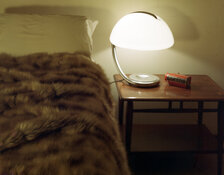
Bear with me as a beginner. I shot this bedroom with a Sinar F1, 210mm lens. The room is 12 feet deep and I had my back against the wall almost. I think I focused on the pillow and front tilted for the fur in the foreground, back tilted for the perspective, then a little front swing to get the clock in focus somewhat, but the lamp and the middle area of the fur are still out of focus. This was either f11 or f16. Would stopping down further fill in that chunk or is this just not possible? I have another image like that, foreground and background in focus but the electric poles and the trees are out of focus. That one was just a little front tilt, f16.
 

Attachments

  • street.jpg
    street.jpg
    610.7 KB · Views: 60
  • bedroom.jpg
    bedroom.jpg
    268.2 KB · Views: 59
Bear with me as a beginner. I shot this bedroom with a Sinar F1, 210mm lens. The room is 12 feet deep and I had my back against the wall almost. I think I focused on the pillow and front tilted for the fur in the foreground, back tilted for the perspective, then a little front swing to get the clock in focus somewhat, but the lamp and the middle area of the fur are still out of focus. This was either f11 or f16. Would stopping down further fill in that chunk or is this just not possible? I have another image like that, foreground and background in focus but the electric poles and the trees are out of focus. That one was just a little front tilt, f16.

your process of focusing confuses me. Just focus on what is important to you and stop down to a reasonable aperture. Tilt and swing are only used when the object plane and film plane are not parallel. Google for 'Merklinger' and his instructions about 'Scheimpflug' to understand tilt and swing with view cameras. It's actually fairly simple.
 
your process of focusing confuses me. Just focus on what is important to you and stop down to a reasonable aperture. Tilt and swing are only used when the object plane and film plane are not parallel. Google for 'Merklinger' and his instructions about 'Scheimpflug' to understand tilt and swing with view cameras. It's actually fairly simple.

Lol I want everything to be in focus. I’m greedy. I kept reading that you “focus on the far, tilt to the near” or maybe it’s the other way round.
 
For swings and tilts you want to get your near and far in focus, then stop down enough to get the things between in. For the front standard you "focus to the near, then tilt/swing to the far" a few times, then if anything between your near and far is still out you have to stop down.
 
@jacnorectangle you're either putting too much stock in movements, and/or are misunderstanding how they work.

In the first photo, you have successfully tilted the plane of focus so it aligns more or less with the road surfacing receding into the background. However, that also means that the tree tops at the top of the frame will end up pretty far out of that plane of focus and thus become blurry.

On the bedroom shot it's a little difficult to see what happened exactly (also due to the inherently fluffy nature of the duvet), but I think it's a similar issue with the plane of focus being indeed swung in relation to the camera back so it intersects with the pillow, the lamp foot and the clock on the table, and also tilted so it runs away from the camera. The result is that much of the scene that ends up further away from this swung & tilted plane is blurred, like the top of the lamp (which extends quite a bit above the plane of focus) and the table legs (extending below it).

Keep in mind that if you add movements, you may tilt and swing the plane of focus, but you're not making a larger plane of focus. Also, it will remain a 2-dimensional plane and it will never turn into something 3-dimensional. If you think this through, it turns out that if you take a scene where there's not a dominant plane that you want to place focus on, but there's actually several intersecting planes (or even a jumble of objects, near & far), adding movements often accomplishes the exact opposite from 'getting as much as possible in focus'. You actually end up with less stuff in the image frame being in perfect focus than if you would just keep front & back parallel and stopped down.

It's surprising in how many instances movements don't really bring much to the party, or can even be counterproductive. What you're showing is IMO an effective illustration of this issue.
 
@jacnorectangle you're either putting too much stock in movements, and/or are misunderstanding how they work.

In the first photo, you have successfully tilted the plane of focus so it aligns more or less with the road surfacing receding into the background. However, that also means that the tree tops at the top of the frame will end up pretty far out of that plane of focus and thus become blurry.

On the bedroom shot it's a little difficult to see what happened exactly (also due to the inherently fluffy nature of the duvet), but I think it's a similar issue with the plane of focus being indeed swung in relation to the camera back so it intersects with the pillow, the lamp foot and the clock on the table, and also tilted so it runs away from the camera. The result is that much of the scene that ends up further away from this swung & tilted plane is blurred, like the top of the lamp (which extends quite a bit above the plane of focus) and the table legs (extending below it).

Keep in mind that if you add movements, you may tilt and swing the plane of focus, but you're not making a larger plane of focus. Also, it will remain a 2-dimensional plane and it will never turn into something 3-dimensional. If you think this through, it turns out that if you take a scene where there's not a dominant plane that you want to place focus on, but there's actually several intersecting planes (or even a jumble of objects, near & far), adding movements often accomplishes the exact opposite from 'getting as much as possible in focus'. You actually end up with less stuff in the image frame being in perfect focus than if you would just keep front & back parallel and stopped down.

It's surprising in how many instances movements don't really bring much to the party, or can even be counterproductive. What you're showing is IMO an effective illustration of this

The entire lamp and the left side of the table is blurred really. It’s odd because it’s in line with the pillow, which is in focus. I guess the swing mostly focused the right side of the table but strange that it doesn’t affect the pillow.
 
1776931915295.png

Here's the line that intersects the plane of sharp focus with a couple of the objects in the scene. Due to the tilt, the plane of focus runs away from the camera through the wall in the back.

That scene would have looked OK with a little front tilt and stopping down lots.
 
View attachment 422960
Here's the line that intersects the plane of sharp focus with a couple of the objects in the scene. Due to the tilt, the plane of focus runs away from the camera through the wall in the back.

That scene would have looked OK with a little front tilt and stopping down lots.

it helps to think of it as two simple planes, the subject plane and the focus plane, that have to intersect at one line. Avoid compound planes (turned in both tilt and swing), or it gets unnecessarily complicated.
 
Movements might help in you situation, however, doing close-up work that isn't perfectly flat at "f/11 or f/16" on a large-format camera is going to end up out-of-focus areas. I don't think I've ever made a 4x5 image at a larger aperture than f/22. FWIW, f/22 is the "sweet spot" for most LF lenses, so anything larger than that is really unnecessary unless you really want out-of-focus areas or need the shutter speed for some reason. Most of my images are made at f/32.

As far as learning to apply tilts and swings and focus the view camera, I recommend the articles on the LF.info home page here: https://www.largeformatphotography.info/ Some of them are a bit hard to dig through, but really worth it.

FWIW, your bedroom shot and trying to get everything in focus is a difficult situation. Stopping down lots will help, learning to optimally place the plane of sharp focus with movements could help optimize the depth of field too.

Best,

Doremus
 
Photrio.com contains affiliate links to products. We may receive a commission for purchases made through these links.
To read our full affiliate disclosure statement please click Here.

PHOTRIO PARTNERS EQUALLY FUNDING OUR COMMUNITY:


Ilford ADOX Freestyle Photographic Stearman Press Weldon Color Lab Blue Moon Camera & Machine
Top Bottom